Radiation Pressure and Mass Ejection in Rho-like States of GRS 1915+105
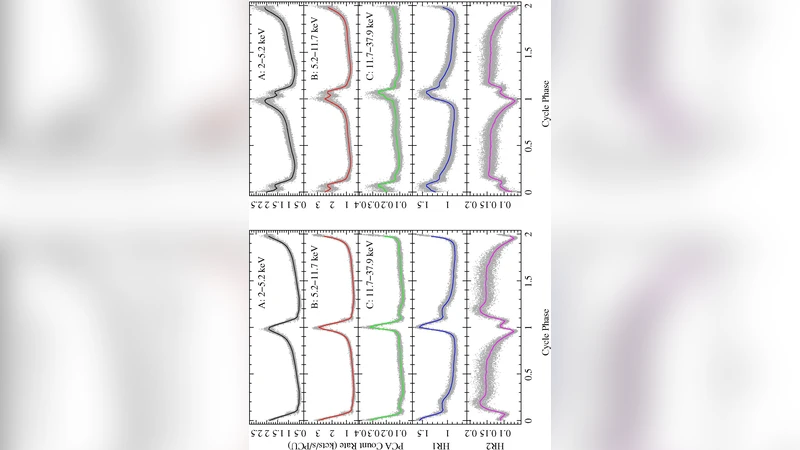
We present a unifying scenario to address the physical origin of the diversity of X-ray lightcurves within the rho variability class of the microquasar GRS 1915+105. This ‘heartbeat’ state is characterized by a bright flare that recurs every ~50-100 seconds, but the profile and duration of the flares varies significantly from observation to observation. Based on a comprehensive, phase-resolved study of heartbeats in the RXTE archive, we demonstrate that very different X-ray lightcurves do not require origins in different accretion processes. Indeed, our detailed comparison of the phase-resolved spectra of a double-peaked oscillation and a single-peaked oscillation shows that different cycles can have basically similar X-ray spectral evolution. We argue that all heartbeat oscillations can be understood as the result of a combination of a thermal-viscous radiation pressure instability, a local Eddington limit in the disk, and a sudden, radiation-pressure-driven evaporation or ejection event in the inner accretion disk. This ejection appears to be a universal, fundamental part of the rho state, and is largely responsible for a hard X-ray pulse seen in the lightcurve of all cycles. We suggest that the detailed shape of oscillations in the mass accretion rate through the disk is responsible for the phenomenological differences between different rho-type lightcurves, and we discuss how future time-dependent simulations of disk instabilities may provide new insights into the role of radiation pressure in the accretion flow.
💡 Research Summary
The microquasar GRS 1915+105 exhibits one of the most striking forms of X‑ray variability known as the “rho” or heartbeat state. In this state the X‑ray light curve shows a bright flare that recurs every 50–100 s, but the detailed shape of each flare can differ dramatically from observation to observation. Some cycles display a single sharp peak, others a double‑peaked structure, and the duration of the rise and decay phases varies widely. Historically, these differences have been interpreted as evidence for multiple, distinct accretion processes. In this paper the authors argue that a single, unified physical mechanism can account for the entire phenomenology of the rho class.
Using the complete RXTE archive, the authors performed a systematic, phase‑resolved analysis of hundreds of rho cycles. They aligned each cycle on a common temporal phase (rise, peak, decay, hard‑pulse) and extracted spectra at each phase. By comparing a prototypical double‑peaked cycle with a single‑peaked one, they found that the spectral evolution—disk blackbody temperature, inner‑disk radius, and the strength of the high‑energy Comptonised tail—is essentially identical in both cases. This key result demonstrates that the apparent diversity of light‑curve shapes does not require fundamentally different accretion physics; instead, it reflects subtle variations in the time‑dependent mass accretion rate (ṁ) through the inner disk.
The authors propose a three‑component scenario. First, a thermal‑viscous radiation‑pressure instability operates in the inner radiation‑pressure dominated region of the disk. When the local radiation pressure exceeds the viscous stress, the disk temperature and surface density rise together, launching a limit‑cycle oscillation. Second, as the instability grows, the disk locally reaches the Eddington limit. At this point radiation pressure lifts material vertically, inflating the disk thickness and temporarily halting the inward flow. Third, once the inflated region exceeds a critical thickness, radiation pressure drives a rapid evaporation or ejection of inner‑disk material. This ejection produces the hard X‑ray pulse that is observed in every rho cycle, regardless of whether the soft flare appears as a single or double peak.
Spectrally, the rise phase is dominated by a steep increase in the disk blackbody temperature (up to ~2 keV) and a concurrent hardening of the Comptonised component. The hard pulse appears as a brief, high‑energy excess (10–30 keV) that coincides with the moment of mass ejection. After the ejection, the inner disk rapidly refills, the temperature drops, and the hard component fades, completing the cycle. The authors argue that the precise shape of the ṁ(t) profile determines whether the soft flare splits into two peaks (a rapid rise followed by a brief dip before the hard pulse) or remains a single, smoother peak.
Importantly, the proposed mechanism is not specific to GRS 1915+105. Similar limit‑cycle behaviour has been reported in other high‑luminosity black‑hole binaries, suggesting that radiation‑pressure‑driven instabilities combined with local Eddington limits may be a generic feature of accretion disks operating near the Eddington rate.
The paper concludes with a forward‑looking discussion. The authors stress that fully self‑consistent, time‑dependent simulations that incorporate radiation hydrodynamics, magnetic fields, and realistic opacity laws are needed to test the quantitative predictions of their model. Such simulations could clarify how the ejection event couples to jet formation, why the hard pulse is so reproducible, and how the disk‑corona geometry evolves throughout the cycle. Moreover, future high‑throughput, high‑time‑resolution missions (e.g., NICER, eXTP, Athena) will be able to resolve the rapid spectral changes during the hard pulse, providing a stringent test of the evaporation/ejection hypothesis.
In summary, the authors present compelling observational evidence that all rho‑type heartbeats in GRS 1915+105 arise from a single physical process: a radiation‑pressure instability that pushes the inner disk to a local Eddington limit, followed by a rapid, radiation‑driven mass ejection. Variations in the detailed mass‑accretion‑rate waveform produce the observed diversity of light‑curve shapes, while the hard X‑ray pulse remains a universal signature of the ejection phase. This unified picture advances our understanding of how radiation pressure can dominate the dynamics of accretion flows in the most luminous stellar‑mass black‑hole systems.