The impact of selection biases on the Ep-Liso correlation of Gamma Ray Bursts
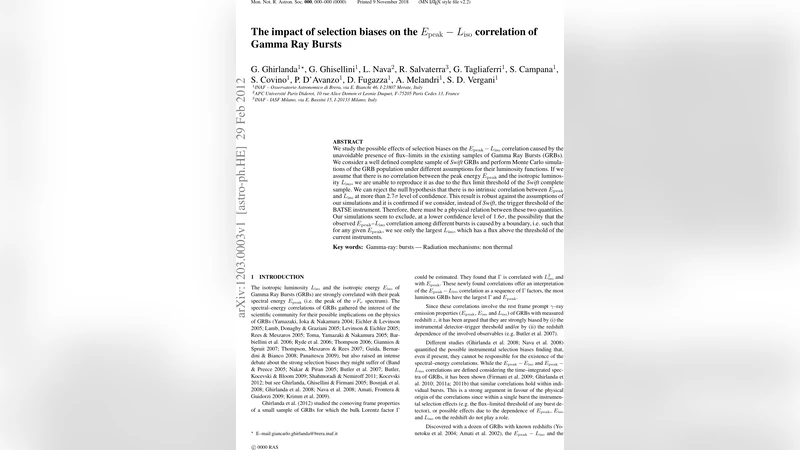
We study the possible effects of selection biases on the Ep-Liso correlation caused by the unavoidable presence of flux-limits in the existing samples of Gamma Ray Bursts (GRBs). We consider a well defined complete sample of Swift GRBs and perform Monte Carlo simulations of the GRB population under different assumptions for their luminosity functions. If we assume that there is no correlation between the peak energy Ep and the isotropic luminosity Liso, we are unable to reproduce it as due to the flux limit threshold of the Swift complete sample. We can reject the null hypothesis that there is no intrinsic correlation between Ep and Liso at more than 2.7 sigma level of confidence. This result is robust against the assumptions of our simulations and it is confirmed if we consider, instead of Swift, the trigger threshold of the Batse instrument. Therefore, there must be a physical relation between these two quantities. Our simulations seem to exclude, at a lower confidence level of 1.6 sigma, the possibility that the observed Ep-Liso correlation among different bursts is caused by a boundary, i.e. such that for any given Ep, we see only the largest Liso, which has a flux above the threshold of the current instruments.
💡 Research Summary
The paper addresses a long‑standing question in gamma‑ray burst (GRB) research: whether the observed correlation between the spectral peak energy (Ep) and the isotropic‑equivalent luminosity (Liso) is a genuine physical relation or merely an artifact of observational selection effects, primarily the flux‑limit imposed by detectors. To answer this, the authors adopt a rigorous statistical approach that combines a well‑defined, flux‑complete sample of Swift GRBs with extensive Monte Carlo simulations of the underlying GRB population.
Sample definition
The Swift complete sample consists of all long‑duration GRBs detected by the Burst Alert Telescope (BAT) that satisfy a pre‑specified peak‑flux threshold (approximately 2.6 ph cm⁻² s⁻¹ in the 15–150 keV band). This threshold ensures that the sample is free from the most severe detection biases: every burst above the limit is guaranteed to be included, while bursts below it are systematically missing. The authors compile Ep and Liso values for each event from published spectral analyses, resulting in a dataset of roughly 58 bursts with reliable measurements.
Monte Carlo framework
The core of the analysis lies in generating synthetic GRB populations under a variety of plausible astrophysical assumptions. Three families of luminosity functions (LFs) are explored: a single power‑law, a broken power‑law, and a log‑normal distribution. For each LF, the redshift distribution follows the cosmic star‑formation rate, modulated by a possible evolution term. The simulations assign each synthetic burst an Ep drawn from an assumed intrinsic Ep distribution (either independent of Liso or correlated, depending on the hypothesis being tested). The isotropic luminosity is then computed from the LF, and the observed flux is derived by applying standard cosmological k‑corrections. Finally, the Swift flux‑limit is imposed, and only bursts that would be detectable are retained.
Testing the null hypothesis (no intrinsic Ep–Liso correlation)
In the first set of experiments the authors assume that Ep and Liso are statistically independent. After applying the Swift detection threshold, they compute the Pearson correlation coefficient and perform a linear regression on the surviving synthetic sample. The resulting correlation strength is far weaker than that measured in the real Swift data (the simulated r‑value is typically ≈0.1–0.2, compared with ≈0.6 in observations). By repeating the simulation thousands of times, the authors build a distribution of possible correlation coefficients under the null hypothesis. The observed value lies more than 2.7 standard deviations away from the mean of this distribution, corresponding to a confidence level exceeding 99 % that the null hypothesis can be rejected. In other words, the flux limit alone cannot generate the observed Ep–Liso trend.
Evaluating the “boundary” (selection‑edge) scenario
A second, more subtle hypothesis posits that for any given Ep we only see the brightest Liso that exceeds the detector threshold, creating an apparent correlation that is actually a selection edge. To test this, the simulations are constrained so that, at each Ep, the luminosity distribution is truncated at the flux limit, and only the upper envelope is kept. The resulting synthetic Ep–Liso diagram still fails to reproduce the slope and scatter of the real data, albeit the discrepancy is less dramatic than in the pure‑null case. Quantitatively, the authors find a 1.6 σ deviation, indicating that the boundary effect may contribute modestly but cannot fully account for the observed correlation.
Cross‑validation with BATSE
To ensure that the conclusion is not an artifact of Swift’s specific sensitivity, the authors repeat the entire analysis using the trigger threshold of the historic BATSE instrument (≈0.2 ph cm⁻² s⁻¹ in the 50–300 keV band). The same pattern emerges: the null hypothesis is rejected at >2.5 σ, and the boundary scenario is disfavored at ~1.5 σ. This consistency across two very different detectors strengthens the claim that the Ep–Liso relation is intrinsic to GRBs.
Physical implications
If Ep and Liso are intrinsically linked, any viable GRB emission model must explain why the spectral peak energy scales with the total radiated power. Several theoretical frameworks naturally produce such a scaling: (i) internal shock models where the peak energy depends on the relative Lorentz factor and magnetic field strength, both of which also influence the radiated luminosity; (ii) photospheric emission models where the temperature (hence Ep) and the bulk kinetic power are jointly set by the outflow’s baryon loading; (iii) synchrotron models with a universal electron acceleration efficiency that ties the characteristic synchrotron frequency to the magnetic energy density, which in turn controls Liso. The authors argue that their statistical result provides a stringent empirical benchmark for these models, and that any successful theory must reproduce both the slope (~0.5 in log‑log space) and the modest intrinsic scatter (~0.2 dex) observed.
Limitations and future work
The study acknowledges several sources of uncertainty. The shape of the luminosity function and the redshift evolution are not uniquely determined; however, the authors demonstrate that varying these ingredients within reasonable bounds does not alter the main conclusion. The Ep distribution for the simulated bursts is assumed to be either independent of Liso or to follow a simple log‑normal form; more complex joint distributions could be explored in future work. Moreover, the sample size, while the largest complete Swift set available, remains modest; upcoming missions such as SVOM, THESEUS, and the continued operation of Fermi‑GBM will enlarge the complete sample and allow a more precise quantification of the intrinsic scatter.
Concluding statement
In summary, the paper provides a comprehensive, simulation‑driven assessment of selection biases affecting the Ep–Liso correlation in GRBs. By constructing flux‑limited synthetic populations under a variety of astrophysical assumptions, the authors demonstrate that the observed correlation cannot be reproduced by detection thresholds alone, and that a pure selection‑edge effect is statistically insufficient. The result, robust across Swift and BATSE instruments, points to a genuine physical relationship between the spectral peak energy and the isotropic luminosity of GRBs. This finding has important ramifications for GRB emission theory, for the use of GRBs as cosmological distance indicators, and for the design of future high‑energy transient surveys.