Chandra observations of the old pulsar PSR B1451-68
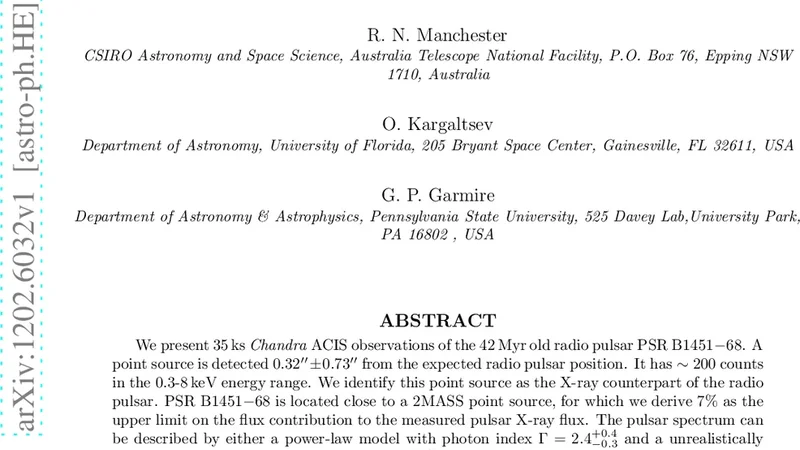
We present 35 ks Chandra ACIS observations of the 42 Myr old radio pulsar PSR B1451-68. A point source is detected 0.32" +/- 0.73" from the expected radio pulsar position. It has ~200 counts in the 0.3-8 keV energy range. We identify this point source as the X-ray counterpart of the radio pulsar. PSR B1451-68 is located close to a 2MASS point source, for which we derive 7% as the upper limit on the flux contribution to the measured pulsar X-ray flux. The pulsar spectrum can be described by either a power-law model with photon index Gamma=2.4 (+0.4/-0.3) and a unrealistically high absorbing column density N(H)= (2.5 (+1.2/-1.3)) * 10^(21) cm^-2, or by a combination of a kT=0.35 (+0.12/-0.07) keV blackbody and a Gamma = 1.4 +/- 0.5 power-law component for N(H)[DM]= 2.6 * 10^(20) cm^-2, estimated from the pulsar dispersion measure. At the parallactic, Lutz-Kelker bias corrected distance of 480 pc, the non-thermal X-ray luminosities in the 0.3-8 keV energy band are either Lx(nonth)= (11.3 +/- 1.7) * 10^(29) erg/s or Lx(nonth)= (5.9 (+4.9/-5.0)) * 10^(29) erg/s, respectively. This corresponds to non-thermal X-ray efficiencies of either eta(nonth)= Lx(nonth) / (dE/dt) ~ 0.005 or 0.003, respectively.
💡 Research Summary
This paper reports the first X‑ray detection of the 42 Myr old radio pulsar PSR B1451‑68 using a 35 ks Chandra ACIS observation. A point source was found within 0.32″ of the radio position, with a positional uncertainty of ±0.73″, and yielded roughly 200 counts in the 0.3–8 keV band. The source lies close to a 2MASS infrared object, but detailed image analysis limits the star’s contribution to less than 7 % of the total X‑ray flux, confirming the emission originates from the pulsar.
Spectral fitting was performed with two models. A single power‑law fit gives a photon index Γ = 2.4 (+0.4/‑0.3) but requires an absorbing column N_H ≈ 2.5 × 10²¹ cm⁻², an order of magnitude higher than the value inferred from the pulsar’s dispersion measure (DM), rendering the model physically implausible. A more realistic composite model combines a blackbody (kT = 0.35 (+0.12/‑0.07) keV) with a power‑law (Γ = 1.4 ± 0.5), fixing N_H at the DM‑derived value of 2.6 × 10²⁰ cm⁻². The blackbody component corresponds to an emitting area of ~10⁴ m², consistent with a heated polar cap, while the power‑law represents non‑thermal magnetospheric emission.
Adopting the Lutz‑Kelker bias‑corrected parallax distance of 480 pc, the non‑thermal X‑ray luminosity in the 0.3–8 keV band is L_X(non‑th) ≈ (5.9 +4.9/‑5.0) × 10²⁹ erg s⁻¹ (or 1.13 ± 0.17 × 10³⁰ erg s⁻¹ for the single‑power‑law fit). This translates to an X‑ray efficiency η = L_X/Ė of 0.003–0.005, i.e., 0.3–0.5 % of the pulsar’s spin‑down power, a value comparable to other old pulsars such as PSR B0950+08 and PSR J2043+2740.
The detection of both thermal and non‑thermal components indicates that even at advanced ages, polar‑cap heating persists and magnetospheric particle acceleration remains active. The relatively hard non‑thermal spectrum (Γ ≈ 1.4) suggests efficient high‑energy processes, while the modest efficiency aligns with the notion that a roughly constant fraction of spin‑down energy is converted into X‑rays across a wide age range.
Overall, the study provides a robust X‑ray counterpart identification for PSR B1451‑68, refines its spectral characteristics, and contributes valuable data to the growing sample of old pulsars with measured X‑ray properties. Future deeper observations with higher timing resolution could resolve pulsations, separate the thermal and non‑thermal contributions more cleanly, and further constrain models of magnetospheric emission and polar‑cap heating in aging neutron stars.