Global Calculations of Density Waves and Gap Formation in Protoplanetary Disks using a Moving Mesh
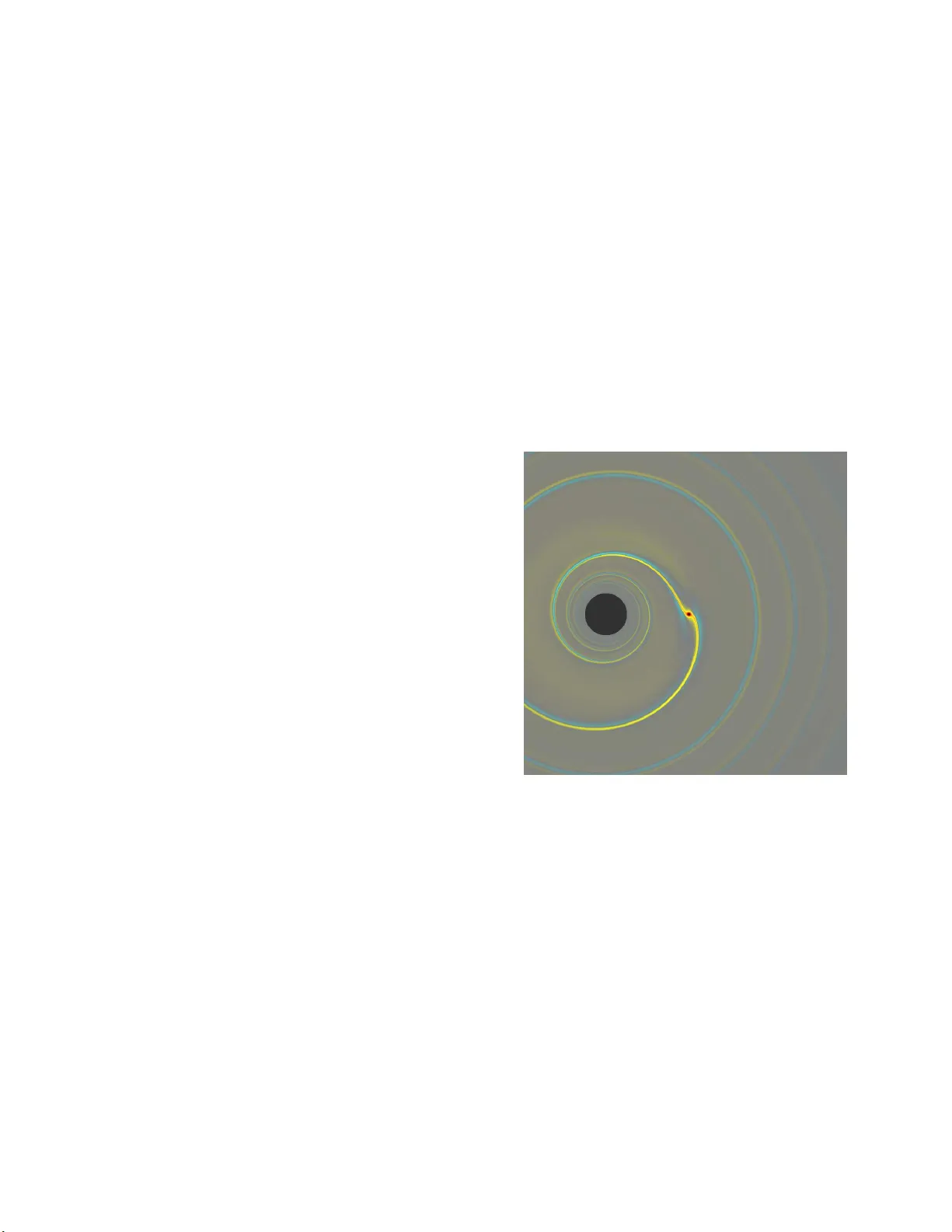
We calculate the global quasi-steady state of a thin disk perturbed by a low-mass protoplanet orbiting at a fixed radius using extremely high-resolution numerical integrations of Euler’s equations in two dimensions. The calculations are carried out using a moving computational domain, which greatly reduces advection errors and allows for much longer time-steps than a fixed grid. We calculate the angular momentum flux and the torque density as a function of radius and compare them with analytical predictions. We discuss the quasi-steady state after 100 orbits and the prospects for gap formation by low mass planets.
💡 Research Summary
This paper presents a comprehensive, global study of density‑wave excitation, angular‑momentum transport, and gap formation in a thin protoplanetary disk perturbed by a low‑mass planet on a fixed circular orbit. The authors employ a moving‑mesh hydrodynamics code that advects the computational grid with the Keplerian flow, thereby minimizing numerical diffusion and allowing substantially larger Courant‑limited time steps compared with conventional fixed‑grid schemes. The simulations are two‑dimensional (radial–azimuthal) integrations of the Euler equations, assuming an isothermal equation of state and a geometrically thin disk (H/r ≪ 1). Three planetary mass ratios are explored: Mₚ/M★ = 10⁻⁴, 3 × 10⁻⁴, and 10⁻³. The mesh resolution reaches 4096 radial cells and 8192 azimuthal cells, providing sub‑scale resolution of the spiral wake and its subsequent non‑linear evolution.
Key methodological advances include: (1) a mesh that rotates at the local orbital frequency, which eliminates the dominant advection term and reduces the effective numerical viscosity; (2) adaptive cell spacing that follows the background density gradient, ensuring that the wake is resolved throughout the computational domain; and (3) a time‑step that is limited only by the sound‑speed Courant condition rather than the orbital period, enabling integrations over >100 planetary orbits.
The results can be grouped into four major findings. First, the linear density wave launched by the planet carries an angular‑momentum flux F_J(r) that matches the analytic predictions of Goldreich & Tremaine (1979) and Tanaka et al. (2002) to within a few percent. The torque density dT/dr extracted from the simulations follows the expected r⁻⁴ scaling and reproduces the predicted location of the Lindblad resonances. Second, after roughly 100 orbital periods the disk reaches a quasi‑steady state in which the wave pattern is continuously regenerated by the planet and simultaneously damped by viscous dissipation, establishing a balance between wave‑driven torque and viscous spreading. Third, gap formation is found to be highly sensitive to planetary mass. For the lowest mass case (10⁻⁴ M★) the wave remains linear and its torque is insufficient to overcome the background viscous torque; consequently the surface density profile shows only a shallow, transient depression. In contrast, the highest mass case (≈10⁻³ M★) pushes the wave into the non‑linear regime, leading to rapid shock formation, strong angular‑momentum deposition, and the emergence of a measurable, though still relatively shallow, gap. This threshold is consistent with the theoretical criterion Mₚ ≳ (H/r)³ M★ for non‑linear wave breaking. Fourth, the moving‑mesh approach dramatically reduces artificial viscosity compared with fixed‑grid runs. In fixed‑grid tests the same planetary masses produced premature gap opening because numerical diffusion artificially amplified wave damping. The moving‑mesh results therefore provide a more faithful representation of the physical processes governing gap formation.
The authors discuss the astrophysical implications of their findings. The persistence of a quasi‑steady spiral pattern for low‑mass planets suggests that early planetary cores can coexist with an essentially unperturbed disk, allowing continued accretion of solids and gas. The identification of a clear mass threshold for gap opening informs interpretations of observed sub‑structures in protoplanetary disks (e.g., ALMA rings) and helps constrain the masses of unseen embedded planets. Moreover, the demonstrated superiority of the moving‑mesh technique points toward its adoption as a new standard for high‑fidelity planet–disk interaction studies.
Future work outlined includes extending the integrations to several hundred orbits to examine long‑term viscous evolution, exploring a broader range of viscosity parameters (α‑prescriptions), and incorporating realistic temperature gradients to assess their impact on wave propagation and gap depth. The paper thus establishes both a robust numerical framework and a set of benchmark results that will serve the community in modeling planet formation and disk evolution.