Double Compact Objects I: The Significance Of The Common Envelope On Merger Rates
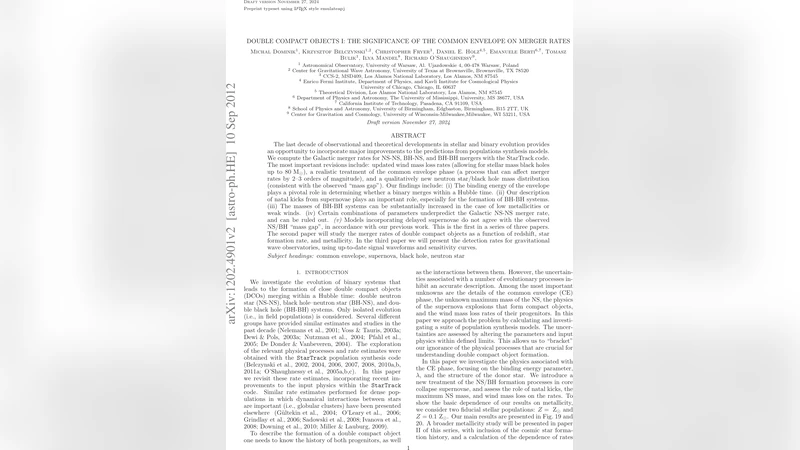
The last decade of observational and theoretical developments in stellar and binary evolution provides an opportunity to incorporate major improvements to the predictions from populations synthesis models. We compute the Galactic merger rates for NS-NS, BH-NS, and BH-BH mergers with the StarTrack code. The most important revisions include: updated wind mass loss rates (allowing for stellar mass black holes up to $80 \msun$), a realistic treatment of the common envelope phase (a process that can affect merger rates by 2–3 orders of magnitude), and a qualitatively new neutron star/black hole mass distribution (consistent with the observed “mass gap”). Our findings include: (i) The binding energy of the envelope plays a pivotal role in determining whether a binary merges within a Hubble time. (ii) Our description of natal kicks from supernovae plays an important role, especially for the formation of BH-BH systems. (iii) The masses of BH-BH systems can be substantially increased in the case of low metallicities or weak winds. (iv) Certain combinations of parameters underpredict the Galactic NS-NS merger rate, and can be ruled out. {\em (v)} Models incorporating delayed supernovae do not agree with the observed NS/BH “mass gap”, in accordance with our previous work. This is the first in a series of three papers. The second paper will study the merger rates of double compact objects as a function of redshift, star formation rate, and metallicity. In the third paper we will present the detection rates for gravitational wave observatories, using up-to-date signal waveforms and sensitivity curves.
💡 Research Summary
This paper presents a comprehensive population‑synthesis study of double compact object (DCO) mergers in the Milky Way, using the updated StarTrack code. The authors incorporate four major improvements over previous work: (1) revised stellar wind mass‑loss prescriptions that allow black holes (BHs) up to ~80 M⊙, especially at low metallicity; (2) a physically motivated treatment of the common‑envelope (CE) phase, including realistic binding‑energy (λ) calculations and an efficiency parameter (αCE); (3) a modern natal‑kick distribution for supernovae, with weaker kicks for BH formation; and (4) a new neutron‑star/black‑hole mass function that reproduces the observed 2–5 M⊙ “mass gap.”
The study finds that the CE binding energy is the dominant factor controlling whether a binary will merge within a Hubble time. Small variations in λ (0.1–1) can change merger rates by two to three orders of magnitude. The natal‑kick prescription strongly influences BH‑BH formation: weak kicks (≤50 km s⁻¹) allow many BH‑BH progenitors to survive the supernova, while strong kicks disrupt most systems. Metallicity plays a crucial role for BH‑BH masses; low‑Z environments produce weaker winds, leading to more massive BHs (30–80 M⊙) and higher merger rates, whereas high‑Z stars lose more mass and form lighter BHs.
Models that adopt delayed supernova mechanisms fail to reproduce the observed mass gap, confirming earlier findings that such prescriptions are inconsistent with current data. Certain combinations of αCE and λ (e.g., very low αCE or λ) underpredict the Galactic NS‑NS merger rate (~10⁻⁴ yr⁻¹) and can therefore be ruled out. Conversely, models with αCE≈1 and λ≈0.5–1 match the observed NS‑NS rate and predict realistic BH‑NS and BH‑BH merger rates.
The paper concludes that accurate modeling of the CE phase, realistic natal kicks, and metallicity‑dependent winds are essential for reliable DCO merger predictions. These results lay the groundwork for the subsequent papers in the series: the second will explore redshift, star‑formation‑rate, and metallicity dependencies of merger rates, and the third will translate the astrophysical rates into detection rates for current and future gravitational‑wave observatories using up‑to‑date waveforms and sensitivity curves.