Exploring the supernova remnant G308.4-1.4
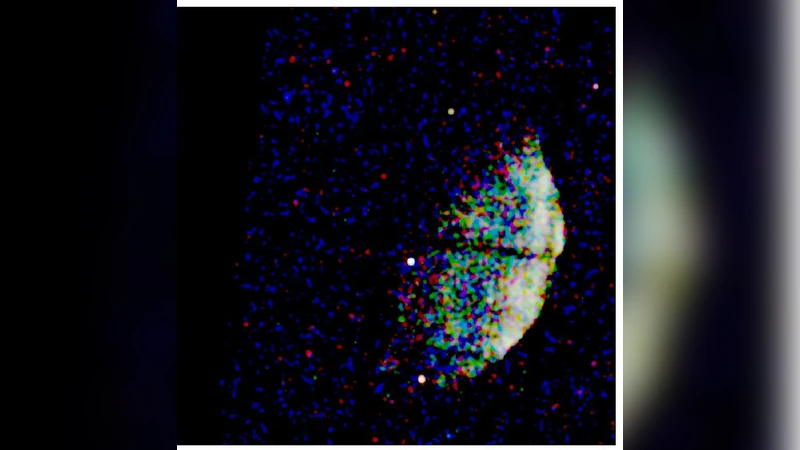
Aims: We present a detailed X-ray and radio wavelength study of G308.4-1.4, a candidate supernova remnant (SNR) in the ROSAT All Sky Survey and the MOST supernova remnant catalogue, in order to identify it as a SNR. Methods: The SNR candidate and its central sources were studied using observations from the Chandra X-ray Observatory, SWIFT, the Australian Telescope Compact Array (ATCA) at 1.4 and 2.5 GHz and WISE infrared observation at 24 $\mu$m. Results: We conclude that G308.4-1.4 is indeed a supernova remnant by means of its morphology matching at X-ray, radio and infrared wavelength, its spectral energy distribution in the X-ray band and its emission characteristics in the radio band. G308.4-1.4 is a shell-type SNR. X-ray, radio and infrared emission is seen only in the eastern part of the remnant. The X-ray emission can best be described by an absorbed non-equilibrium collisional plasma with a hydrogen density of $n_\mathrm{H}=(1.02\pm 0.04) \times 10^{22}$ cm$^{-2}$, a plasma temperature of $6.3^{+1.2}_{-0.7}$ million Kelvin and an under-abundance of Iron, Neon and Magnesium, as well as an overabundance in Sulfur with respect to the solar values. The SNR has a spectral index in the radio band of $\alpha=-0.7\pm0.2$. A detailed analysis revealed that the remnant is at a distance of 6 to 12 kpc and the progenitor star exploded $\sim 5000$ to 7500 years ago. Two faint X-ray point sources located near to the remnant’s geometrical center are detected. Both sources have no counterpart at other wavelengths, leaving them as candidates for the compact remnant of the supernova explosion.
💡 Research Summary
The paper presents a comprehensive multi‑wavelength investigation of the Galactic object G308.4‑1.4, previously listed as a supernova remnant (SNR) candidate in the ROSAT All‑Sky Survey and the MOST SNR catalogue. Using high‑resolution Chandra ACIS‑I imaging and spectroscopy, together with Swift follow‑up, ATCA radio interferometry at 1.4 GHz and 2.5 GHz, and WISE 24 µm infrared data, the authors aim to confirm the SNR nature and to characterize its physical properties. The X‑ray morphology reveals a bright, shell‑like structure confined to the eastern limb of the source; the interior is essentially void of emission. Spectral fitting favors a non‑equilibrium ionization (NEI) plasma model with an absorbing column density N_H = (1.02 ± 0.04) × 10²² cm⁻² and a plasma temperature kT ≈ 0.54 keV (≈ 6.3 MK). Elemental abundances show a depletion of Fe, Ne, and Mg relative to solar values, while sulfur is over‑abundant, suggesting that ejecta material has partially mixed with the shocked interstellar medium. In the radio band, ATCA detects emission only where the X‑ray shell is bright, and the measured spectral index α = ‑0.7 ± 0.2 is consistent with synchrotron radiation from shock‑accelerated electrons. The 24 µm WISE image displays a coincident infrared filament, indicating heated dust co‑located with the shocked gas. By combining the X‑ray absorption, HI/CO line information, and the empirical Σ‑D relation, the authors estimate a distance of 6–12 kpc. Assuming a Sedov‑Taylor expansion phase, the remnant’s radius (≈ 5′) translates into an age of roughly 5 kyr to 7.5 kyr and an average expansion velocity of ~600 km s⁻¹. Two faint point‑like X‑ray sources (CXOU J134… and CXOU J135…) lie near the geometric centre of the shell. Neither has counterparts at optical, infrared, or radio wavelengths, and their X‑ray luminosities (~10³² erg s⁻¹) are compatible with a young, isolated neutron star or a low‑luminosity black hole left behind by the supernova. The convergence of morphological coincidence across X‑ray, radio, and infrared bands, the NEI plasma characteristics, the non‑thermal radio spectrum, and the consistent distance/age estimates lead the authors to firmly classify G308.4‑1.4 as a shell‑type supernova remnant. The pronounced asymmetry—emission confined to the eastern side—likely reflects an inhomogeneous ambient medium or an intrinsically asymmetric explosion. The paper concludes by recommending deeper, high‑resolution radio polarimetry and time‑domain X‑ray studies to resolve the nature of the central compact objects and to model the interaction between the shock front and the surrounding interstellar material in greater detail.