Thermonuclear X-ray bursts from the 401 Hertz accreting pulsar IGR J17498-2921: indication of burning in confined regions
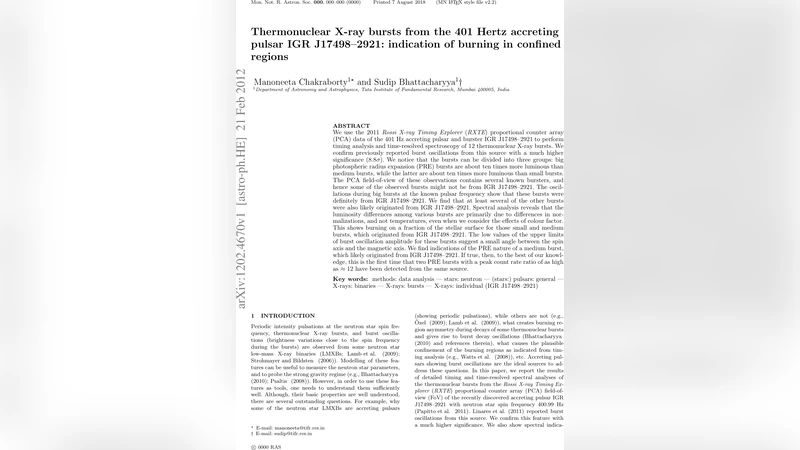
We use the 2011 Rossi X-ray Timing Explorer (RXTE) proportional counter array (PCA) data of the 401 Hz accreting pulsar and burster IGR J17498-2921 to perform timing analysis and time-resolved spectroscopy of 12 thermonuclear X-ray bursts. We confirm previously reported burst oscillations from this source with a much higher significance (8.8\sigma). We notice that the bursts can be divided into three groups: big photospheric radius expansion (PRE) bursts are about ten times more luminous than medium bursts, while the latter are about ten times more luminous than small bursts. The PCA field-of-view of these observations contains several known bursters, and hence some of the observed bursts might not be from IGR J17498-2921. The oscillations during big bursts at the known pulsar frequency show that these bursts were definitely from IGR J17498-2921. We find that at least several of the other bursts were also likely originated from IGR J17498-2921. Spectral analysis reveals that the luminosity differences among various bursts are primarily due to differences in normalizations, and not temperatures, even when we consider the effects of colour factor. This shows burning on a fraction of the stellar surface for those small and medium bursts, which originated from IGR J17498-2921. The low values of the upper limits of burst oscillation amplitude for these bursts suggest a small angle between the spin axis and the magnetic axis. We find indications of the PRE nature of a medium burst, which likely originated from IGR J17498-2921. If true, then, to the best of our knowledge, this is the first time that two PRE bursts with a peak count rate ratio of as high as {\approx} 12 have been detected from the same source.
💡 Research Summary
This paper presents a comprehensive timing and spectral study of twelve thermonuclear X‑ray bursts observed from the 401 Hz accreting pulsar and burster IGR J17498‑2921 using the Rossi X‑ray Timing Explorer (RXTE) Proportional Counter Array (PCA) data collected in 2011. The authors first performed a timing analysis to search for burst oscillations. They confirm the previously reported oscillations at the known spin frequency with a much higher significance (8.8 σ). The oscillations are especially strong in the “big” bursts that exhibit photospheric radius expansion (PRE), unequivocally establishing that those bursts originated from IGR J17498‑2921.
The bursts are then classified into three luminosity groups based on their peak count rates: big PRE bursts, medium bursts, and small bursts. The big bursts are roughly ten times more luminous than the medium ones, and the medium bursts are about ten times more luminous than the small bursts. Because the PCA field of view contains several other known bursters, the authors carefully assess the origin of each burst. The detection of spin‑frequency oscillations in the big bursts guarantees their association with IGR J17498‑2921, and additional evidence (e.g., similar spectral parameters) suggests that several of the medium and small bursts also likely came from the same source.
Time‑resolved spectroscopy was performed using an absorbed blackbody model with a colour‑correction factor. The key finding is that the large differences in burst luminosities are driven primarily by differences in the blackbody normalisation (i.e., emitting area) rather than temperature. Even after accounting for colour‑factor effects, the temperatures of all bursts remain within a narrow range (≈2.0–2.5 keV), while the normalisations vary by up to an order of magnitude. This implies that the medium and small bursts ignite only on a fraction of the neutron‑star surface, whereas the big PRE bursts involve near‑global burning.
The authors also examine the amplitude of burst oscillations. For the medium and small bursts, only upper limits could be set, and these limits are low. Since the oscillation amplitude depends on the geometric angle between the observer’s line of sight, the spin axis, and the magnetic axis, the low amplitudes suggest a small misalignment between the spin and magnetic axes. This geometry would naturally reduce the observable modulation for bursts confined to a limited region.
A particularly intriguing result is the identification of PRE‑like behaviour in one of the medium bursts. If this interpretation is correct, it would represent the first case where two PRE bursts from the same source differ in peak count rate by a factor of ≈12. Such a large disparity challenges standard models of burst ignition, which typically predict more modest variations in PRE strength for a given source. The authors propose that differences in fuel column depth, composition, or magnetic confinement could produce the observed range.
In summary, the paper provides strong evidence that thermonuclear bursts from IGR J17498‑2921 can be either global (big PRE bursts) or confined to a limited surface area (medium and small bursts). The detection of high‑significance burst oscillations at the spin frequency confirms the source of the big bursts and supports the hypothesis of a small angle between the spin and magnetic axes. The possible PRE nature of a medium burst, together with the unprecedented factor‑12 difference in PRE peak fluxes, offers a new observational benchmark for theoretical models of burst ignition, fuel accumulation, and magnetic confinement on accreting neutron stars. Future high‑resolution timing and spectral observations, combined with detailed magneto‑hydrodynamic simulations, will be essential to fully understand the interplay between rotation, magnetic field geometry, and thermonuclear burning on such rapidly spinning pulsars.