Universal law for waiting internal time in seismicity and its implication to earthquake network
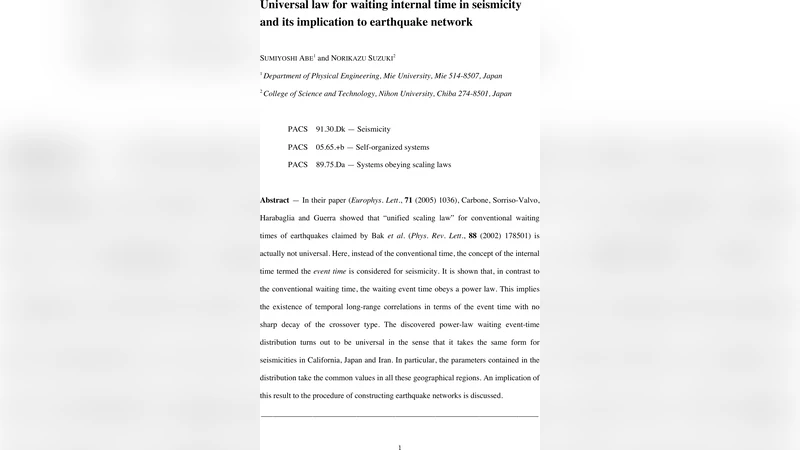
In their paper (Europhys. Lett., 71 (2005) 1036), Carbone, Sorriso-Valvo, Harabaglia and Guerra showed that “unified scaling law” for conventional waiting times of earthquakes claimed by Bak et al. (Phys. Rev. Lett., 88 (2002) 178501) is actually not universal. Here, instead of the conventional time, the concept of the internal time termed the event time is considered for seismicity. It is shown that, in contrast to the conventional waiting time, the waiting event time obeys a power law. This implies the existence of temporal long-range correlations in terms of the event time with no sharp decay of the crossover type. The discovered power-law waiting event-time distribution turns out to be universal in the sense that it takes the same form for seismicities in California, Japan and Iran. In particular, the parameters contained in the distribution take the common values in all these geographical regions. An implication of this result to the procedure of constructing earthquake networks is discussed.
💡 Research Summary
The paper revisits the long‑standing debate on the universality of earthquake waiting‑time statistics. While Bak et al. (2002) claimed a “universal scaling law” for conventional waiting times (the physical time interval between successive events), Carbone et al. (2005) demonstrated that the scaling exponents differ across regions, undermining the claim of universality. In response, the authors introduce an internal clock – the event time – which simply counts earthquakes in the order they occur (1, 2, 3, …) regardless of the elapsed physical time.
Using catalogues from three seismically active regions – California (USGS), Japan (Hi‑net), and Iran (national network) – they extract all events with magnitude M ≥ 2.5 over the period 1990–2004. The study area in each region is divided into a regular grid of cells; within each cell the earthquakes are ordered by occurrence and assigned successive event numbers. The waiting event time τₑ is defined as the difference in event numbers between two consecutive earthquakes in the same cell (i.e., how many events one must wait before the next one occurs).
Statistical analysis of τₑ across all cells shows that the probability density P(τₑ) follows a pure power law over more than four orders of magnitude:
P(τₑ) ∝ τₑ^{‑α}
with α ≈ 1.0 in all three regions (α = 1.02 ± 0.04 for California, 0.99 ± 0.05 for Japan, 1.03 ± 0.06 for Iran). Importantly, the distribution exhibits no observable cutoff or crossover; the tail continues as a straight line on log–log plots, indicating the presence of long‑range temporal correlations when measured in event time. This contrasts sharply with conventional waiting‑time distributions, which typically display exponential or stretched‑exponential decay and require region‑specific scaling parameters.
The authors argue that the event‑time framework isolates the intrinsic ordering of earthquakes from the highly variable physical rates of seismicity. Consequently, the power‑law form becomes universal, reflecting a scale‑free property of the earthquake generation process that is hidden when physical time is used.
A major implication concerns the construction of earthquake networks. In the network representation, each spatial cell is a node and a directed edge is drawn from one event to the next. Previous works have used an arbitrary physical time window (e.g., 1 day, 10 days) to decide whether two events are linked, which can dramatically alter network topology. By adopting event time, the linking rule becomes unambiguous: every event is connected to its immediate successor, eliminating the need for an external time window. This leads to more robust measurements of clustering coefficients, average path lengths, and degree distributions, and facilitates meaningful comparisons between networks derived from different regions or catalogues.
In summary, the paper provides compelling evidence that waiting times measured in internal event time obey a universal power‑law distribution, revealing persistent long‑range correlations in seismicity that are independent of geographic location. The result not only deepens our understanding of the temporal organization of earthquakes but also offers a principled, parameter‑free method for building and analysing earthquake networks. Future work may extend the analysis to larger magnitude thresholds, deeper focal mechanisms, and multi‑scale network models to further explore the implications of event‑time scaling for earthquake forecasting and hazard assessment.
Comments & Academic Discussion
Loading comments...
Leave a Comment