F-GAMMA: On the phenomenological classification of continuum radio spectra variability patterns of Fermi blazars
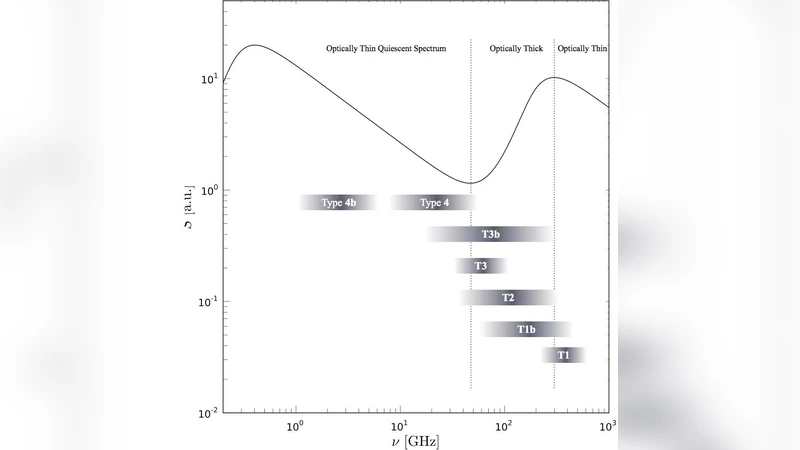
The F-GAMMA program is a coordinated effort to investigate the physics of Active Galactic Nuclei (AGNs) via multi-frequency monitoring of Fermi blazars. In the current study we show and discuss the evolution of broad-band radio spectra, which are measured at ten frequencies between 2.64 and 142 GHz using the Effelsberg 100-m and the IRAM 30-m telescopes. It is shown that any of the 78 sources studied can be classified in terms of their variability characteristics in merely 5 types of variability. It is argued that these can be attributed to only two classes of variability mechanisms. The first four types are dominated by spectral evolution and can be described by a simple two-component system composed of: (a) a steep quiescent spectral component from a large scale jet and (b) a time evolving flare component following the “Shock-in-Jet” evolutionary path. The fifth type is characterised by an achromatic change of the broad band spectrum, which could be attributed to a different mechanism, likely involving differential Doppler boosting caused by geometrical effects. Here we present the classification, the assumed physical scenario and the results of calculations that have been performed for the spectral evolution of flares.
💡 Research Summary
The F‑GAMMA program was designed to study the physics of active galactic nuclei (AGN) by providing dense, multi‑frequency radio monitoring of a large sample of Fermi‑detected blazars. In this paper the authors present the results of a two‑year campaign that measured the broadband radio spectra of 78 blazars at ten frequencies ranging from 2.64 GHz to 142 GHz using the Effelsberg 100‑m and IRAM 30‑m telescopes. The data set is exceptionally homogeneous: each source was observed roughly monthly, the same set of frequencies was used for every epoch, and systematic calibration uncertainties were kept below 5 %. After standard data reduction (opacity correction, gain calibration, and baseline subtraction) the authors derived, for each epoch, a spectral energy distribution (SED) and fitted a simple power‑law (Sν ∝ ν^α) to obtain the instantaneous spectral index α and the peak frequency νₚ of any flaring component.
By tracking the temporal evolution of α and νₚ, the authors discovered that every source could be placed into one of only five phenomenological variability classes. The first four classes (labelled A–D) share a common characteristic: a transient, high‑frequency component appears, its νₚ drifts systematically toward lower frequencies, and the overall spectrum evolves in a way that is fully consistent with the classic “Shock‑in‑Jet” scenario (Marscher & Gear 1985). In this picture a shock propagates down the relativistic jet, compressing the plasma, amplifying the magnetic field, and accelerating electrons. The shock’s early stage produces a synchrotron spectrum that peaks at high frequencies; as the shock expands, radiative losses and adiabatic cooling shift the peak to lower frequencies while the flux decays. The authors model this evolution with a two‑component description: (1) a steep, quasi‑steady component (α ≈ ‑0.7) that represents the large‑scale, optically thin jet, and (2) a time‑dependent flare component that follows the Shock‑in‑Jet trajectory. By adjusting the flare’s initial flux density, magnetic field strength, electron energy index, and evolution timescales, the authors reproduce the observed νₚ‑time tracks and flux curves for all A–D sources. The differences among A, B, C, and D are mainly quantitative: A shows a single, dominant flare with a rapid νₚ migration; B displays weaker flares and slower spectral evolution; C contains overlapping flares that partially mask each other; D exhibits a complex superposition of several flares, sometimes producing multiple peaks in the SED. Nevertheless, all four classes can be interpreted within the same physical framework.
The fifth class (E) behaves fundamentally differently. Its broadband spectrum retains the same shape (i.e., the same α) while the overall flux level rises or falls uniformly across all frequencies. This achromatic variability cannot be explained by the appearance or evolution of a synchrotron flare, because such events inevitably alter νₚ and α. Instead, the authors argue that class E reflects changes in the Doppler boosting factor of the entire jet. Small variations in the viewing angle (θ) or in the bulk Lorentz factor (Γ) modify the Doppler factor δ =