3 to 12 millimetre studies of dense gas towards the western rim of supernova remnant RX J1713.7-3946
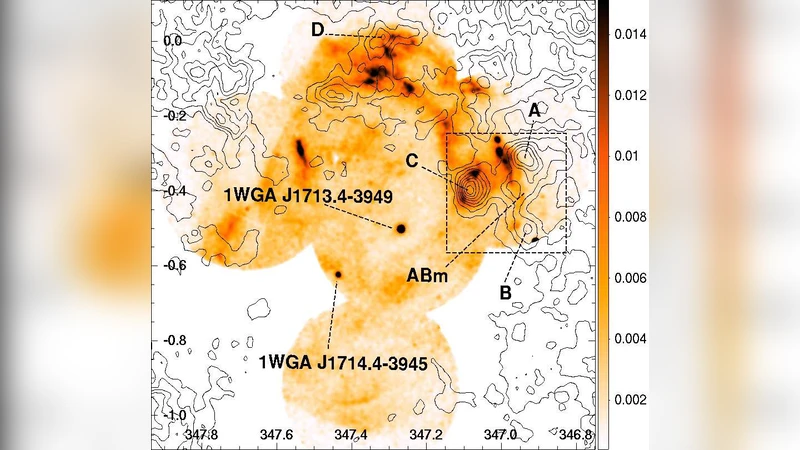
The young X-ray and gamma-ray-bright supernova remnant RXJ1713.7-3946 (SNR G347.3-0.5) is believed to be associated with molecular cores that lie within regions of the most intense TeV emission. Using the Mopra telescope, four of the densest cores were observed using high-critical density tracers such as CS(J=1-0,J=2-1) and its isotopologue counterparts, NH3(1,1) and (2,2) inversion transitions and N2H+(J=1-0) emission, confirming the presence of dense gas >10^4cm^-3 in the region. The mass estimates for Core C range from 40M_{\odot} (from CS(J=1-0)) to 80M_{\odot} (from NH3 and N2H+), an order of magnitude smaller than published mass estimates from CO(J=1-0) observations. We also modelled the energy-dependent diffusion of cosmic-ray protons accelerated by RXJ1713.7-3946 into Core C, approximating the core with average density and magnetic field values. We find that for considerably suppressed diffusion coefficients (factors \chi=10^{-3} down to 10^{-5} the galactic average), low energy cosmic-rays can be prevented from entering the inner core region. Such an effect could lead to characteristic spectral behaviour in the GeV to TeV gamma-ray and multi-keV X-ray fluxes across the core. These features may be measurable with future gamma-ray and multi-keV telescopes offering arcminute or better angular resolution, and can be a novel way to understand the level of cosmic-ray acceleration in RXJ1713.7-3946 and the transport properties of cosmic-rays in the dense molecular cores.
💡 Research Summary
The paper presents a detailed investigation of dense molecular material located on the western rim of the young super‑nova remnant RX J1713.7‑3946 (also known as SNR G347.3‑0.5), a source that is exceptionally bright in both X‑rays and TeV γ‑rays. Using the Mopra 22‑m radio telescope, the authors targeted four of the most compact molecular cores identified in previous CO surveys, focusing on high‑critical‑density tracers: CS (J = 1‑0 and 2‑1) together with its isotopologue C³⁴S, the ammonia inversion lines NH₃ (1,1) and (2,2), and N₂H⁺ (J = 1‑0). All four cores were detected in these lines, confirming the presence of gas with densities ≥10⁴ cm⁻³, a regime that CO (1‑0) alone cannot uniquely probe.
Core C, which lies directly beneath the brightest TeV emission, receives special attention. By assuming local thermodynamic equilibrium (LTE) and using standard excitation analysis, the authors derive a mass of ≈ 40 M⊙ from the CS (1‑0) line and ≈ 80 M⊙ from the combined NH₃ and N₂H⁺ data. Both estimates are an order of magnitude lower than the ≈ 400 M⊙ mass previously inferred from CO (1‑0) observations. The discrepancy is interpreted as a consequence of CO tracing a much larger, lower‑density envelope, whereas the high‑density tracers isolate the truly compact, star‑forming component. The ammonia line ratios yield a kinetic temperature of about 15 K, indicating that the dense gas is cold and largely shielded from the shock‑heated plasma that dominates the X‑ray emission. Magnetic field strengths, inferred from existing Zeeman and polarization measurements in the region, are taken to be ≈ 30 µG, a value that is typical for dense molecular clouds but higher than the ambient interstellar field.
Having established the physical conditions, the authors construct a simple diffusion model for cosmic‑ray (CR) protons accelerated at the SNR shock and propagating into Core C. The core is approximated as a sphere with uniform density and magnetic field. The diffusion coefficient is parameterised as D(E) = χ D_Gal(E), where D_Gal(E) ≈ 3 × 10²⁸ (E/GeV)^0.5 cm² s⁻¹ is the canonical Galactic diffusion coefficient and χ is a suppression factor. By exploring χ = 10⁻³, 10⁻⁴, and 10⁻⁵, the model shows that for χ ≤ 10⁻⁴ low‑energy CRs (E ≲ 10 GeV) are effectively excluded from the core interior, while only higher‑energy particles (E ≳ 100 GeV) can penetrate. This selective penetration leads to a characteristic spectral imprint: the γ‑ray spectrum produced by neutral‑pion decay inside the core becomes unusually hard (flat) because the soft, low‑energy component is missing, whereas the surrounding lower‑density gas retains the conventional softer spectrum. A similar effect is expected for non‑thermal X‑ray emission, where synchrotron radiation from secondary electrons would be suppressed in the core centre but could still arise in the outer layers.
The authors discuss two plausible physical mechanisms for such strong diffusion suppression. First, the combination of high gas density and amplified magnetic turbulence can increase the scattering rate of CRs, effectively reducing the mean free path. Second, the turbulence spectrum inside the core may be steeper than the Kolmogorov cascade, enhancing resonant scattering for low‑energy particles. Both mechanisms are consistent with the observed high magnetic field and the presence of dense clumps.
From an observational standpoint, the paper emphasizes that current γ‑ray instruments (H.E.S.S., Fermi‑LAT) lack the angular resolution (≈ 0.1°) needed to resolve the ≈ 1′‑scale core, making it impossible to test the predicted spectral variations directly. However, the upcoming Cherenkov Telescope Array (CTA) will achieve sub‑arcminute resolution and sufficient sensitivity to map the γ‑ray morphology across the core. Likewise, next‑generation X‑ray observatories such as eROSITA, XRISM, and Athena will provide arcminute or better imaging spectroscopy in the keV band. Detecting a spatial gradient in the γ‑ray spectral index—from a hard spectrum in the core centre to a softer one at the periphery—would constitute direct evidence for diffusion suppression. Conversely, a uniform spectrum would argue against the extreme χ values proposed.
In summary, the study combines high‑density molecular line observations with a simplified CR diffusion framework to reassess the mass of the dense cores associated with RX J1713.7‑3946 and to explore how suppressed diffusion can shape the multi‑wavelength emission. The work highlights the importance of accurate mass estimates (using tracers like CS, NH₃, N₂H⁺) for interpreting γ‑ray data, and it proposes a concrete observational test that future high‑resolution γ‑ray and X‑ray facilities can perform. Successful verification would not only refine our understanding of particle acceleration efficiency in this iconic SNR but also provide a rare probe of cosmic‑ray transport properties inside cold, dense molecular environments.