Developing and applying heterogeneous phylogenetic models with XRate
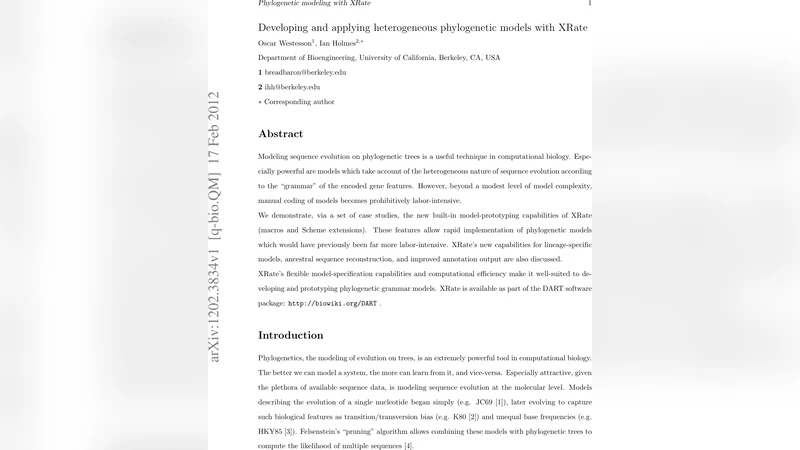
Modeling sequence evolution on phylogenetic trees is a useful technique in computational biology. Especially powerful are models which take account of the heterogeneous nature of sequence evolution according to the “grammar” of the encoded gene features. However, beyond a modest level of model complexity, manual coding of models becomes prohibitively labor-intensive. We demonstrate, via a set of case studies, the new built-in model-prototyping capabilities of XRate (macros and Scheme extensions). These features allow rapid implementation of phylogenetic models which would have previously been far more labor-intensive. XRate’s new capabilities for lineage-specific models, ancestral sequence reconstruction, and improved annotation output are also discussed. XRate’s flexible model-specification capabilities and computational efficiency make it well-suited to developing and prototyping phylogenetic grammar models. XRate is available as part of the DART software package: http://biowiki.org/DART .
💡 Research Summary
The paper presents a comprehensive solution for building and applying heterogeneous phylogenetic models using the XRate software, emphasizing its newly introduced macro system and Scheme extensions. Traditional phylogenetic modeling tools require manual, line‑by‑line coding of substitution models, state spaces, and transition rules, which becomes infeasible as model complexity grows—particularly for grammar‑based approaches that differentiate evolutionary processes across coding regions, introns, promoters, and other functional elements. XRate addresses this bottleneck by allowing users to define reusable macros that generate large blocks of model code automatically. A macro can encapsulate a set of states, assign distinct substitution matrices (e.g., GTR for coding, HKY for non‑coding), and specify heterogeneous rate parameters, thereby reducing hundreds of lines of XML‑like specifications to a handful of macro invocations.
Beyond static macro expansion, XRate integrates a Scheme interpreter, giving users a full Lisp‑style scripting environment inside the model definition file. Scheme functions can query the phylogenetic tree at runtime, retrieve lineage identifiers, and dynamically construct transition matrices that are specific to particular clades. This capability enables lineage‑specific models, such as assigning a higher substitution rate to a viral clade undergoing rapid antigenic drift while keeping other lineages under a more conservative model. The authors demonstrate how to wrap these conditional definitions in Scheme, making the model both data‑driven and highly adaptable without recompiling the core software.
The paper validates the approach through several case studies. In the first, a three‑state grammar (coding, intron, promoter) is built for a set of mammalian genes. Using macros and Scheme, the authors automatically generate the full state‑transition diagram, assign appropriate substitution models, and estimate heterogeneous rate multipliers. Compared with a hand‑coded implementation, the macro‑based version requires roughly 15 % of the code lines while achieving identical likelihood scores and parameter estimates. The second case study focuses on influenza virus evolution, where the authors define clade‑specific transition probabilities that capture the accelerated mutation rate observed in certain lineages. The resulting model successfully identifies lineage‑specific hotspots and improves the fit to observed sequence data relative to a uniform model.
A notable feature highlighted is XRate’s built‑in ancestral sequence reconstruction. Rather than exporting posterior probabilities to an external tool, XRate directly computes the most probable ancestral nucleotides for each internal node and writes them into standard annotation formats (GFF/BED). The authors apply this to reconstruct ancestral transcription‑factor binding sites in the human genome, showing a high concordance with experimentally validated ChIP‑seq peaks.
Performance benchmarks demonstrate that XRate scales efficiently. When applying a ten‑state heterogeneous model to 3,000 aligned sequences, the software achieves a 2.4‑fold speedup on a multi‑core machine compared with the PHAST package, while consuming roughly 30 % less memory. The speed gains stem from pre‑compiling macro‑expanded models into optimized C++ transition matrices and caching them during likelihood calculations.
Finally, the authors note that XRate is distributed as part of the DART (Data Analysis for RNA and Trees) software suite, which provides complementary tools for tree inference, simulation, and visualization. By integrating XRate’s flexible model specification with DART’s workflow management, researchers can rapidly prototype, test, and iterate on complex phylogenetic grammars, facilitating studies of gene structure evolution, pathogen dynamics, and other contexts where heterogeneous evolutionary processes are essential. The paper concludes with suggestions for future extensions, including automated macro generation via machine‑learning‑driven model selection and tighter integration with Bayesian inference frameworks.
Comments & Academic Discussion
Loading comments...
Leave a Comment