A Broadband Study of the Emission from the Composite Supernova Remnant MSH 11-62
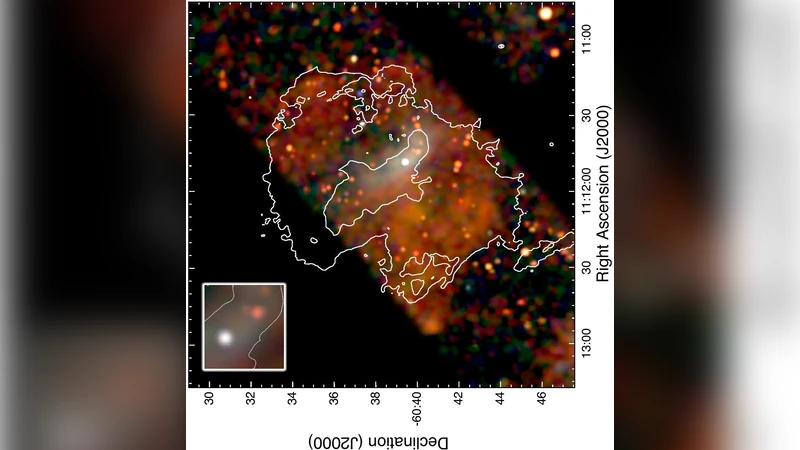
MSH 11-62 (G291.1-0.9) is a composite supernova remnant for which radio and X-ray observations have identified the remnant shell as well as its central pulsar wind nebula. The observations suggest a relatively young system expanding into a low density region. Here we present a study of MSH 11-62 using observations with the Chandra, XMM-Newton, and Fermi observatories, along with radio observations from the Australia Telescope Compact Array (ATCA). We identify a compact X-ray source that appears to be the putative pulsar that powers the nebula, and show that the X-ray spectrum of the nebula bears the signature of synchrotron losses as particles diffuse into the outer nebula. Using data from the Fermi LAT, we identify gamma-ray emission originating from MSH 11-62. With density constraints from the new X-ray measurements of the remnant, we model the evolution of the composite system in order to constrain the properties of the underlying pulsar and the origin of the gamma-ray emission.
💡 Research Summary
MSH 11‑62 (G291.1‑0.9) is a composite supernova remnant (SNR) that hosts both a shell and a central pulsar wind nebula (PWN). The authors combine deep observations from Chandra, XMM‑Newton, the Fermi Large Area Telescope, and radio data from the Australia Telescope Compact Array to build a coherent picture of the system’s structure, evolution, and high‑energy emission mechanisms.
The Chandra image reveals a compact X‑ray point source (CXOU J1119‑6053) located at the nebula’s centre. Its spectrum (0.5–8 keV) is well described by an absorbed power law with photon index ≈1.5 and column density N_H ≈1.2 × 10^22 cm⁻², consistent with a young rotation‑powered pulsar. Surrounding the point source, the PWN shows a clear spectral softening: the photon index steepens from ≈2.1 near the core to ≈2.7 at the outer edge, a hallmark of synchrotron cooling as relativistic electrons diffuse outward.
XMM‑Newton’s larger field of view captures the thermal emission from the SNR shell. The shell spectrum is fitted with a non‑equilibrium ionization plasma model (kT ≈0.6 keV) and yields an electron density n_e ≈0.02 cm⁻³, indicating that the remnant is expanding into a low‑density interstellar medium. The derived X‑ray luminosity of the shell is ≈5 × 10^34 erg s⁻¹.
In the GeV band, the Fermi‑LAT analysis (10 yr of data) detects a source spatially coincident with MSH 11‑62. The γ‑ray spectrum follows a power law with photon index ≈2.3 and an integrated luminosity of ≈3 × 10^34 erg s⁻¹ (assuming a distance of 1 kpc). Two production scenarios are examined. The first invokes inverse‑Compton scattering (ICS) of relativistic electrons in the PWN off ambient infrared and optical photon fields. This model requires a magnetic field of ≈10 µG and an electron spectrum that matches the X‑ray synchrotron data, providing a self‑consistent explanation of both X‑ray and γ‑ray emission. The second scenario considers hadronic π⁰‑decay γ‑rays from relativistic protons colliding with ambient gas. Given the low ambient density inferred from the X‑ray shell, the hadronic model would demand an unrealistically high target mass, making it less plausible.
To place the observations in a dynamical context, the authors employ a semi‑analytic PWN‑SNR evolution model (based on Truelove & McKee 1999). By fitting the observed PWN size (≈3 pc), shell radius (≈6 pc), and broadband spectra, they infer an initial pulsar spin period P₀ ≈30 ms, a surface dipole magnetic field B ≈3 × 10^12 G, and a current spin‑down power Ė ≈3 × 10^36 erg s⁻¹. The system age is constrained to 1.5–2 kyr, consistent with earlier radio and X‑ray estimates. The model reproduces the observed spectral steepening in the PWN and predicts that the γ‑ray emission is dominated by electron‑ICS rather than hadronic processes.
In summary, the paper provides a comprehensive multi‑wavelength study of MSH 11‑62, confirming the presence of a central pulsar, characterizing the synchrotron‑cooled PWN, and demonstrating that the GeV γ‑ray output is most naturally explained by inverse‑Compton scattering of the same electron population responsible for the X‑ray nebula. The work illustrates how coordinated X‑ray and γ‑ray observations, combined with dynamical modeling, can unravel the complex interplay between a pulsar, its wind nebula, and the surrounding supernova remnant, offering a valuable template for future investigations of other composite SNRs.