Revisiting the Higgs Mass and Dark Matter in the CMSSM
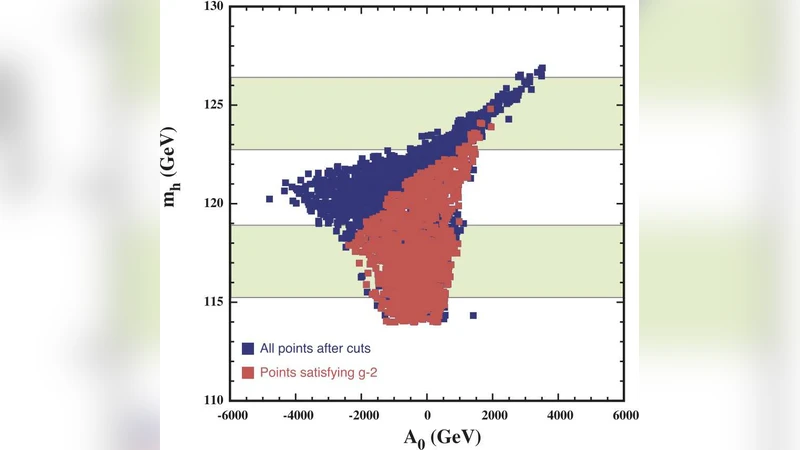
Taking into account the available accelerator and astrophysical constraints, the mass of the lightest neutral Higgs boson h in the minimal supersymmetric extension of the Standard Model with universal soft supersymmetry-breaking masses (CMSSM) has been estimated to lie between 114 and ~ 130 GeV. Recent data from ATLAS and CMS hint that m_h ~ 125 GeV, though m_h ~ 119 GeV may still be a possibility. Here we study the consequences for the parameters of the CMSSM and direct dark matter detection if the Higgs hint is confirmed, focusing on the strips in the (m_1/2, m_0) planes for different tan beta and A_0 where the relic density of the lightest neutralino chi falls within the range of the cosmological cold dark matter density allowed by WMAP and other experiments. We find that if m_h ~ 125 GeV focus-point strips would be disfavoured, as would the low-tan beta stau-chi and stop -chi coannihilation strips, whereas the stau-chi coannihilation strip at large tan beta and A_0 > 0 would be favoured, together with its extension to a funnel where rapid annihilation via direct-channel H/A poles dominates. On the other hand, if m_h ~ 119 GeV more options would be open. We give parametrizations of WMAP strips with large tan beta and fixed A_0/m_0 > 0 that include portions compatible with m_h = 125 GeV, and present predictions for spin-independent elastic dark matter scattering along these strips. These are generally low for models compatible with m_h = 125 GeV, whereas the XENON100 experiment already excludes some portions of strips where m_h is smaller.
💡 Research Summary
The paper revisits the phenomenology of the Constrained Minimal Supersymmetric Standard Model (CMSSM) in light of two possible values for the mass of the lightest CP‑even Higgs boson, h, suggested by the LHC: around 125 GeV, which is the current central hint, and a lower alternative near 119 GeV. The CMSSM is defined by four universal soft‑supersymmetry‑breaking parameters at the grand‑unification scale: the common gaugino mass m₁/₂, the common scalar mass m₀, the ratio of the Higgs vacuum expectation values tan β, and the common trilinear coupling A₀. Within this four‑dimensional space, the requirement that the relic density of the lightest neutralino χ⁰₁ matches the cosmologically measured cold‑dark‑matter density (Ω_CDM h²≈0.12) selects narrow “WMAP strips”. These strips correspond to distinct mechanisms that enhance neutralino annihilation in the early universe: (i) stau‑neutralino co‑annihilation, (ii) stop‑neutralino co‑annihilation, (iii) the focus‑point region where the Higgsino component of χ⁰₁ becomes sizable, and (iv) rapid annihilation through the heavy Higgs (H/A) s‑channel poles, often called the “funnel”.
The authors first explore the implications of a Higgs mass near 125 GeV. Achieving such a mass in the CMSSM requires sizable radiative corrections, which in turn push the scalar and gaugino masses to relatively high values. Consequently, the focus‑point region, which relies on a relatively low μ‑parameter (and thus a substantial Higgsino fraction), is strongly disfavoured because the required large m₀ and m₁/₂ drive μ to higher values. Similarly, low‑tan β scenarios (tan β≈10) that support stau‑χ⁰₁ or stop‑χ⁰₁ co‑annihilation become incompatible with other precision observables (e.g., b→sγ, (g‑2)μ) once the Higgs mass constraint is imposed. In contrast, for large tan β (≈40–55) and positive A₀, the stau‑χ⁰₁ co‑annihilation strip can be adjusted to accommodate m_h≈125 GeV while still yielding the correct relic density. This strip naturally extends into the H/A funnel region, where neutralinos annihilate efficiently via direct‑channel heavy‑Higgs poles. Thus, the combination of large tan β and A₀>0 emerges as the most viable CMSSM configuration if the 125 GeV Higgs is confirmed.
The paper then examines the alternative hypothesis of a Higgs mass around 119 GeV. In this case the constraints are milder: the focus‑point region re‑enters the allowed parameter space, and both low‑tan β co‑annihilation strips become viable again. The required radiative corrections are smaller, allowing lower values of m₀ and m₁/₂, and consequently a broader set of CMSSM points satisfy all experimental bounds.
A key part of the analysis concerns direct dark‑matter detection. The spin‑independent neutralino‑nucleon scattering cross section σ_SI is computed along the various WMAP strips. For the 125 GeV‑compatible points, σ_SI typically lies in the range 10⁻⁹–10⁻⁸ pb, well below the current exclusion limit from XENON100, reflecting the reduced Higgsino admixture and heavier scalar spectrum. Conversely, many of the 119 GeV‑compatible points, especially those with relatively low m₀ and m₁/₂, predict σ_SI≈10⁻⁸ pb or larger, and are already partially excluded by XENON100 data. The authors provide analytic parametrizations of the large‑tan β, fixed‑A₀/m₀>0 strips that include portions compatible with m_h≈125 GeV, facilitating future phenomenological studies.
In summary, the paper demonstrates that a confirmed Higgs mass near 125 GeV dramatically reshapes the viable CMSSM landscape, favouring large tan β, positive A₀, and stau‑co‑annihilation/funnel regions while disfavoring focus‑point and low‑tan β co‑annihilation scenarios. The associated direct‑detection prospects are modest, requiring next‑generation experiments (e.g., XENON1T, LZ) to probe the remaining parameter space. If the Higgs mass turns out to be closer to 119 GeV, a richer set of CMSSM configurations remains viable, many of which are already being tested by current dark‑matter searches. The work underscores the powerful interplay between collider measurements, cosmological relic density constraints, and underground dark‑matter experiments in shaping supersymmetric model building.