Two-Phase ICM in the Central Region of the Rich Cluster of Galaxies Abell 1795: A Joint Chandra, XMM-Newton, and Suzaku View
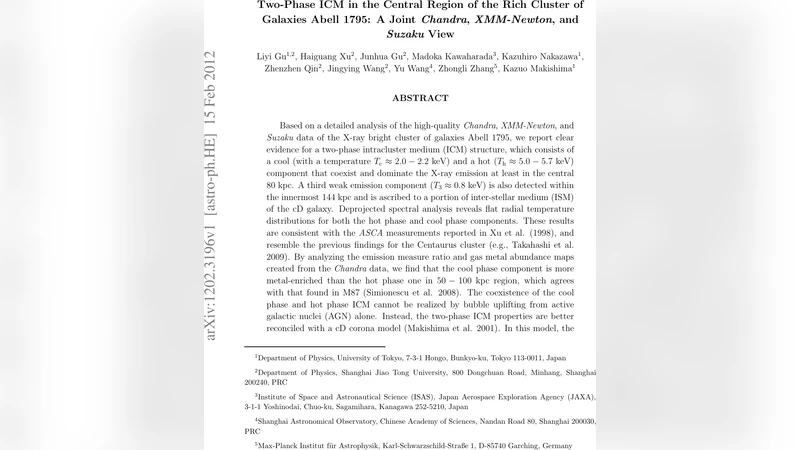
Based on a detailed analysis of the high-quality Chandra, XMM-Newton, and Suzaku data of the X-ray bright cluster of galaxies Abell 1795, we report clear evidence for a two-phase intracluster medium (ICM) structure, which consists of a cool (with a temperature T = 2.0-2.2 keV) and a hot (T = 5.0-5.7 keV) component that coexist and dominate the X-ray emission at least in the central 80 kpc. A third weak emission component (T = 0.8 keV) is also detected within the innermost 144 kpc and is ascribed to a portion of inter-stellar medium (ISM) of the cD galaxy. Deprojected spectral analysis reveals flat radial temperature distributions for both the hot phase and cool phase components. These results are consistent with the ASCA measurements reported in Xu et al. (1998), and resemble the previous findings for the Centaurus cluster (e.g., Takahashi et al. 2009). By analyzing the emission measure ratio and gas metal abundance maps created from the Chandra data, we find that the cool phase component is more metal-enriched than the hot phase one in 50-100 kpc region, which agrees with that found in M87 (Simionescu et al. 2008). The coexistence of the cool phase and hot phase ICM cannot be realized by bubble uplifting from active galactic nuclei (AGN) alone. Instead, the two-phase ICM properties are better reconciled with a cD corona model (Makishima et al. 2001). (Abridged)
💡 Research Summary
This paper presents a comprehensive multi‑instrument X‑ray study of the rich galaxy cluster Abell 1795, focusing on the physical state of the intracluster medium (ICM) within the central ~80 kpc. By jointly analyzing deep Chandra ACIS‑I, XMM‑Newton EPIC‑MOS/pn, and Suzaku XIS observations, the authors achieve unprecedented spectral quality and spatial coverage, allowing them to disentangle multiple thermal components that coexist in the cluster core.
Data reduction follows the latest calibration standards for each observatory, with careful flare filtering, point‑source excision, and background modeling. Spectra are extracted in concentric annuli (5 kpc width) out to 144 kpc and deprojected using the XSPEC “projct” model under the assumption of spherical symmetry. The spectral fitting strategy proceeds from a single‑temperature (1T) model to a two‑temperature (2T) model, and finally to a three‑component model when required. The 2T model, comprising a cool phase at T ≈ 2.0–2.2 keV and a hot phase at T ≈ 5.0–5.7 keV, yields a statistically significant improvement (Δχ² and F‑test) over the 1T description across all radii. In the innermost 144 kpc a faint third component with T ≈ 0.8 keV is also detected; its low temperature and spatial confinement suggest an origin in the inter‑stellar medium (ISM) of the central cD galaxy rather than the diffuse ICM.
Deprojected temperature profiles reveal that both the cool and hot phases are remarkably flat with radius, contradicting the classic cooling‑flow picture that predicts a steep temperature decline toward the centre. Emission‑measure (EM) maps show that the cool phase dominates the X‑ray output in the 50–100 kpc shell, while the hot phase provides the bulk of the emission at larger radii. Metallicity maps derived from the Chandra data indicate that the cool phase is significantly more enriched (Z ≈ 0.8 Z⊙) than the hot phase (Z ≈ 0.4 Z⊙) in the same radial range. This metal segregation mirrors findings in other well‑studied systems such as M87 and the Centaurus cluster, reinforcing the notion that metal‑rich gas can remain confined within a distinct thermal component.
The authors examine whether AGN‑driven buoyant bubbles could lift cool, metal‑rich gas into the hot atmosphere and thereby produce the observed two‑phase structure. Energetic calculations and comparisons with hydrodynamic simulations suggest that bubble uplift alone cannot maintain the observed temperature flatness and metal contrast over the required spatial scales. Instead, the data are more naturally explained by the “cD corona” model originally proposed by Makishima et al. (2001). In this framework, the central cD galaxy is surrounded by a dense, low‑temperature corona that is in quasi‑hydrostatic equilibrium with the surrounding hot ICM. The corona continuously receives metal‑rich stellar ejecta, while thermal conduction and turbulent mixing at the corona–ICM interface are suppressed, preserving both the temperature dichotomy and the metal enrichment of the cool phase.
The paper also revisits earlier ASCA results (Xu et al. 1998), confirming that the two‑phase temperatures and relative emission measures are consistent with those lower‑resolution measurements, thereby validating the robustness of the multi‑instrument approach. By drawing parallels with the Centaurus cluster (Takahashi et al. 2009) and M87 (Simionescu et al. 2008), the authors place Abell 1795 within a growing class of clusters where a cD corona appears to dominate the core thermodynamics.
In summary, the study provides compelling evidence that the central ICM of Abell 1795 is not a single, smoothly varying plasma but a superposition of at least two distinct thermal components—a cool, metal‑rich phase and a hotter, more tenuous phase—plus a weak ISM contribution from the cD galaxy. The flat temperature profiles, metal segregation, and inability of pure AGN bubble uplift to reproduce these features collectively favour the cD corona scenario. These findings have important implications for our understanding of cooling‑flow suppression, metal transport, and the interplay between central galaxies and their surrounding hot atmospheres in massive galaxy clusters.