Correlated dynamics in egocentric communication networks
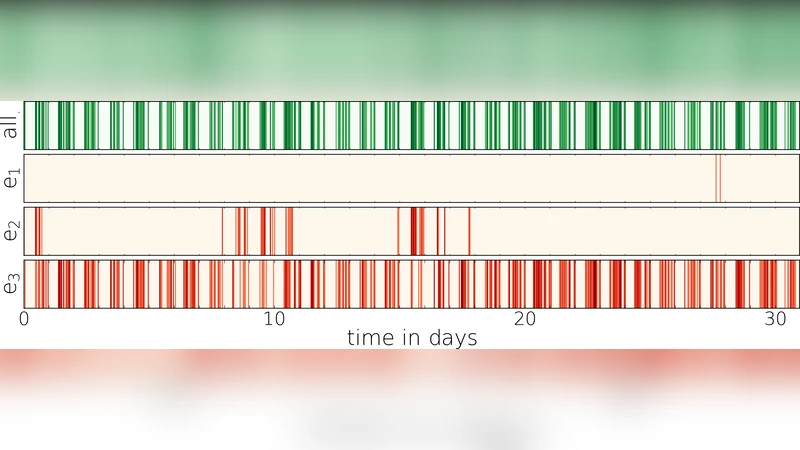
We investigate the communication sequences of millions of people through two different channels and analyze the fine grained temporal structure of correlated event trains induced by single individuals. By focusing on correlations between the heterogeneous dynamics and the topology of egocentric networks we find that the bursty trains usually evolve for pairs of individuals rather than for the ego and his/her several neighbors thus burstiness is a property of the links rather than of the nodes. We compare the directional balance of calls and short messages within bursty trains to the average on the actual link and show that for the trains of voice calls the imbalance is significantly enhanced, while for short messages the balance within the trains increases. These effects can be partly traced back to the technological constrains (for short messages) and partly to the human behavioral features (voice calls). We define a model that is able to reproduce the empirical results and may help us to understand better the mechanisms driving technology mediated human communication dynamics.
💡 Research Summary
The paper investigates the fine‑grained temporal organization of human communication by analysing massive call‑detail records (CDRs) and short‑message (SMS) logs from a mobile operator. The authors focus on egocentric networks—each individual (the ego) and all of his or her direct contacts (alters)—and examine how events (calls or messages) cluster in time. By defining a “burst train” as a sequence of consecutive events separated by less than a chosen inter‑event threshold Δt (tested at multiple scales, e.g., 1 min, 5 min, 30 min), they quantify two key properties: (1) link concentration, i.e., the fraction of events in a burst that involve the same alter, and (2) directional balance, i.e., the proportion of events initiated by the ego versus the alter within a burst.
Empirical analysis of millions of users reveals that bursts are overwhelmingly link‑centric. For voice calls, more than 70 % of bursts consist of interactions with a single alter, while for SMS the figure is still above 55 %. This contradicts earlier “node‑centric” burst models that assumed many contacts to be involved simultaneously. The study further uncovers a striking contrast in directional balance between the two media. In call bursts, the balance is skewed toward the initiator (average balance ≈ 0.35), and the skew intensifies for longer bursts, indicating that one party often makes a series of consecutive calls. Conversely, SMS bursts display a more balanced or even slightly reverse pattern (average balance ≈ 0.55), suggesting that short messages tend to be exchanged back‑and‑forth. The authors attribute these differences to a combination of technological constraints (SMS length limits and cost encourage rapid turn‑taking) and human behavioural factors (calls are often used for urgent or emotionally charged situations, prompting one‑sided sequences).
To explain the observations, the authors propose a stochastic model that couples two probabilistic mechanisms: (i) a link‑activation probability p_link, governing the likelihood that the same ego‑alter pair will be selected for the next event, and (ii) a direction‑transition probability p_dir, determining whether the current initiator will remain the initiator in the subsequent event. By calibrating p_link≈0.8 and p_dir≈0.7 for calls, and p_link≈0.6 and p_dir≈0.4 for SMS, the model reproduces the empirical burst‑size distributions, link concentration, and directional‑balance trends across all Δt values. Sensitivity analyses show that adjusting p_link captures the effect of technological constraints (e.g., the need to switch contacts in calls), while varying p_dir captures behavioural tendencies (e.g., persistence of the initiator in voice conversations).
The discussion highlights the broader implications of a link‑centric view of burstiness. It suggests that many existing network‑dynamics models, which treat nodes as the primary source of temporal clustering, may overlook crucial dyadic processes. Moreover, the media‑specific balance patterns indicate that communication platforms shape, and are shaped by, distinct social routines. The model’s simplicity and extensibility make it a useful tool for exploring other digital media (instant messaging, social‑media comments, etc.) by simply re‑tuning p_link and p_dir to reflect platform‑specific affordances.
In conclusion, the study provides robust evidence that bursty communication is a property of individual links rather than of the ego’s whole neighbourhood, and that voice calls and short messages exhibit opposite directional‑balance dynamics within bursts. The proposed probabilistic framework captures these phenomena and offers a foundation for future work on technology‑mediated human interaction, network‑aware service design, and the integration of temporal burstiness into broader models of social network evolution.
Comments & Academic Discussion
Loading comments...
Leave a Comment