Linear stability analysis of transverse dunes
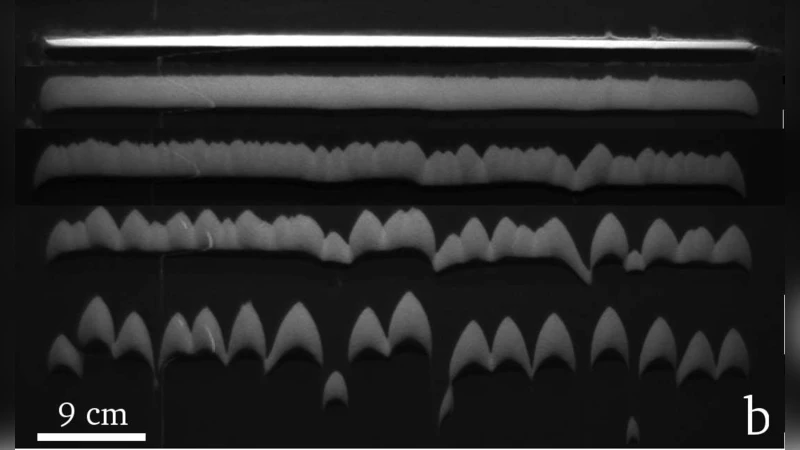
Sand-moving winds blowing from a constant direction in an area of high sand availability form transverse dunes, which have a fixed profile in the direction orthogonal to the wind. Here we show, by means of a linear stability analysis, that transverse dunes are intrinsically unstable. Any along-axis perturbation on a transverse dune amplify in the course of dune migration due to the combined effect of two main factors, namely: the lateral transport through avalanches along the dune’s slip-face, and the scaling of dune migration velocity with the inverse of the dune height. Our calculations provide a quantitative explanation for recent observations from experiments and numerical simulations, which showed that transverse dunes moving on the bedrock cannot exist in a stable form and decay into a chain of crescent-shaped barchans.
💡 Research Summary
The paper investigates the intrinsic stability of transverse dunes—elongated sand ridges that form when unidirectional winds blow over an abundant sand supply. While such dunes appear stationary in the direction perpendicular to the wind, the authors demonstrate that they are fundamentally unstable when subjected to perturbations along their crest. Using a linear stability analysis, the study derives a quantitative description of how small sinusoidal disturbances grow as the dune migrates.
The analysis begins by defining a base state: a perfectly uniform transverse dune of constant height (h_0) moving at a constant speed (v_0) under a steady wind. A perturbation of infinitesimal amplitude (\varepsilon) is introduced as a height variation (h(x,t)=h_0+\varepsilon\eta(x,t)) along the crest coordinate (x). Two physical mechanisms are identified as the drivers of instability.
-
Lateral transport on the slip‑face – The lee side of a dune (the slip‑face) maintains a near‑critical angle of repose. When a crest perturbation creates a local height difference, sand avalanches laterally from higher to lower sections. This lateral flux can be expressed as a term proportional to the gradient (\partial\eta/\partial x) in the mass‑conservation equation, representing a “side‑shear” that amplifies the perturbation.
-
Height‑dependent migration velocity – Empirical observations and wind‑tunnel experiments show that dune migration speed scales inversely with dune height, (v\propto 1/h). Consequently, the lower portions of a perturbed crest advance faster than the higher portions, stretching the wave and further increasing its amplitude.
Linearising the coupled continuity and transport equations yields a dispersion relation for the growth rate (\sigma(k)) of a mode with wavenumber (k):
\
Comments & Academic Discussion
Loading comments...
Leave a Comment