A Variable Partial Covering Model for the Seyfert 1 Galaxy MCG-6-30-15
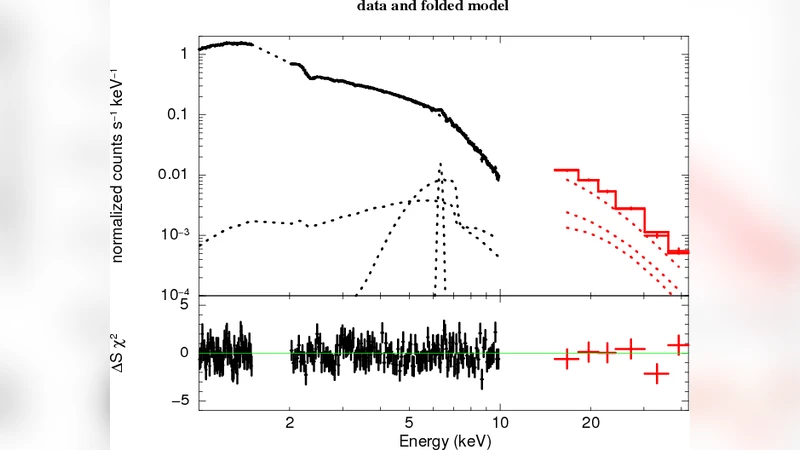
We propose a simple spectral model for the Seyfert 1 Galaxy MCG-6-30-15 that can explain most of the 1 - 40 keV spectral variation by change of the partial covering fraction, similar to the one proposed by Miller et al. (2008). Our spectral model is composed of three continuum components; (1) a direct power-law component, (2) a heavily absorbed power-law component by mildly ionized intervening matter, and (3) a cold disk reflection component far from the black hole with moderate solid-angle ({\Omega}/2{\pi} \approx 0.3) accompanying a narrow fluorescent iron line. The first two components are affected by the surrounding highly ionized thin absorber with N_H \approx 10^{23.4}cm-2 and log {\xi} \approx 3.4. The heavy absorber in the second component is fragmented into many clouds, each of which is composed of radial zones with different ionization states and column densities, the main body (N_H \approx 10^24.2cm-2, log {\xi} \approx 1.6), the envelope (N_H \approx 10^22.1cm-2, log {\xi} \approx 1.9) and presumably a completely opaque core. These parameters of the ionized absorbers, as well as the intrinsic spectral shape of the X-ray source, are unchanged at all. The central X-ray source is moderately extended, and its luminosity is not significantly variable. The observed flux and spectral variations are mostly explained by variation of the geometrical partial covering fraction of the central source from 0 (uncovered) to \sim0.63 by the intervening ionized clouds in the line of sight. The ionized iron K-edge of the heavily absorbed component explains most of the seemingly broad line-like feature, a well-known spectral characteristic of MCG-6-30-15. The direct component and the absorbed component anti-correlate, cancelling their variations each other, so that the fractional spectral variation becomes the minimum at the iron energy band; another observational characteristic of MCG-6-30-15 is thus explained.
💡 Research Summary
The paper presents a parsimonious spectral model for the Seyfert 1 galaxy MCG‑6‑30‑15 that accounts for the majority of its 1–40 keV spectral variability through changes in the partial covering fraction of the central X‑ray source. The model consists of three continuum components: (1) an unobscured power‑law representing the direct emission, (2) a heavily absorbed power‑law that passes through a dense, mildly ionized cloud complex, and (3) a cold disk reflection component arising far from the black hole with a moderate solid angle (Ω/2π ≈ 0.3) and a narrow Fe Kα line. All three components are further modified by a highly ionized, thin absorber with column density N_H ≈ 10^23.4 cm⁻² and ionization parameter log ξ ≈ 3.4.
The heavily absorbed component is not a monolithic screen but a fragmented ensemble of clouds. Each cloud possesses radial zones of distinct ionization states and column densities: a main body (N_H ≈ 10^24.2 cm⁻², log ξ ≈ 1.6), an envelope (N_H ≈ 10^22.1 cm⁻², log ξ ≈ 1.9), and presumably an almost opaque core. Importantly, the intrinsic spectral shape of the X‑ray source and the physical parameters of all absorbers remain constant throughout the observations.
The key driver of the observed variability is the geometrical partial covering fraction (f_cov) of the central source by the ionized cloud ensemble. The authors find that f_cov varies smoothly from 0 (no covering) up to ≈ 0.63. As f_cov increases, the direct component is increasingly suppressed while the absorbed component becomes stronger; the two vary in opposite directions and largely cancel each other in the iron‑K band (6–7 keV). This anti‑correlation explains why the fractional variability spectrum shows a pronounced dip at the iron line energy, a hallmark of MCG‑6‑30‑15.
The model also reinterprets the historically “broad iron line” feature. The ionized Fe K‑edge of the heavily absorbed component reproduces the apparent broad, skewed excess without invoking relativistic blurring near the event horizon. Consequently, the need for extreme gravitational redshift or light‑bending effects is reduced, and the spectral shape can be explained by relatively distant, partially covering material.
To validate the model, the authors performed simultaneous fits to multiple epochs of XMM‑Newton, Suzaku, and NuSTAR data, keeping all physical parameters fixed and allowing only f_cov to vary. The fits achieve statistically acceptable χ² values, and residuals around the Fe K region are minimized. Time‑resolved spectroscopy shows that the RMS spectrum and flux–flux plots are reproduced by the model’s predicted anti‑correlated behavior of the two primary components.
In summary, the study demonstrates that the complex X‑ray spectral variability of MCG‑6‑30‑15 can be understood primarily as a geometric effect—variations in the line‑of‑sight covering fraction of a clumpy, ionized absorber—rather than intrinsic changes in the central engine or strong relativistic effects. This framework offers a new perspective on AGN variability, suggesting that similar partial‑covering scenarios may be applicable to other Seyfert galaxies. Future high‑resolution missions such as XRISM and Athena will be able to test the universality of this model by probing the detailed structure of the absorbing clouds and their dynamics.