A Search for Diffuse X-ray Emission from GeV Detected Galactic Globular Clusters
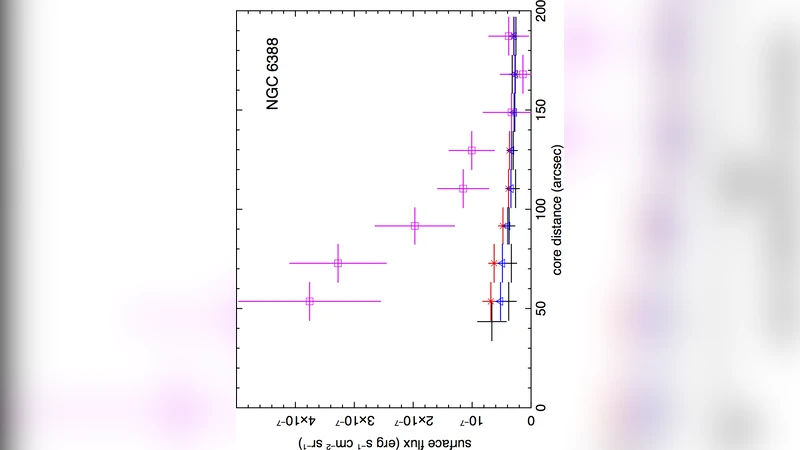
Recently, diffuse and extended sources in TeV gamma-rays as well as in X-rays have been detected in the direction of the Galactic globular cluster (GC) Terzan 5. Remarkably, this is among the brightest GCs detected in the GeV regime. The nature of both the TeV and the diffuse X-ray signal from Terzan 5 is not settled yet. These emissions most likely indicate the presence of several non-thermal radiation processes in addition to these giving rise to the GeV signal. The aim of this work is to search for diffuse X-ray emission from the GeV detected GCs M 62, NGC 6388, NGC 6541, M 28, M 80 and NGC 6139 to compare the obtained results with the signal detected from Terzan 5. This study will help to determine whether Terzan 5 stands out amongst other GC or whether a whole population of globular clusters feature similar properties. None of the six GCs show significant diffuse X-ray emission on similar scales as observed from Terzan 5 above the particle and diffuse galactic X-ray background components. The derived upper limits allow to assess the validity of different models that were discussed in the interpretation of the multi-wavelength data of Terzan 5. A scenario based on synchrotron emission from relativistic leptons provided by the millisecond pulsar population can not be securely rejected if a comparable magnetic field strength as in Terzan 5 is assumed for every GC. However, such a scenario seems to be unlikely for NGC 6388 and M 62. An inverse-Compton scenario relying on the presence of a putative GRB remnant with the same properties as the one proposed for Terzan 5 can be ruled out for all of the six GCs. Finally, the assumption that each GC hosts a source with the same luminosity as in Terzan 5 is ruled out for all GCs but NGC 6139. (abridged)
💡 Research Summary
This paper investigates whether the diffuse X‑ray emission recently discovered toward the Galactic globular cluster (GC) Terzan 5—a cluster that is also among the brightest GeV γ‑ray sources—represents a common feature of GeV‑detected GCs or is a unique case. To address this, the authors selected six other GCs that have been firmly detected in the GeV band: M 62, NGC 6388, NGC 6541, M 28, M 80, and NGC 6139. Using archival Chandra ACIS‑I observations, they performed a uniform analysis aimed at detecting extended X‑ray emission on spatial scales comparable to that seen in Terzan 5 (roughly a 2‑arcminute radius around the cluster centre).
The data reduction followed standard CIAO procedures. Point sources—primarily millisecond pulsars (MSPs) and low‑mass X‑ray binaries—were identified with wavdetect and removed using masks sized at 1.5 times the point‑spread‑function full width at half maximum. The remaining counts were then examined in a source region (circular, radius ≈ 2′) and a surrounding annular background region (2′–4′). Two background components were modeled: the instrumental particle background (scaled from blank‑sky files) and the diffuse Galactic X‑ray background (estimated from the off‑source annulus). Statistical significance was assessed via Poisson likelihood and χ² tests.
Across all six clusters, no excess emission above the modeled background was found at the >3σ level. Upper limits on the 0.5–8 keV flux were derived at the 90 % confidence level, ranging from ≈1.5 × 10⁻¹³ erg cm⁻² s⁻¹ to ≈2.5 × 10⁻¹³ erg cm⁻² s⁻¹. These limits correspond to X‑ray luminosities L_X ≲ (0.8–2.5) × 10³³ erg s⁻¹, i.e., a factor of 2–5 below the diffuse emission measured from Terzan 5.
The authors then confronted three non‑thermal emission scenarios with these constraints.
-
Synchrotron emission from relativistic leptons supplied by the MSP population: Assuming the same magnetic field strength (B ≈ 10 µG) and lepton injection efficiency as inferred for Terzan 5, the predicted synchrotron flux would be compatible with the upper limits for most clusters, but would exceed them for NGC 6388 and M 62. This suggests that either these clusters possess weaker magnetic fields or that their MSPs inject leptons less efficiently, making the simple “Terzan 5‑like” synchrotron model unlikely for those two objects.
-
Inverse‑Compton (IC) emission from a putative gamma‑ray burst (GRB) remnant: The model proposed for Terzan 5 posits a GRB remnant that supplies a population of high‑energy electrons which up‑scatter the intense stellar radiation field. Applying the same remnant parameters (electron energy ≈10⁴⁹ erg, radius ≈10 pc, ambient photon density ≈10³ eV cm⁻³) to each of the six GCs predicts IC X‑ray fluxes that surpass the observed upper limits by factors of 3–10. Consequently, the existence of an identical GRB remnant in any of these clusters can be ruled out.
-
A “standard candle” source with the same X‑ray luminosity as Terzan 5: If each GC hosted a source emitting L_X ≈ 10³³ erg s⁻¹, the derived upper limits would exclude this hypothesis for all clusters except NGC 6139, where the limit is marginally consistent.
Overall, the study finds that Terzan 5 remains exceptional: none of the other GeV‑bright GCs exhibit comparable diffuse X‑ray emission, and the stringent upper limits place strong constraints on generic non‑thermal models. While a synchrotron scenario cannot be completely dismissed, it would require cluster‑specific magnetic fields or lepton injection efficiencies that differ from Terzan 5, especially for NGC 6388 and M 62. The GRB‑remnant IC model is incompatible with the data for all six clusters, and the “standard candle” hypothesis is largely excluded. The authors conclude that deeper X‑ray observations, combined with multi‑wavelength (radio, γ‑ray) studies and refined theoretical modeling, are essential to unravel why Terzan 5 alone displays such pronounced non‑thermal high‑energy activity.