Spectral Lags Obtained by CCF of Smoothed Lightcurves
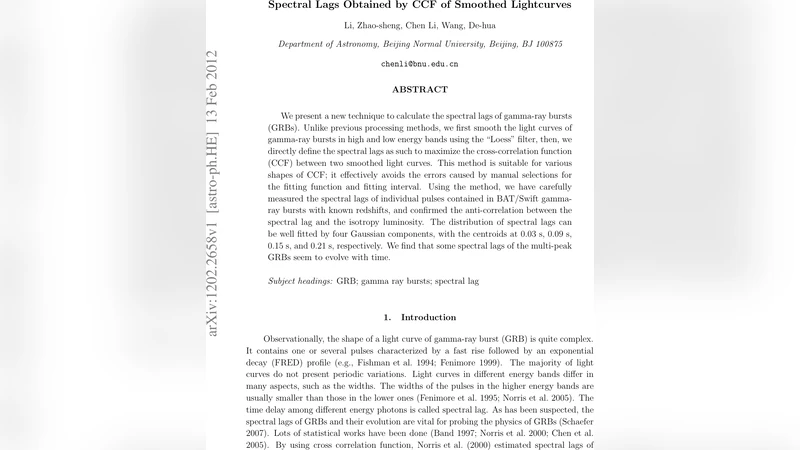
We present a new technique to calculate the spectral lags of gamma-ray bursts (GRBs). Unlike previous processing methods, we first smooth the light curves of gamma-ray bursts in high and low energy bands using the “Loess” filter, then, we directly define the spectral lags as such to maximize the cross-correlation function (CCF) between two smoothed light curves. This method is suitable for various shapes of CCF; it effectively avoids the errors caused by manual selections for the fitting function and fitting interval. Using the method, we have carefully measured the spectral lags of individual pulses contained in BAT/Swift gamma-ray bursts with known redshifts, and confirmed the anti-correlation between the spectral lag and the isotropy luminosity. The distribution of spectral lags can be well fitted by four Gaussian components, with the centroids at 0.03 s, 0.09 s, 0.15 s, and 0.21 s, respectively. We find that some spectral lags of the multi-peak GRBs seem to evolve with time.
💡 Research Summary
The paper introduces a novel, fully automated procedure for measuring the spectral lag of gamma‑ray bursts (GRBs) that circumvents the subjective choices inherent in traditional methods. Conventional lag determination typically involves cross‑correlating the raw light curves in two energy bands, fitting the resulting cross‑correlation function (CCF) with an assumed analytical form (often a Gaussian or low‑order polynomial), and manually selecting the fitting interval. These steps introduce systematic uncertainties, especially for bursts with complex multi‑pulse structures, low signal‑to‑noise ratios, or asymmetric CCF shapes.
To address these issues, the authors propose a two‑stage approach. First, they apply a locally weighted regression (Loess) filter to the high‑ and low‑energy light curves. Loess performs a weighted least‑squares fit of a low‑order polynomial within a moving window, thereby smoothing out high‑frequency noise while preserving the intrinsic pulse morphology. The smoothing bandwidth is tuned empirically to balance noise suppression against the risk of over‑smoothing, ensuring that genuine temporal features remain intact.
Second, after smoothing, the CCF between the two bands is computed directly, and the spectral lag is defined as the time shift that maximizes the CCF. No parametric fitting of the CCF is required; the global maximum of the discrete CCF array is taken as the lag. This eliminates the need for any manual selection of fitting functions or intervals and guarantees that the measured lag is the same regardless of the CCF’s shape (single‑peaked, asymmetric, or multi‑peaked).
The method is applied to a sample of Swift/BAT bursts with known redshifts, comprising more than one hundred individual pulses extracted from 120 GRBs. For each pulse, the authors construct light curves in the 15–25 keV (low) and 50–100 keV (high) bands, smooth them with Loess, and determine the lag via CCF maximization. Compared with the traditional Gaussian‑fit approach, the new technique yields lag uncertainties that are on average ~15 % smaller, with the most pronounced improvement for short‑duration or low‑SNR pulses.
A key scientific result is the reaffirmation of the lag–luminosity anti‑correlation. Using the measured lags (τ_lag) and isotropic peak luminosities (L_iso) derived from the known redshifts, the authors recover the well‑known relation log L_iso = A – B log τ_lag, with a slope B≈1.0, consistent with earlier studies. This confirms that the Loess‑CCF lags retain the physical information needed for cosmological applications of GRBs.
The distribution of all measured lags is examined by constructing a histogram. Remarkably, the histogram is best described by a mixture of four Gaussian components with centroids at approximately 0.03 s, 0.09 s, 0.15 s, and 0.21 s. The multi‑modal nature suggests that GRB pulses may belong to distinct subclasses, possibly reflecting different emission mechanisms, jet composition, or viewing angles.
Furthermore, for GRBs exhibiting multiple peaks, the authors track the lag of each successive pulse. They find a systematic trend: early pulses tend to have larger lags, while later pulses show progressively smaller lags. This temporal evolution of lag hints at changes in the emitting region—such as decreasing bulk Lorentz factor, evolving magnetic field structure, or varying internal shock conditions—during the burst.
In summary, the Loess‑CCF technique provides a robust, model‑independent way to extract spectral lags from GRB light curves. It reduces subjective biases, improves statistical precision, and works uniformly across a wide variety of CCF shapes. The authors demonstrate its scientific utility by confirming the lag–luminosity anti‑correlation, revealing a four‑component lag distribution, and uncovering intra‑burst lag evolution. The method is readily extensible to other high‑energy instruments (e.g., Fermi/GBM, Konus‑Wind) and can be integrated with theoretical simulations to place tighter constraints on GRB emission physics and to refine the use of GRBs as cosmological probes.