Probing the X-Ray Binary Populations of the Ring Galaxy NGC 1291
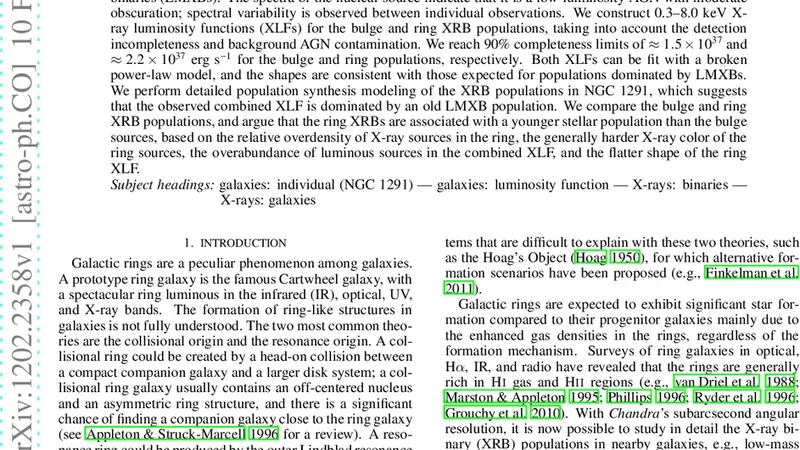
We present Chandra studies of the X-ray binary (XRB) populations in the bulge and ring regions of the ring galaxy NGC 1291. We detect 169 X-ray point sources in the galaxy, 75 in the bulge and 71 in the ring, utilizing the four available Chandra observations totaling an effective exposure of 179 ks. We report photometric properties of these sources in a point-source catalog. There are ~40% of the bulge sources and ~25% of the ring sources showing >3\sigma long-term variability in their X-ray count rate. The X-ray colors suggest that a significant fraction of the bulge (~75%) and ring (~65%) sources are likely low-mass X-ray binaries (LMXBs). The spectra of the nuclear source indicate that it is a low-luminosity AGN with moderate obscuration; spectral variability is observed between individual observations. We construct 0.3-8.0 keV X-ray luminosity functions (XLFs) for the bulge and ring XRB populations, taking into account the detection incompleteness and background AGN contamination. We reach 90% completeness limits of ~1.5\times10^{37} and ~2.2\times10^{37} erg/s for the bulge and ring populations, respectively. Both XLFs can be fit with a broken power-law model, and the shapes are consistent with those expected for populations dominated by LMXBs. We perform detailed population synthesis modeling of the XRB populations in NGC 1291, which suggests that the observed combined XLF is dominated by an old LMXB population. We compare the bulge and ring XRB populations, and argue that the ring XRBs are associated with a younger stellar population than the bulge sources, based on the relative overdensity of X-ray sources in the ring, the generally harder X-ray color of the ring sources, the overabundance of luminous sources in the combined XLF, and the flatter shape of the ring XLF.
💡 Research Summary
This paper presents a comprehensive Chandra X‑ray study of the X‑ray binary (XRB) populations in the bulge and the prominent outer ring of the nearby ring galaxy NGC 1291. Using four archival ACIS‑I observations that sum to an effective exposure of 179 ks, the authors detect 169 point sources in the 0.3–8.0 keV band. Of these, 75 are located in the central bulge and 71 in the ring, while the remainder are either background objects or lie outside the defined regions.
Long‑term variability is assessed by comparing count rates across the individual observations. Approximately 40 % of the bulge sources and 25 % of the ring sources vary at the >3σ level, indicating that a substantial fraction of the XRBs experience changes in accretion rate or absorbing column on timescales of months to years.
X‑ray color analysis (hardness ratios) shows that the majority of sources in both components occupy the region of the color‑color diagram typical of low‑mass X‑ray binaries (LMXBs): about 75 % of bulge sources and 65 % of ring sources. Nevertheless, the ring population displays a modest excess of harder sources, hinting at a contribution from younger, possibly high‑mass X‑ray binaries (HMXBs) or from LMXBs formed more recently.
The nuclear source is identified as a low‑luminosity active galactic nucleus (LLAGN). Spectral fitting reveals moderate intrinsic absorption (N_H ≈ 10^22 cm⁻²) and a power‑law photon index that varies between observations, suggesting changes in either the obscuring material or the accretion flow.
To characterize the underlying XRB populations, the authors construct X‑ray luminosity functions (XLFs) for the bulge and ring separately. They apply rigorous completeness corrections derived from extensive simulations and subtract the expected contribution of background AGN based on deep field number counts. The 90 % completeness limits are 1.5 × 10^37 erg s⁻¹ for the bulge and 2.2 × 10^37 erg s⁻¹ for the ring. Both XLFs are well described by broken power‑law models. The bulge XLF shows a steep high‑luminosity slope and a clear break near 5 × 10^38 erg s⁻¹, consistent with an old LMXB population. In contrast, the ring XLF is flatter, with a less pronounced break and an overabundance of sources above 10^38 erg s⁻¹, indicating a younger or more mixed population.
Population synthesis modeling is employed to interpret the observed XLFs in the context of the galaxy’s star‑formation history, metallicity, and binary evolution physics. The best‑fit models for the combined XLF are dominated by an ancient (≈10 Gyr) LMXB component, reproducing the overall shape and normalization. However, when the ring is modeled separately, adding a modest recent star‑formation episode (≤1 Gyr ago) improves the fit, accounting for the flatter slope and excess of luminous sources.
The authors conclude that NGC 1291’s bulge hosts a classic, old LMXB population similar to those found in elliptical and early‑type spirals, while the ring contains a younger sub‑population that likely originated from a more recent burst of star formation associated with the ring’s dynamical formation. The differences in source density, X‑ray colors, and XLF shapes between the two regions provide compelling evidence that the ring’s XRBs trace a distinct stellar component. This work demonstrates how high‑resolution X‑ray imaging combined with population synthesis can disentangle the complex evolutionary histories of composite galaxies.