Elemental Abundances in the Possible Type Ia Supernova Remnant G344.7-0.1
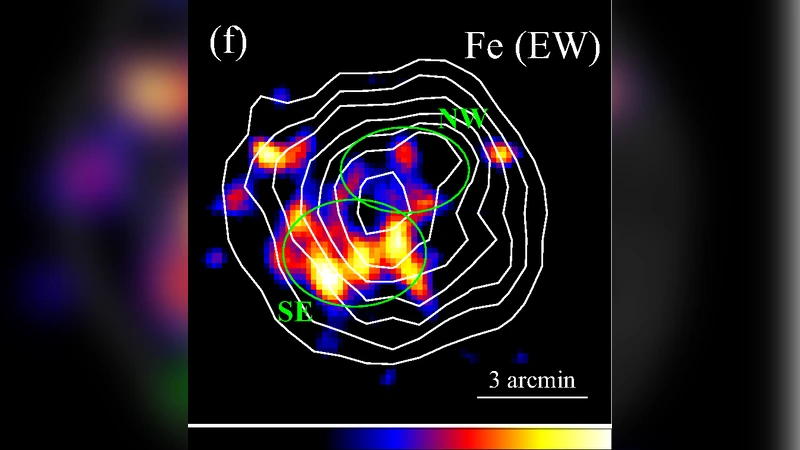
Recent studies on the Galactic supernova remnant (SNR) G344.7-0.1 have commonly claimed its origin to be a core-collapse supernova (SN) explosion, based on its highly asymmetric morphology and/or proximity to a star forming region. In this paper, however, we present an X-ray spectroscopic study of this SNR using Suzaku, which is supportive of a Type Ia origin. Strong K-shell emission from lowly ionized Fe has clearly been detected, and its origin is determined, for the first time, to be the Fe-rich SN ejecta. The abundance pattern is highly consistent with that expected for a somewhat-evolved Type Ia SNR. It is suggested, therefore, that the X-ray point-like source CXOU J170357.8-414302 located at the SNR’s geometrical center is not associated with the SNR but is likely to be a foreground object. Our result further indicates that G344.7-0.1 is the first possible Type Ia SNR categorized as a member of the so-called “mixed-morphology” class. In addition, we have detected emission from He-like Al at ~1.6 keV, the first clear detection of this element in the spectrum of an extended X-ray source. The possible enhancement of the Al/Mg abundance ratio from the solar value suggests that the ambient interstellar medium has a relatively high metallicity (not less than 10% of the solar value), if this SNR has indeed a Type Ia origin. We also report marginal detection of Cr and Mn, although the measured fluxes have large statistical and systematic uncertainties.
💡 Research Summary
In this work the authors revisit the nature of the Galactic supernova remnant (SNR) G344.7‑0.1 using deep Suzaku X‑ray observations. Earlier studies classified the remnant as a core‑collapse (CC) supernova product because of its markedly asymmetric morphology and its proximity to a star‑forming region. The Suzaku X‑ray Imaging Spectrometer (XIS) data, however, reveal a very different picture. A strong Fe Kα line at ≈6.42 keV is detected with a narrow width, indicating low‑ionisation iron that is not consistent with shocked interstellar material but rather with Fe‑rich ejecta. Spectral fitting with a non‑equilibrium ionisation (VNEI) plasma model shows that the abundances of Mg, Si, S, Ar, Ca, and especially Fe follow the pattern expected from a moderately evolved Type Ia SNR. The Fe/Si ratio is markedly higher than in typical CC remnants, while the intermediate‑mass element ratios (Mg/Si, S/Si, etc.) match those predicted by standard Type Ia nucleosynthesis models such as W7 or delayed‑detonation (DD‑T).
A novel detection is the He‑like Al line at ∼1.6 keV, the first clear identification of aluminium in an extended X‑ray source. The measured Al/Mg abundance ratio exceeds the solar value by roughly 50 %, implying that the ambient interstellar medium (ISM) into which the remnant expands has a metallicity of at least 10 % of solar. This finding challenges the common assumption that Type Ia SNRs evolve in low‑metallicity environments. Marginal evidence for Cr and Mn lines is also reported; although the statistical and systematic uncertainties are large, their presence would be consistent with the nucleosynthetic yields of a Type Ia explosion.
Morphologically the remnant displays a radio shell but a centrally peaked X‑ray surface brightness, placing it in the “mixed‑morphology” (MM) class. Historically, MM SNRs have been associated almost exclusively with CC explosions. The present analysis therefore establishes G344.7‑0.1 as the first plausible Type Ia member of the MM class, expanding the phenomenology of this group.
The point‑like X‑ray source CXOU J170357.8‑414302, located near the geometric centre of the remnant, was previously suggested as a possible compact object left behind by the supernova. Spectral analysis shows a power‑law spectrum with a column density lower than that of the surrounding SNR, indicating that the source is likely a foreground object (e.g., a background AGN or a Galactic star) and not physically associated with the explosion.
In summary, the Suzaku spectroscopic study provides compelling evidence that G344.7‑0.1 originated from a Type Ia supernova. The detection of low‑ionisation Fe ejecta, the Type Ia‑consistent abundance pattern, the unprecedented Al line, and the re‑interpretation of the central point source together overturn the earlier CC classification. The work also highlights that Type Ia supernovae can produce mixed‑morphology remnants, and it underscores the importance of high‑resolution X‑ray spectroscopy for disentangling the origins of Galactic SNRs. Future observations with forthcoming missions such as XRISM and Athena will be essential to refine the Cr and Mn measurements, to map the spatial distribution of the ejecta, and to better constrain the metallicity of the surrounding ISM.