Discovery of the millisecond pulsar PSR J2043+1711 in a Fermi source with the Nancay Radio Telescope
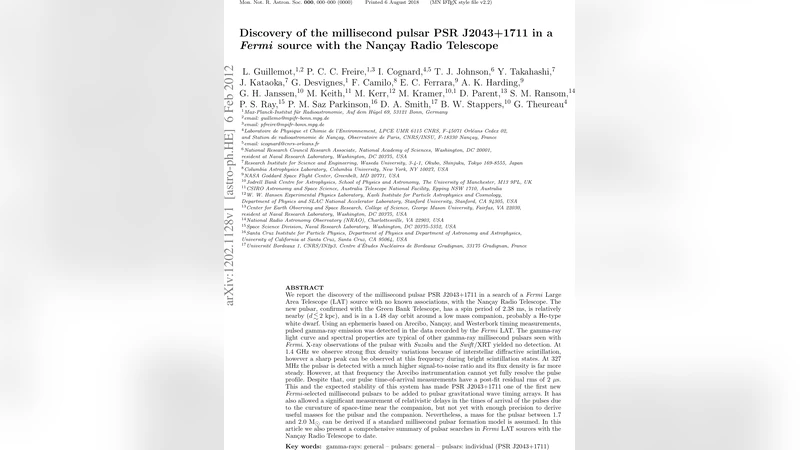
We report the discovery of the millisecond pulsar PSR J2043+1711 in a search of a Fermi Large Area Telescope (LAT) source with no known associations, with the Nancay Radio Telescope. The new pulsar, confirmed with the Green Bank Telescope, has a spin period of 2.38 ms, is relatively nearby (d <~ 2 kpc), and is in a 1.48 day orbit around a low mass companion, probably a He-type white dwarf. Pulsed gamma-ray emission was detected in the data recorded by the Fermi LAT. The gamma-ray light curve and spectral properties are typical of other gamma-ray millisecond pulsars seen with Fermi. X-ray observations of the pulsar with Suzaku and the Swift/XRT yielded no detection. At 1.4 GHz we observe strong flux density variations because of interstellar diffractive scintillation, however a sharp peak can be observed at this frequency during bright scintillation states. At 327 MHz the pulsar is detected with a much higher signal-to-noise ratio and its flux density is far more steady. However, at that frequency the Arecibo instrumentation cannot yet fully resolve the pulse profile. Despite that, our pulse time-of-arrival measurements have a post-fit residual rms of 2 \mus. This and the expected stability of this system has made PSR J2043+1711 one of the first new Fermi-selected millisecond pulsars to be added to pulsar gravitational wave timing arrays. It has also allowed a significant measurement of relativistic delays in the times of arrival of the pulses due to the curvature of space-time near the companion, but not yet with enough precision to derive useful masses for the pulsar and the companion. A mass for the pulsar between 1.7 and 2.0 solar masses can be derived if a standard millisecond pulsar formation model is assumed. In this article we also present a comprehensive summary of pulsar searches in Fermi LAT sources with the Nancay Radio Telescope to date.
💡 Research Summary
The paper reports the discovery of the millisecond pulsar PSR J2043+1711 through a targeted radio search of an unassociated Fermi Large Area Telescope (LAT) source using the Nançay Radio Telescope, with confirmation from the Green Bank Telescope (GBT). The pulsar spins every 2.38 ms, lies at a distance of roughly 2 kpc, and resides in a 1.48‑day nearly circular binary orbit with a low‑mass companion, most likely a helium white dwarf of minimum mass ~0.2 M☉.
Initial observations at 1.4 GHz with Nançay revealed strong diffractive scintillation, causing large flux density variations; however, during bright scintillation episodes a clear pulsar signal was detected, allowing a preliminary period and dispersion measure (DM ≈ 20 pc cm⁻³) to be established. Follow‑up observations at 327 MHz, where scintillation effects are weaker, yielded a much higher signal‑to‑noise ratio and a steadier flux, despite the Arecibo instrumentation not yet fully resolving the pulse shape at that frequency.
Combining data from Nançay, GBT, and Arecibo, the authors constructed a high‑precision timing solution with post‑fit residuals of only 2 µs. This level of precision makes PSR J2043+1711 an excellent addition to pulsar timing arrays (PTAs) used for low‑frequency gravitational‑wave detection. The timing analysis also uncovered measurable Shapiro delay signatures, indicating relativistic propagation effects due to the companion’s gravitational field. Although the current data are insufficient to determine precise masses, assuming a standard millisecond‑pulsar recycling scenario yields a pulsar mass in the range 1.7–2.0 M☉.
Gamma‑ray analysis of eight years of LAT data revealed pulsed emission aligned with the radio ephemeris. The gamma‑ray light curve displays two sharp peaks separated by ~0.4 in phase, and the spectrum is well described by a power‑law with an exponential cutoff (photon index ≈ 1.5, cutoff energy ≈ 3 GeV), typical of LAT‑detected millisecond pulsars. The inferred gamma‑ray luminosity is ∼10³³ erg s⁻¹. X‑ray observations with Suzaku and Swift/XRT failed to detect the source, placing an upper limit on the X‑ray luminosity of ≲10³¹ erg s⁻¹, indicating that the pulsar is faint in X‑rays despite being bright in radio and gamma‑rays.
The paper also provides a comprehensive overview of the Nançay radio searches of Fermi LAT sources to date. Over 50 LAT unassociated sources have been examined, leading to the discovery of roughly ten new millisecond pulsars, confirming the efficacy of gamma‑ray‑selected radio surveys. The authors emphasize that PSR J2043+1711, with its stable timing, modest distance, and binary configuration, will contribute significantly to PTA efforts and to tests of relativistic gravity once longer timing baselines improve the measurement of Shapiro delay and allow precise mass determinations.
Comments & Academic Discussion
Loading comments...
Leave a Comment