Recommender Systems
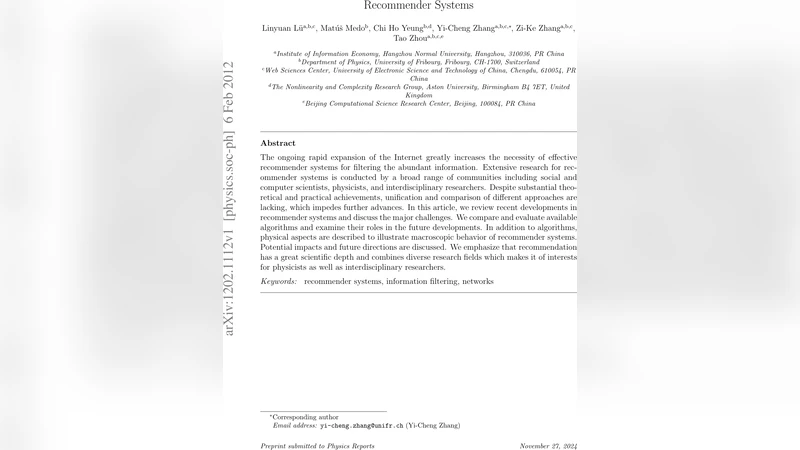
The ongoing rapid expansion of the Internet greatly increases the necessity of effective recommender systems for filtering the abundant information. Extensive research for recommender systems is conducted by a broad range of communities including social and computer scientists, physicists, and interdisciplinary researchers. Despite substantial theoretical and practical achievements, unification and comparison of different approaches are lacking, which impedes further advances. In this article, we review recent developments in recommender systems and discuss the major challenges. We compare and evaluate available algorithms and examine their roles in the future developments. In addition to algorithms, physical aspects are described to illustrate macroscopic behavior of recommender systems. Potential impacts and future directions are discussed. We emphasize that recommendation has a great scientific depth and combines diverse research fields which makes it of interests for physicists as well as interdisciplinary researchers.
💡 Research Summary
The paper provides a comprehensive review of modern recommender systems, positioning them as essential tools for mitigating the information overload generated by the rapid expansion of the Internet. It begins by highlighting the interdisciplinary nature of recommender research, which draws contributions from computer science, physics, social sciences, and other fields. Despite significant theoretical and practical progress, the authors argue that a unified framework for comparing and integrating the myriad approaches remains lacking, hindering further advancement.
The core of the review is organized around two complementary perspectives: algorithmic taxonomy and physical modeling. From the algorithmic side, the authors systematically categorize the most influential families of techniques. Traditional collaborative filtering (CF) is split into memory‑based methods, which rely on similarity measures such as cosine or Pearson correlation, and model‑based methods, primarily matrix factorization (MF). MF variants—including singular value decomposition (SVD), non‑negative matrix factorization (NMF), alternating least squares (ALS), Bayesian MF, and SVD++—are discussed in detail, with emphasis on how they address data sparsity and the cold‑start problem by learning latent user and item factors.
Content‑based filtering (CBF) is presented as an orthogonal approach that exploits item metadata (text, images, tags) to construct feature vectors and match them against user profiles. While CBF excels at recommending newly introduced items, it suffers from limited ability to capture evolving user tastes and can reinforce “filter bubbles.”
Hybrid methods that combine CF and CBF are examined next. The paper outlines several fusion strategies—weighted averaging, switching, and meta‑level integration—and highlights recent deep‑learning hybrids that jointly train recurrent neural networks (RNN/LSTM) on user interaction sequences and convolutional or transformer networks on item content. These models capture both temporal dynamics and high‑dimensional semantic information, improving accuracy, diversity, and serendipity.
Graph‑based recommender systems constitute the third major pillar. By representing users, items, and auxiliary attributes as nodes in a bipartite or heterogeneous graph, techniques such as Random Walk with Restart, Graph Convolutional Networks (GCN), and Graph Attention Networks (GAT) can propagate information across multi‑hop neighborhoods. This structure naturally alleviates sparsity and cold‑start issues and scales well to large‑scale networks.
Evaluation methodology receives thorough treatment. Beyond classic accuracy metrics (Precision, Recall, MAP, NDCG), the authors stress the importance of diversity, serendipity, fairness, and privacy. Experiments are reported on benchmark datasets (MovieLens, Netflix, Amazon reviews) as well as domain‑specific corpora, providing quantitative comparisons that reveal trade‑offs among the various algorithm families.
A distinctive contribution of the article is the introduction of a physics‑inspired macroscopic model of recommender systems. By mapping the user‑item interaction network onto a spin system, the authors interpret a “temperature” parameter as the exploration depth of the recommendation process. Simulations demonstrate that higher temperature increases recommendation diversity at the cost of reduced accuracy, mirroring a phase‑transition‑like behavior. This analogy offers a novel lens for studying system stability, critical points, and emergent phenomena in large‑scale recommendation environments.
Finally, the paper outlines five key research directions for the future. (1) Explainable recommendation: developing transparent models that allow users to understand why items are suggested. (2) Real‑time, online learning: algorithms capable of continuous adaptation to streaming data. (3) Multi‑modal and reinforcement‑learning approaches: integrating visual, textual, and contextual signals with decision‑making frameworks. (4) Privacy‑preserving techniques: federated learning and differential privacy to protect user data while maintaining performance. (5) Societal and ethical considerations: embedding fairness, bias mitigation, and ethical guidelines into the core design of recommender systems.
In sum, the article argues that recommender systems possess deep scientific richness and span multiple disciplines. By unifying algorithmic advances with physical insights and by addressing pressing challenges such as explainability, scalability, and ethics, the field is poised to continue its rapid evolution and to impact a broad spectrum of applications ranging from e‑commerce and media streaming to personalized education and public policy.
Comments & Academic Discussion
Loading comments...
Leave a Comment