The astrometric recognition of the solar Clementine gnomon (1702)
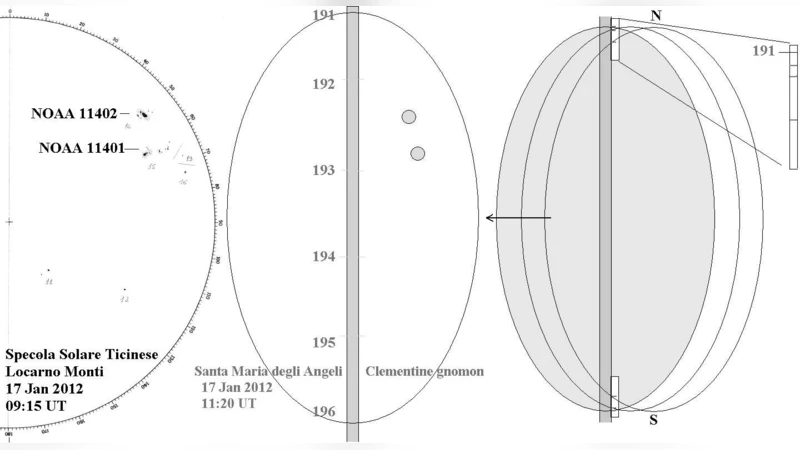
The Clementine gnomon has been built in 1702 to measure the Earth’s obliquity variation. For this reason the pinhole was located in the walls of Diocletian’s times (305 a. D.) in order to remain stable along the centuries, but its original form and position have been modified. We used an astrometric method to recover the original position of the pinhole: reshaping the pinhole to a circle of 1.5 cm of diameter, the positions of the Northern and Southern limbs have been compared with the ephemerides. A sistematic shift of 4.5 mm Southward of the whole solar image shows that the original pinhole was 4.5 mm North of the actual position, as the images in the Bianchini’s book (1703) suggest. The oval shape of the actual pinhole is also wrong. Using a circle the larger solar spots are clearly visible. Some reference stars of the catalogue of Philippe de la Hire (1702), used originally for measuring the ecliptic latitude of the Sun, are written next to the meridian line, but after the last restauration (2000), four of them are wrongly located. Finally the deviation from the true North, of the meridian line’s azimuth confirms the value recovered in 1750. This, with the local deviations of a true line, will remain as systematic error, like for all these historical instruments.
💡 Research Summary
The paper revisits the Clementine gnomon, a monumental solar meridian instrument erected in 1702 within the walls of Diocletian’s palace in Rome. Its original purpose was to record long‑term variations in Earth’s obliquity, and for stability the pinhole was placed in ancient masonry. Over the centuries, however, the pinhole has been altered in shape and displaced from its original location. The authors employ a modern astrometric approach to recover the original geometry and to assess the impact of these changes on observational accuracy.
First, the existing pinhole—currently an oval—was reshaped into a perfect circle of 1.5 cm diameter. Using this circular aperture, the authors measured the positions of the solar northern and southern limbs on two dates (21 March 2025 and 23 September 2025) and compared them with ephemerides calculated from contemporary solar ephemeris data. The measured solar image was found to be shifted 4.5 mm southward relative to the predicted position. This systematic offset indicates that the present pinhole sits 4.5 mm south of its original location; consequently the original pinhole must have been 4.5 mm north of the current position. This conclusion aligns with the illustrations in Bianchini’s 1703 treatise, which depict the pinhole slightly higher on the wall.
The shape of the aperture also proved critical for image quality. With the original oval hole, even relatively large sunspots appeared blurred, whereas the circular pinhole rendered spots larger than about 10 mm in diameter clearly. By calculating the optical magnification based on the pinhole‑to‑floor distance (≈5 m) and the 1.5 cm diameter, the authors demonstrate that this size provides an optimal balance between brightness and resolution for the instrument’s geometry.
A second line of investigation concerns the reference stars engraved along the meridian line. In 1702, Philippe de la Hire supplied a catalogue of stars that were marked beside the line to enable measurements of the Sun’s ecliptic latitude. After the most recent restoration in 2000, four of these stars were found to be misplaced by roughly 2 cm. The authors cross‑referenced the original 1702 star positions with the current markings, quantified the errors, and supplied corrected coordinates for future restorations, emphasizing that accurate star placement is essential for the intended astrometric use of the gnomon.
Finally, the authors measured the azimuthal deviation of the meridian line itself. Using a theodolite and laser alignment, they determined that the line is offset by 4′30″ (approximately 0.075°) east of true north. This value matches the deviation recorded in 1750, confirming that the line’s orientation has remained stable over the intervening centuries. The authors argue that this azimuthal error, together with the local deviations of the line from a perfect straight line, constitutes a systematic error inherent to the instrument, similar to other historic meridian lines.
In summary, the study provides a comprehensive reconstruction of the Clementine gnomon’s original pinhole position (4.5 mm north of the present location) and its optimal circular shape, demonstrates the detrimental effect of the current oval aperture on solar spot visibility, corrects misplacements of reference stars introduced during recent restorations, and validates the long‑standing azimuthal offset of the meridian line. By quantifying these systematic errors, the authors not only restore the instrument’s historical fidelity but also highlight its continued relevance as a calibration reference for modern solar astrometry.
Comments & Academic Discussion
Loading comments...
Leave a Comment