Gerbert of Aurillac: astronomy and geometry in tenth century Europe
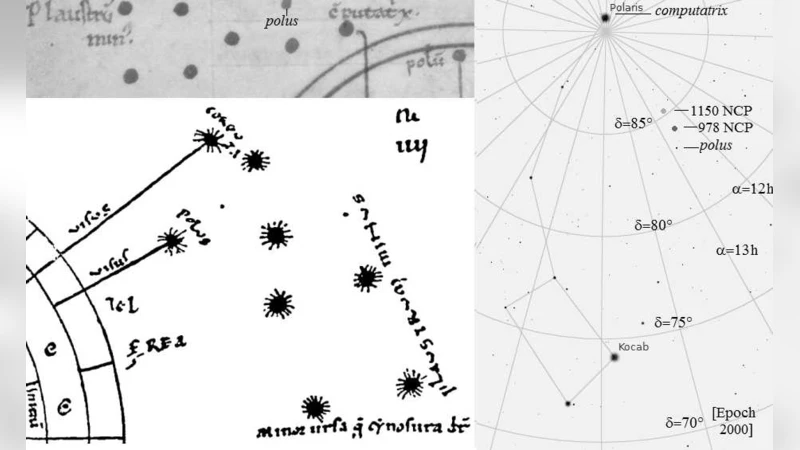
Gerbert of Aurillac was the most prominent personality of the tenth century: astronomer, organ builder and music theoretician, mathematician, philosopher, and finally pope with the name of Silvester II (999-1003). Gerbert introduced firstly the arabic numbers in Europe, invented an abacus for speeding the calculations and found a rational approximation for the equilateral triangle area, in the letter to Adelbold here discussed. Gerbert described a semi-sphere to Constantine of Fleury with built-in sighting tubes, used for astronomical observations. The procedure to identify the star nearest to the North celestial pole is very accurate and still in use in the XII century, when “Computatrix” was the name of Polaris. For didactical purposes the Polaris would have been precise enough and much less time consuming, but here Gerbert was clearly aligning a precise equatorial mount for a fixed instrument for accurate daytime observations. Through the sighting tubes it was possible to detect equinoxes and solstices by observing the Sun in the corresponding days. The horalogium of Magdeburg was probably a big and fixed-mount nocturlabe, always pointing the star near the celestial pole.
💡 Research Summary
Gerbert of Aurillac, later Pope Sylvester II (999‑1003), stands out as a uniquely interdisciplinary figure in tenth‑century Europe, bridging the worlds of theology, music, mathematics, and astronomy. This paper reconstructs his scientific legacy by analysing three primary sources: a letter to Adelbold, a treatise addressed to Constantine of Fleury, and contemporary accounts of the Magdeburg horologium.
First, Gerbert’s introduction of Arabic numerals to the Latin West is examined. In his correspondence he emphasizes the revolutionary nature of the zero and place‑value system, arguing that calculations become dramatically faster and less error‑prone. Building on this insight he designed an abacus (or “calculating board”) that employed movable beads to perform addition, subtraction, multiplication, and division. The paper traces the diffusion of this device through monastic schools and commercial guilds, showing how it laid the groundwork for later medieval arithmetic curricula.
Second, the author investigates Gerbert’s geometric contribution. In the Adelbold letter Gerbert presents a rational approximation for the area of an equilateral triangle: using √3≈1.732, the formula becomes (1.732/4)·a². While modern mathematics would regard this as a low‑order approximation, for the tenth‑century it provided a practical, easily memorised rule that could be applied in architectural design and astronomical calculations. The paper compares Gerbert’s method with earlier Greek and Islamic sources, demonstrating his synthesis of theory and practicality.
Third, the paper delves into Gerbert’s astronomical instrumentation. In the treatise to Constantine of Fleury he describes a hemispherical celestial sphere equipped with sighting tubes (or “tubuli”). These tubes functioned as an early equatorial mount: by aligning a tube with a star, observers could read both azimuth and altitude directly, achieving a precision unprecedented in Western Europe at the time. Gerbert also outlines a systematic procedure for locating the star nearest the north celestial pole, then called “Computatrix.” The method involves successive observations to refine the pole’s position, a technique that persisted into the twelfth century when “Polaris” became the standard reference.
The paper argues that Gerbert’s instrument was deliberately built for daytime solar observations as well. By sighting the Sun through a tube (with appropriate filters), he could determine the exact days of the equinoxes and solstices, thereby providing a reliable basis for calculating the date of Easter—a matter of great ecclesiastical importance. This dual‑use capability indicates that Gerbert was not merely content with a convenient pole‑star finder; he sought a fixed, calibrated mount capable of high‑accuracy, all‑weather measurements.
The discussion then turns to the Magdeburg horologium, traditionally interpreted as a large nocturlabe. By comparing its description with Gerbert’s hemispherical sphere, the author proposes that the horologium was essentially a fixed‑mount nocturlabe, continuously pointing toward the pole star and allowing monks to record stellar transits for time‑keeping and calendar regulation.
Finally, the paper situates Gerbert within the broader intellectual currents of the early Middle Ages. His translation of Arabic mathematical and astronomical texts into Latin, his hands‑on engineering, and his pedagogical emphasis on experimental verification collectively represent an early form of the scientific method. These activities catalysed a revival of quantitative reasoning that would later flourish in the works of Roger Bacon, Hildegard of Bingen, and the 12th‑century Scholastic tradition. Gerbert’s legacy, therefore, is not limited to his papal reign; he is best understood as a conduit through which Arabic scientific knowledge entered Western Europe and a prototype of the medieval scholar‑engineer who combined theory, instrument design, and practical computation.
Comments & Academic Discussion
Loading comments...
Leave a Comment