This Letter presents a reduction of the lattice modified Korteweg-de-Vries equation that gives rise to a $q$-analogue of the sixth Painlev\'e equation. This new approach allows us to give the first ultradiscrete Lax representation of an ultradiscrete analogue of the sixth Painlev\'e equation.
Deep Dive into Reductions of lattice mKdV to $q$-$mathrm{P}_{VI}$.
This Letter presents a reduction of the lattice modified Korteweg-de-Vries equation that gives rise to a $q$-analogue of the sixth Painlev'e equation. This new approach allows us to give the first ultradiscrete Lax representation of an ultradiscrete analogue of the sixth Painlev'e equation.
This Letter will present a specific reduction of the non-autonomous lattice modified Korteweg-de-Vries equation [10], given by (1) α l (w w -w w) -β m (w w -w w) = 0 where w = w l,m , w = w l+1,m , w = w l,m+1 and w = w l+1,m+1 .
The autonomous version of this equation is equivalent to H3 δ=0 in the list of multidimensionally consistent equations on quad-graphs [1]. Reductions of (1) to q-analogues of the Painlevé equations were considered by Hay et al. [2]. We wish to extend upon this work to provide a new way to think about reductions [8], demonstrating, as an example, how to obtain a q-analogue of the sixth Painlevé equation (q-P VI ) of Jimbo et al. [3], given by f f = q 2 q 2 b 1 t 2 + ga 2 b 2 t 2 + ga 1 (gb 1 q 2 + a 2 ) (a 1 + gb 2 ) , (2a)
as a reduction of (1). Here we note that t = q 2 t for some fixed q ∈ C and the a i and b j are fixed parameters.
This equation originally and a Lax representation first appeared as a connection-preserving deformation [3] and more recently as an equation governing a deformation of the little q-Jacobi polynomials [7].
While q-P VI has appeared as a reduction of a q-analog of the multi-component Kadomtsev-Petviashvili hierarchy [6], this is the first time that we know of that q-P VI has appeared as a reduction of a two-dimensional lattice equation. We will also obtain a new Lax pair by appealing to a new method developed in collaboration with Quispel [8].
We then show that this Lax representation may be ultradiscretized, hence, gives rise to a tropical Lax representation of an ultradiscrete analogue of the sixth Painlevé equation (u-P VI ) [12], given by
where the A i and B j are fixed parameters in R and T = 2Q + T for some fixed Q ∈ R. This is the first time that a tropical Lax representation of u-P VI has appeared that we know of. This Letter is organized as follows. In Section 2 we will show that (2) arises as a reduction of (1). In Section 3 we outline a new method of obtaining a Lax representation of a reduction to find a new Lax representation of (2). In Section 4 we show how both the equation and Lax representation degenerate to give a q-analogue of the third Painlevé equation (q-P III ) and its Lax representation. Lastly, in Section 5, we show how the Lax representation may be ultradiscretized to give a tropical Lax representation of (3).
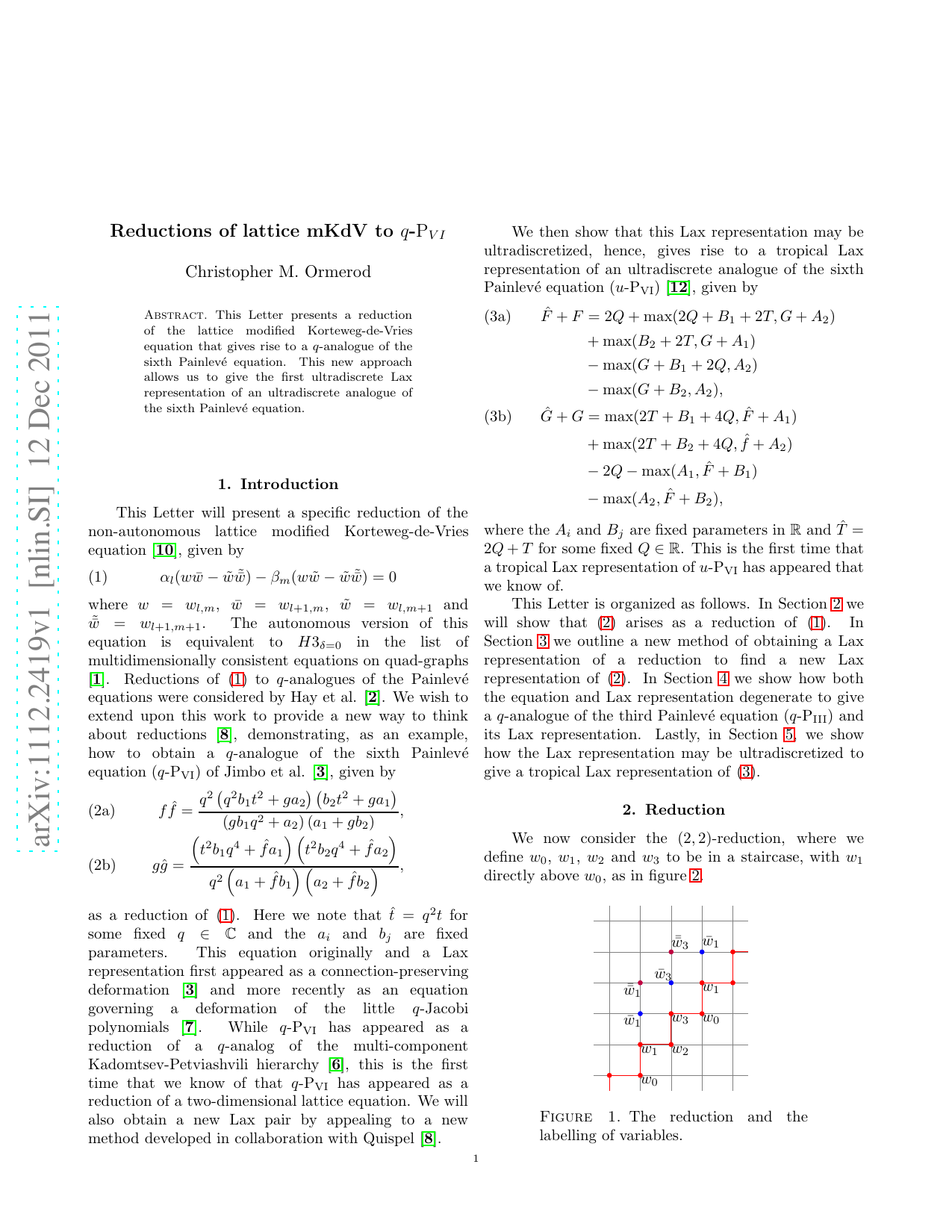
We now consider the (2, 2)-reduction, where we define w 0 , w 1 , w 2 and w 3 to be in a staircase, with w 1 directly above w 0 , as in figure 2. Notice that the evolution is consistent, so long as α l /β m = α l+2 /β m+2 , by which a separation of variables gives us (4)
To satisfy (4), we define constants a i and b i , for i = 1, 2, by letting
If we let t = q m-l , we have that β m /α l ∝ t, where the shift m → m + 2 is equivalent to t → q 2 t. We solve (1) to find w0 and w2 , given by
where we may subsequently use the periodicity and ( 1) to obtain w0 and w2 , given by w1 = w 3 tb 1 w2 q 2 + a 1 w0
Letting w 0 /w 2 = f /t and w 1 /w 3 = g/t gives (2), where we now interpret f and g to be f ĝ respectively.
We use a different approach to reductions to that of Hay et al. [2]. The general method will be further explored in a separate publication [8].
We first note that (1) is multilinear and multidimensionally consistent, giving rise to the following Lax representation
where
and where γ is a spectral parameter [2].
We define two variables,
and a new linear system, φ(x, t), satisfying φ(q 2 x, t) = A(x, t)φ(x, t), (7a) φ(x, q 2 t) = B(x, t)φ(x, t), (7b) where operators A(x, t) and B(x, t) may be interpreted as operating in the (2, 2)-and (0, 2)-directions respectively in our original system. The (2, 2)-operator has the effect of fixing t and letting z → z/q 2 and the (0, 2)-operator fixes z and lets t → q 2 t. We may explicitly construct A(x, t) and B(x, t) in terms of L and M :
where we have directly substituted for x and t. The consistency of (7a) and (7b), which reads (8)
A(x, q 2 t)B(x, t) = B(q 2 x, t)A(x, t), results in (5). We may recast this system by the same identification that related (5) to (2), with an additional factor, h = w 3 , which we interpret to be a gauge factor [3]. Under this identification, we may manipulate the matrices to obtain an equivalent A(x, t) in terms of f , g and h;
where we have used the definitions and ( 5). Note that
and that the leading matrices in the expansion of A(x, t) around x = 0 and x = ∞ are both proportional to the identity matrix, meaning that (7a) and (7b) constitute a connection preserving deformation [3]. The compatibility, given by ( 8), results in (2). However, we obtain a necessary equation satisfied by the gauge factor:
, which bears some similarity to the equation satisfied by the gauge factor of Jimbo et al. [3].
When b 1 = b 2 , the evolution factorizes into two copies of the one mapping, which is also known as q-P III , whose Lax representation was found by Papageorgiou et al. [9]. Here, instead of having m → m + 2, we compute m → m + 1, where
…(Full text truncated)…
This content is AI-processed based on ArXiv data.