We present the analysis of two Suzaku observations of GX 301-2 at two orbital phases after the periastron passage. Variations in the column density of the line-of-sight absorber are observed, consistent with accretion from a clumpy wind. In addition to a CRSF, multiple fluorescence emission lines were detected in both observations. The variations in the pulse profiles and the CRSF throughout the pulse phase have a signature of a magnetic dipole field. Using a simple dipole model we calculated the expected magnetic field values for different pulse phases and were able to extract a set of geometrical angles, loosely constraining the dipole geometry in the neutron star. From the variation of the CRSF width and energy, we found a geometrical solution for the dipole, making the inclination consistent with previously published values.
Deep Dive into Broadband spectroscopy using two Suzaku observation of the HMXB GX 301-2.
We present the analysis of two Suzaku observations of GX 301-2 at two orbital phases after the periastron passage. Variations in the column density of the line-of-sight absorber are observed, consistent with accretion from a clumpy wind. In addition to a CRSF, multiple fluorescence emission lines were detected in both observations. The variations in the pulse profiles and the CRSF throughout the pulse phase have a signature of a magnetic dipole field. Using a simple dipole model we calculated the expected magnetic field values for different pulse phases and were able to extract a set of geometrical angles, loosely constraining the dipole geometry in the neutron star. From the variation of the CRSF width and energy, we found a geometrical solution for the dipole, making the inclination consistent with previously published values.
The High Mass X-ray Binary (HMXB) system GX 301-2 was discovered in 1969 April during a balloon experiment (Lewin et al. 1971;McClintock, Ricker & Lewin 1971). The system consists of an accreting neutron star (NS) fed by the surrounding stellar wind of the B type emission line companion Wray 977 (Jones, Chetin & Liller 1974). A recent luminosity estimate derived from atmospheric models puts its distance at ∼ 3 kpc (Kaper, van der Meer & Najarro 2006), the value utilized in this paper. The orbital period was established to be ∼ 41 days (White, Mason & Sanford 1978) using Ariel 5 observations and was refined with the Burst And Transient Source Experiment (BATSE) to ∼ 41.5 days with an eccentricity of ∼ 0.46 (Koh et al. 1997). Doroshenko et al. (2010a) discussed a possible orbital evolution and determined an orbital period of 41.482 ± 0.001 d, assuming no change in orbital period. Kaper, van der Meer & Najarro (2006) determined that the mass of the companion was in the range 39 M ⊙ < M < 53 M ⊙ and the radius of Wray 977 was R * ∼62 R ⊙ , obtained by fitting atmosphere models.
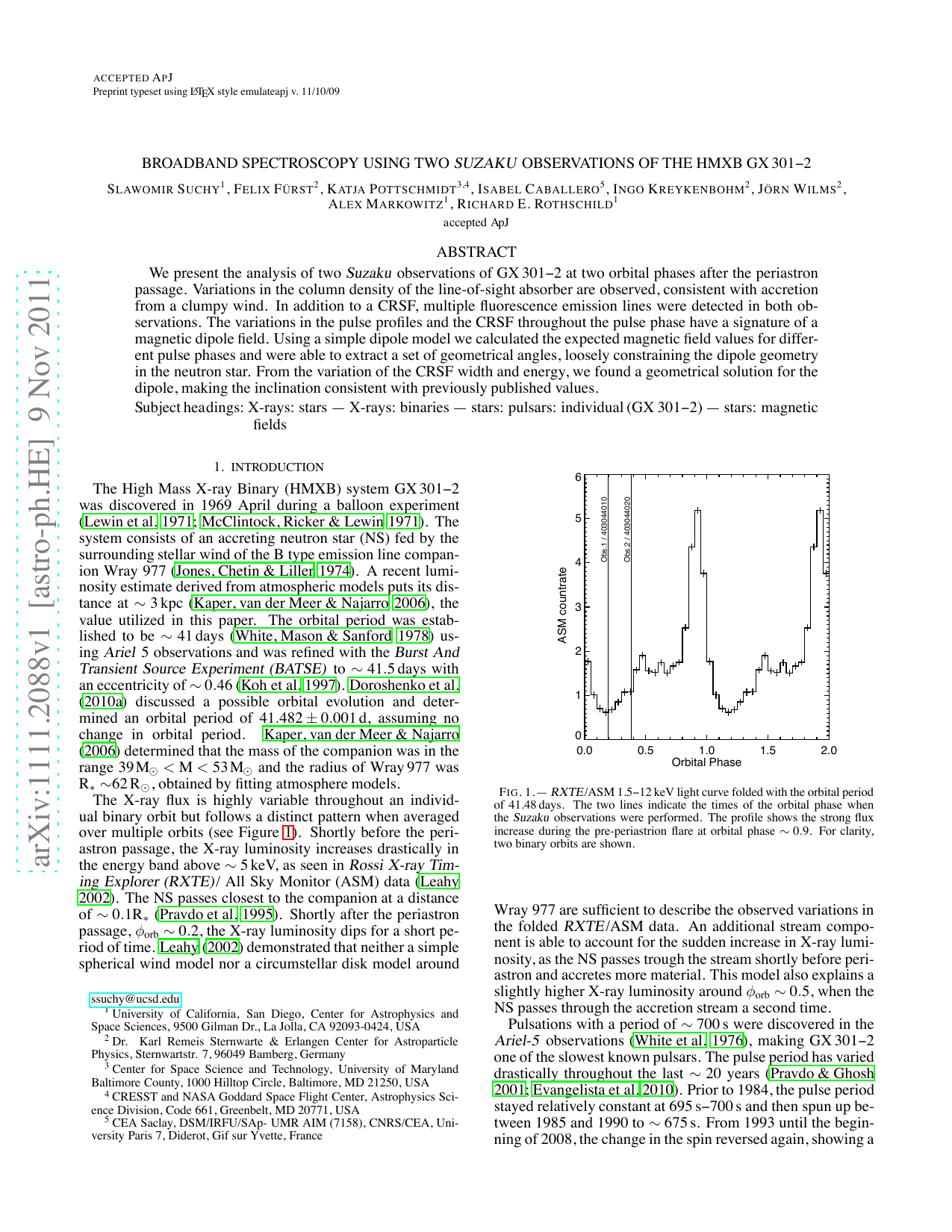
The X-ray flux is highly variable throughout an individual binary orbit but follows a distinct pattern when averaged over multiple orbits (see Figure 1). Shortly before the periastron passage, the X-ray luminosity increases drastically in the energy band above ∼ 5 keV, as seen in Rossi X-ray Timing Explorer (RXTE) / All Sky Monitor (ASM) data (Leahy 2002). The NS passes closest to the companion at a distance of ∼ 0.1R * (Pravdo et al. 1995). Shortly after the periastron passage, φ orb ∼ 0.2, the X-ray luminosity dips for a short period of time. Leahy (2002) Wray 977 are sufficient to describe the observed variations in the folded RXTE /ASM data. An additional stream component is able to account for the sudden increase in X-ray luminosity, as the NS passes trough the stream shortly before periastron and accretes more material. This model also explains a slightly higher X-ray luminosity around φ orb ∼ 0.5, when the NS passes through the accretion stream a second time.
Pulsations with a period of ∼ 700 s were discovered in the Ariel-5 observations (White et al. 1976), making GX 301-2 one of the slowest known pulsars. The pulse period has varied drastically throughout the last ∼ 20 years (Pravdo & Ghosh 2001;Evangelista et al. 2010). Prior to 1984, the pulse period stayed relatively constant at 695 s-700 s and then spun up between 1985 and 1990 to ∼ 675 s. From 1993 until the beginning of 2008, the change in the spin reversed again, showing a decline. Fermi /Galactic Burst Monitor (GBM) data6 have revealed that GX 301-2 experienced another spin reversal and briefly spun-up with the pulse period decreasing from ∼ 687 s to ∼ 681 s between May 2008 and October 2010. Since October 2010, the pulse period has shown only small variations around ∼ 681 s.
Most recently, Gögüş, Kreykenbohm & Belloni (2011) discovered a peculiar 1 ks dip in the luminosity of GX 301-2, where the pulsations disappeared for one spin cycle during the dip. Several such dips have been previously observed in Vela X-1 (Kreykenbohm et al. 1999(Kreykenbohm et al. , 2008)), where it is assumed that the accretion on the NS was interrupted for a short period of time.
The pulse phase average spectrum of GX 301-2 is described using a power law with a high energy cutoff. The continuum does not show a strong variation in the intrinsic parameters (Γ, E cut , and E fold ) throughout the orbit (Mukherjee & Paul 2004), as seen in two data sets from RXTE, taken in 1996 and2000, sampling most phases of the binary orbit. One of the major characteristics of the X-ray spectrum of GX 301-2 is the high and strongly variable column density of its line-of-sight absorber throughout the orbit, indicative of a clumpy stellar wind (N H = 10 22 -10 24 cm -2 ). In addition to the high column density, a very bright Fe Kα emission line can be observed. This line has shown a strong correlation with the observed luminosity, indicating that the line is produced by local clumpy matter surrounding the neutron star (Mukherjee & Paul 2004). Kreykenbohm et al. (2004) used the RXTE data set from 2000 to perform phase resolved spectroscopy and showed that an absorbed and partially covered pulsar continuum (power law with Fermi-Dirac cutoff) as well as a reflected and absorbed pulsar continuum were consistent with the data.
A cyclotron resonance scattering feature (CRSF) at ∼ 35 keV was first discovered with Ginga (Mihara 1995). Orlandini et al. (2000) found systematic deviations from a power law continuum at ∼ 20 and ∼ 40 keV in BeppoSAX, where the former could not be confirmed as a CRSF due to the proximity of the continuum cutoff. Kreykenbohm et al. (2004) excluded the existence of a CRSF at ∼ 20 keV and showed that the CRSF centroid energy varies between 30-38 keV over the pulse rotation of the NS. Furthermore, they showed that the CRSF centroid energy and width are correlated.
We report on two observati
…(Full text truncated)…
This content is AI-processed based on ArXiv data.