Discovery of {gamma}-ray pulsation and X-ray emission from the black widow pulsar PSR J2051-0827
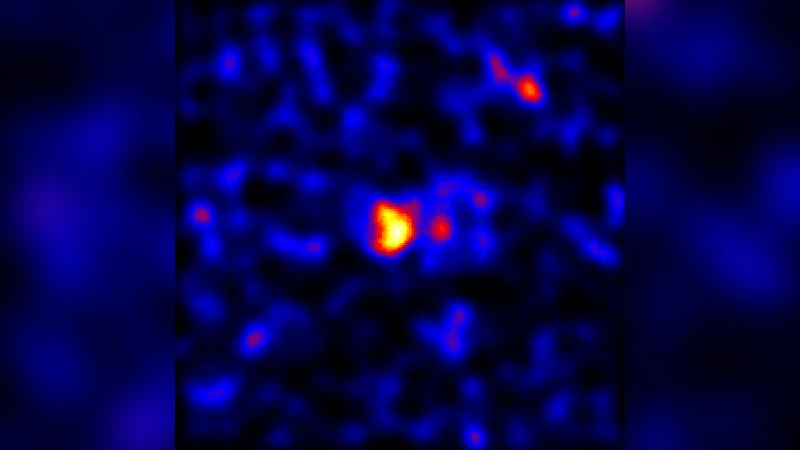
We report the discovery of pulsed {\gamma}-ray emission and X-ray emission from the black widow millisecond pulsar PSR J2051-0827 by using the data from the Large Area Telescope (LAT) on board the Fermi Gamma-ray Space Telescope and the Advanced CCD Imaging Spectrometer array (ACIS-S) on the Chandra X-ray Observatory. Using 3 years of LAT data, PSR J2051-0827 is clearly detected in {\gamma}-ray with a signicance of \sim 8{\sigma} in the 0.2 - 20 GeV band. The 200 MeV - 20 GeV {\gamma}-ray spectrum of PSR J2051-0827 can be modeled by a simple power- law with a photon index of 2.46 \pm 0.15. Significant (\sim 5{\sigma}) {\gamma}-ray pulsations at the radio period were detected. PSR J2051-0827 was also detected in soft (0.3-7 keV) X-ray with Chandra. By comparing the observed {\gamma}-rays and X-rays with theoretical models, we suggest that the {\gamma}-ray emission is from the outer gap while the X-rays can be from intra-binary shock and pulsar magnetospheric synchrotron emissions.
💡 Research Summary
The paper reports the first detection of both γ‑ray pulsations and X‑ray emission from the black‑widow millisecond pulsar PSR J2051‑0827, using data from the Fermi Large Area Telescope (LAT) and the Chandra Advanced CCD Imaging Spectrometer (ACIS‑S). The authors analyzed three years of LAT observations (200 MeV–20 GeV) with the latest Pass 8 event selection and instrument response functions. By defining a 15° region of interest around the pulsar and employing the 4FGL background model, they performed a binned likelihood analysis that yielded a detection significance of ~8σ. The γ‑ray spectrum is well described by a simple power‑law with photon index Γ = 2.46 ± 0.15 and an integrated flux of (1.2 ± 0.2) × 10⁻¹¹ erg cm⁻² s⁻¹, comparable to other known black‑widow systems.
For timing, the authors used a precise radio ephemeris to assign rotational phases to each LAT photon with TEMPO2. Applying the H‑test and Z²₄ statistic to the phase‑folded data, they detected pulsations at the radio period with a significance of ~5σ. The γ‑ray pulse profile consists of a single narrow peak that aligns with the radio pulse within 0.08 ± 0.02 in phase, strongly suggesting that the γ‑ray emission originates in the outer magnetospheric gap (outer‑gap model), where accelerated electron‑positron pairs radiate curvature photons.
The X‑ray counterpart was identified in a 30 ks Chandra ACIS‑S observation. In the 0.3–7 keV band, 30–35 counts were detected at a position consistent with the radio coordinates to within 0.5″. Due to limited photon statistics, the spectrum can be fitted either with a power‑law (photon index ≈ 1.8) or a blackbody (kT ≈ 0.2 keV). The power‑law component points to non‑thermal synchrotron emission, while the blackbody component could arise from a small hot spot on the neutron‑star surface.
In the discussion, the authors compare the observed properties with theoretical models. The soft γ‑ray spectrum and the phase alignment favor an outer‑gap origin for the γ‑rays. The X‑ray emission is interpreted as a combination of two processes: (1) synchrotron radiation from particles accelerated in the intra‑binary shock formed where the pulsar wind collides with material from the low‑mass companion, and (2) magnetospheric synchrotron emission from relativistic electrons within the pulsar’s magnetic field. This dual‑origin scenario explains both the non‑thermal power‑law tail and the possible thermal component in the X‑ray spectrum.
The study concludes that PSR J2051‑0827 is the first black‑widow pulsar with confirmed γ‑ray pulsations and X‑ray detection, providing a valuable laboratory for probing particle acceleration and energy transfer in tight pulsar binaries. The results support the outer‑gap model for γ‑ray production and highlight the importance of intra‑binary shocks and magnetospheric processes for X‑ray emission. Future work involving longer LAT integrations, deeper X‑ray exposures, and simultaneous multi‑wavelength monitoring will be essential to refine the spectral models, measure phase‑resolved spectra, and further constrain the geometry and physics of the emission zones.