Accretion Geometry of the Low-Mass X-ray Binary Aquila X-1 in the Soft and Hard States
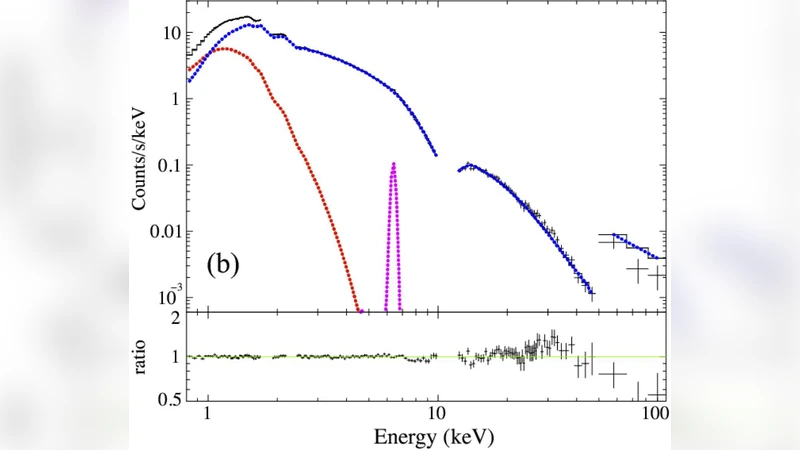
The neutron-star Low-Mass X-ray Binary Aquila X-1 was observed seven times in total with the Suzaku X-ray observatory from September 28 to October 30 in 2007, in the decaying phase of an outburst. In order to constrain the flux-dependent accretion geometry of this source over wider energy bands than employed in most of previous works, the present study utilized two out of the seven data sets. The 0.8-31 keV spectrum on September 28, taken with the XIS and HXD-PIN for an exposure of 13.8 ks, shows an absorbed 0.8-31 keV flux of $3.6\times 10^{-9}$ erg s$^{-1}$ cm$^{-2}$, together with typical characteristics of the soft state of this type of objects. The spectrum was successfully explained by an optically-thick disk emission plus a Comptonized blackbody component. Although these results are in general agreement with previous studies, the significance of a hard tail recently reported using the same data was inconclusive in our analysis. The spectrum acquired on October 9 for an exposure of 19.7 ks was detected over a 0.8-100 keV band with the XIS, HXD-PIN, and HXD-GSO, at an absorbed flux of $8.5\times 10^{-10}$ erg s$^{-1}$ cm$^{-2}$ (in 0.8-100 keV). It shows characteristics of the hard state, and was successfully explained by the same two continuum components but with rather different parameters including much stronger thermal Comptonization, of which the seed photon source was identified with blackbody emission from the neutron-star surface. As a result, the accretion flow in the hard state is inferred to take a form of an optically-thick and geometrically-thin disk down to a radius of $21\pm 4$ km from the neutron star, and then turn into an optically-thin nearly-spherical hot flow.
💡 Research Summary
The authors present a detailed spectral study of the neutron‑star low‑mass X‑ray binary Aquila X‑1 using Suzaku observations obtained during the decay of its 2007 outburst. Seven pointings were performed between 28 September and 30 October; the analysis focuses on two representative datasets that capture the source in its canonical soft (high‑luminosity) and hard (low‑luminosity) states.
The soft‑state observation (28 September) employed the XIS and HXD‑PIN detectors, covering 0.8–31 keV with an exposure of 13.8 ks. The absorbed flux in this band was $3.6\times10^{-9}$ erg s⁻¹ cm⁻². Spectral fitting required an interstellar absorption component plus two continuum components: (i) an optically thick, geometrically thin accretion disc (modeled with diskbb) with an inner temperature $kT_{\rm in}\approx0.6$ keV and an inferred inner radius of order 10 km, and (ii) a Comptonised blackbody (modeled with comptt or nthcomp) whose seed photons are identified with thermal emission from the neutron‑star surface ($kT_{\rm bb}\approx1.5$ keV). The Comptonising electron cloud is relatively cool ($kT_{\rm e}\sim3$ keV) and moderately thick ($\tau\sim5$), producing a modest high‑energy tail. The authors re‑examined a previously reported hard tail above 30 keV and found that, within the statistical and systematic uncertainties of the HXD‑PIN background, the tail is not required; thus its significance remains inconclusive.
The hard‑state observation (9 October) combined XIS, HXD‑PIN, and HXD‑GSO data, extending the coverage to 0.8–100 keV with a 19.7 ks exposure. The absorbed flux dropped to $8.5\times10^{-10}$ erg s⁻¹ cm⁻², roughly a factor of four lower than in the soft state, and the spectrum displayed the classic hard‑state shape. The same two‑component model successfully reproduced the data, but the parameters changed dramatically. The disc became much cooler ($kT_{\rm in}\approx0.2$ keV) and its apparent inner radius expanded to $R_{\rm in}=21\pm4$ km, indicating that the thin disc persists down to a radius roughly twice the neutron‑star radius before being replaced by a hot, quasi‑spherical flow. The Comptonised component now has a high electron temperature ($kT_{\rm e}\approx30$ keV) and a lower optical depth ($\tau\approx2$), and its seed photons are again consistent with blackbody emission from the neutron‑star surface ($kT_{\rm bb}\approx0.9$ keV). This configuration points to a geometry in which the disc truncates at ~21 km, inside of which a radiatively inefficient, optically thin corona or advection‑dominated flow dominates the energy release.
Key insights from the work include: (1) a unified spectral description for both states using the same physical components, allowing a direct comparison of how disc temperature, inner radius, and Comptonisation strength evolve with luminosity; (2) quantitative evidence that even in the hard state the disc remains optically thick, contradicting models that invoke a completely evaporated disc at low accretion rates; (3) a clear measurement of the disc truncation radius in the hard state, supporting theories that attribute the state transition to a change in the inner disc radius rather than a change in the disc’s optical depth alone; (4) confirmation that the seed photons for the hard‑state Comptonisation originate from the neutron‑star surface, implying that a substantial fraction of the accretion power still reaches the star even when the corona dominates the observed spectrum; and (5) a critical reassessment of the previously claimed hard tail, highlighting the importance of accurate background modeling for HXD‑PIN/GSO data.
Overall, the paper provides a comprehensive, broadband view of Aquila X‑1’s accretion geometry across a factor of ~4 in luminosity, demonstrating that the transition from soft to hard state is driven primarily by the inward retreat of the thin disc and the concomitant growth of a hot, nearly spherical flow. These results enrich our understanding of state transitions in neutron‑star low‑mass X‑ray binaries and offer valuable constraints for theoretical models of disc truncation, corona formation, and the interplay between disc and stellar surface emission.