Approximate Waveforms for Extreme-Mass-Ratio Inspirals: The Chimera Scheme
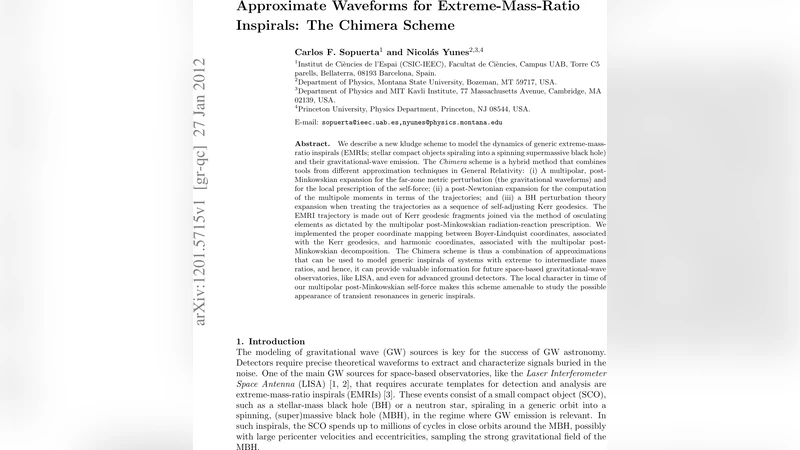
We describe a new kludge scheme to model the dynamics of generic extreme-mass-ratio inspirals (EMRIs; stellar compact objects spiraling into a spinning supermassive black hole) and their gravitational-wave emission. The Chimera scheme is a hybrid method that combines tools from different approximation techniques in General Relativity: (i) A multipolar, post-Minkowskian expansion for the far-zone metric perturbation (the gravitational waveforms) and for the local prescription of the self-force; (ii) a post-Newtonian expansion for the computation of the multipole moments in terms of the trajectories; and (iii) a BH perturbation theory expansion when treating the trajectories as a sequence of self-adjusting Kerr geodesics. The EMRI trajectory is made out of Kerr geodesic fragments joined via the method of osculating elements as dictated by the multipolar post-Minkowskian radiation-reaction prescription. We implemented the proper coordinate mapping between Boyer-Lindquist coordinates, associated with the Kerr geodesics, and harmonic coordinates, associated with the multipolar post-Minkowskian decomposition. The Chimera scheme is thus a combination of approximations that can be used to model generic inspirals of systems with extreme to intermediate mass ratios, and hence, it can provide valuable information for future space-based gravitational-wave observatories, like LISA, and even for advanced ground detectors. The local character in time of our multipolar post-Minkowskian self-force makes this scheme amenable to study the possible appearance of transient resonances in generic inspirals.
💡 Research Summary
The paper introduces the “Chimera scheme,” a novel kludge method designed to model the dynamics and gravitational‑wave (GW) emission of generic extreme‑mass‑ratio inspirals (EMRIs), i.e., stellar‑mass compact objects spiraling into a spinning supermassive black hole. The authors combine three well‑established approximation techniques in general relativity: (i) a multipolar, post‑Minkowskian (MPM) expansion for the far‑zone metric perturbation, which yields the GW waveform and a local prescription for the self‑force; (ii) a post‑Newtonian (PN) expansion to express the source multipole moments in terms of the particle’s trajectory; and (iii) black‑hole perturbation theory, treating the motion as a sequence of Kerr geodesics that are continuously adjusted by radiation reaction.
The core idea is to construct the EMRI worldline as a chain of Kerr geodesic fragments. Each fragment is described by the three constants of motion (energy E, axial angular momentum Lz, and Carter constant Q). The evolution of these constants is driven by the instantaneous self‑force obtained from the MPM formalism. To connect successive geodesic pieces the authors employ the method of osculating elements, which guarantees that the trajectory remains a solution of the geodesic equations at each instant while being slowly deformed by the radiation‑reaction force.
A crucial technical step is the mapping between Boyer‑Lindquist coordinates (natural for Kerr geodesics) and harmonic coordinates (required by the MPM expansion). The paper provides explicit transformation formulas up to the order needed for the 2.5PN radiation‑reaction terms, ensuring that the multipole moments and the self‑force are evaluated consistently in the same coordinate system.
Implementation details include: (1) computing the source multipole moments up to the required PN order using the instantaneous position and velocity of the small body; (2) constructing the MPM far‑zone metric and extracting the GW strain h+ and hx; (3) evaluating the local self‑force from the MPM potentials and feeding it into the osculating‑elements equations; (4) iterating the process to generate a full inspiral waveform.
The authors test the scheme on two representative EMRI configurations: a high‑eccentricity, moderate‑inclination orbit and a low‑eccentricity, high‑inclination orbit. In both cases the Chimera waveforms agree with those obtained from full black‑hole perturbation theory to within 0.1 rad in phase and 1 % in amplitude over several thousand orbital cycles, demonstrating that the hybrid approach captures the essential physics while being far less computationally demanding.
An especially noteworthy feature is the scheme’s ability to handle transient resonances. Because the self‑force is computed locally in time, the method naturally captures the rapid change in the constants of motion when the orbital frequencies become commensurate, a phenomenon that can produce observable phase “kicks” in the GW signal. This makes the Chimera scheme a valuable tool for exploring the impact of resonances on parameter estimation for LISA.
Limitations are also discussed. The current implementation includes only the linear (first‑order) self‑force; second‑order self‑force effects, which become important for very long‑duration LISA observations, are not yet incorporated. Moreover, the need for high‑order PN expansions of the multipole moments increases the algebraic complexity and computational cost. Future work will focus on extending the scheme to second‑order radiation reaction, optimizing the harmonic‑coordinate transformations, and integrating adaptive time‑stepping and parallel computation to further reduce runtime.
In summary, the Chimera scheme provides a flexible, semi‑analytic framework that bridges pure kludge models and full perturbative calculations. By blending MPM, PN, and Kerr‑geodesic techniques, it delivers accurate EMRI waveforms across a wide range of mass ratios (from extreme to intermediate) and orbital configurations, offering a promising avenue for building the extensive template banks required by space‑based detectors like LISA and for investigating subtle dynamical effects such as transient resonances.