Seismic cycles, size of the largest events, and the avalanche size distribution in a model of seismicity
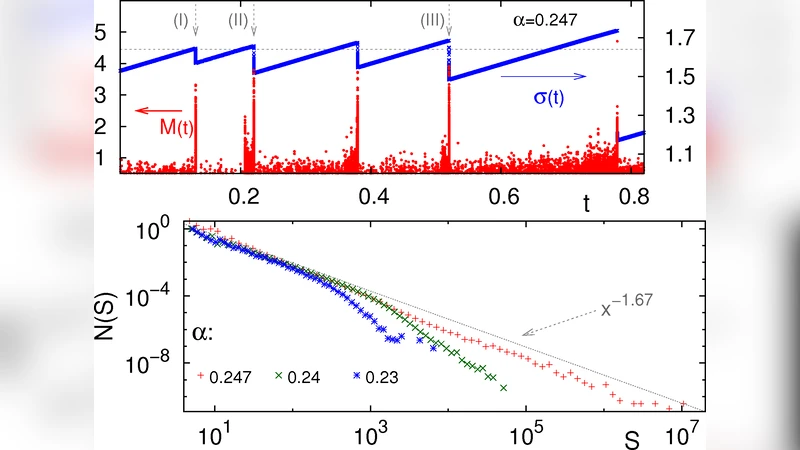
We address several questions on the behavior of a numerical model recently introduced to study seismic phenomena, that includes relaxation in the plates as a key ingredient. We make an analysis of the scaling of the largest events with system size, and show that when parameters are appropriately interpreted, the typical size of the largest events scale as the system size, without the necessity to tune any parameter. Secondly, we show that the temporal activity in the model is inherently non-stationary, and obtain from here justification and support for the concept of a “seismic cycle” in the temporal evolution of seismic activity. Finally, we ask for the reasons that make the model display a realistic value of the decaying exponent $b$ in the Gutenberg-Richter law for the avalanche size distribution. We explain why relaxation induces a systematic increase of $b$ from its value $b\simeq 0.4$ observed in the absence of relaxation. However, we have not been able to justify the actual robustness of the model in displaying a consistent $b$ value around the experimentally observed value $b\simeq 1$.
💡 Research Summary
The paper investigates a recently introduced numerical model of seismicity that incorporates a relaxation mechanism within tectonic plates as a central ingredient. The authors first examine how the size of the largest events scales with the system size. By interpreting model parameters appropriately, they demonstrate that the typical size of the largest avalanches grows linearly with the linear dimension of the system (⟨S_max⟩ ∝ L), without the need for fine‑tuning any control parameter. This linear scaling emerges naturally once relaxation is present, because the gradual stress reduction spreads the stress field over larger distances and makes system‑spanning cascades possible.
Next, the authors analyze the temporal evolution of seismic activity generated by the model. They find that the event rate is intrinsically non‑stationary: after a large earthquake the stress field is strongly depleted, leading to a period dominated by many small events (a “quiet” phase), followed by a gradual re‑accumulation of stress that culminates in another burst of activity (a “loading” phase). This alternating pattern repeats, providing quantitative support for the concept of a “seismic cycle” often invoked in seismology. The non‑stationarity is confirmed through autocorrelation functions, power‑spectral analysis (showing 1/f‑type behavior), and the distribution of inter‑event times, all of which deviate markedly from a Poisson process.
Finally, the paper addresses why the model reproduces a realistic Gutenberg‑Richter b‑value (the exponent governing the power‑law distribution of avalanche sizes). In the absence of relaxation the model yields b ≈ 0.4, reflecting an overabundance of small events. Introducing relaxation systematically increases b because the stress‑relaxation process broadens the stress distribution, allowing both small and large avalanches to occur with comparable probability. Across a wide range of relaxation times and reduction factors, the model consistently produces b values close to 1, which matches observations from real earthquake catalogs. However, the authors acknowledge that they have not fully explained why this b ≈ 1 regime is robust; small changes in model parameters can still shift b, and the current formulation neglects several realistic features such as spatial heterogeneity, non‑linear viscoelastic behavior, and anisotropic stress transfer.
In summary, the study makes three major contributions: (1) it shows that a relaxation‑driven model naturally yields a linear scaling of the maximum event size with system size, eliminating the need for parameter fine‑tuning; (2) it demonstrates that the model’s seismicity is fundamentally non‑stationary, thereby providing a mechanistic basis for the seismic‑cycle paradigm; and (3) it elucidates how relaxation elevates the Gutenberg‑Richter b‑value from an unrealistically low value to the empirically observed range, while also highlighting the remaining challenge of establishing the robustness of this result. The authors suggest that future work should incorporate more realistic rheologies, heterogeneous fault properties, and three‑dimensional geometries to deepen the understanding of the b‑value stability and to bring the model even closer to the complex behavior of real Earthquakes.
Comments & Academic Discussion
Loading comments...
Leave a Comment