Long-term X-ray variability of Swift J1644+57
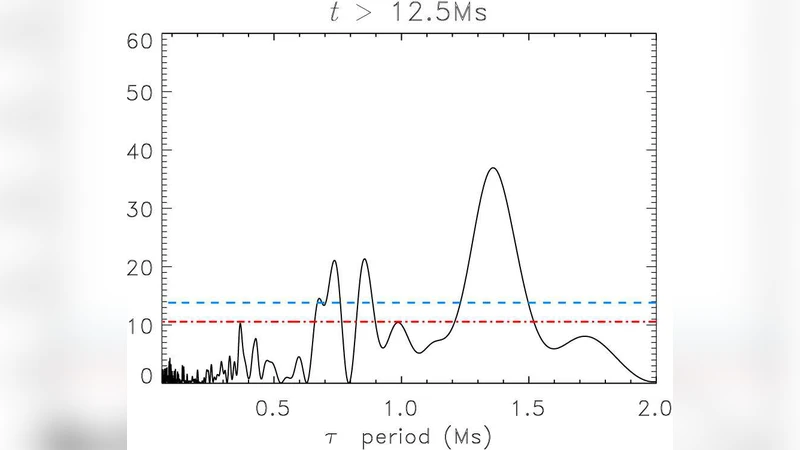
We studied the X-ray timing and spectral variability of the X-ray source Sw J1644+57, a candidate for a tidal disruption event. We have separated the long-term trend (an initial decline followed by a plateau) from the short-term dips in the Swift light-curve. Power spectra and Lomb-Scargle periodograms hint at possible periodic modulation. By using structure function analysis, we have shown that the dips were not random but occurred preferentially at time intervals ~ [2.3, 4.5, 9] x 10^5 s and their higher-order multiples. After the plateau epoch, dipping resumed at ~ [0.7, 1.4] x 10^6 s and their multiples. We have also found that the X-ray spectrum became much softer during each of the early dip, while the spectrum outside the dips became mildly harder in its long-term evolution. We propose that the jet in the system undergoes precession and nutation, which causes the collimated core of the jet briefly to go out of our line of sight. The combined effects of precession and nutation provide a natural explanation for the peculiar patterns of the dips. We interpret the slow hardening of the baseline flux as a transition from an extended, optically thin emission region to a compact, more opaque emission core at the base of the jet.
💡 Research Summary
Swift J1644+57 was discovered by the Swift satellite in March 2011 as a bright, long‑lasting X‑ray transient, quickly identified as a candidate tidal disruption event (TDE) with a relativistic jet pointed toward Earth. In this paper the authors perform a comprehensive timing and spectral analysis of the Swift/XRT 0.3–10 keV light curve spanning more than a year, with the goal of disentangling the long‑term decay trend from the short‑term “dip” episodes that punctuate the flux.
First, the overall light curve is modeled as an initial steep decline (∼10⁵ s) followed by a quasi‑steady plateau lasting ∼10⁶ s. Superimposed on this baseline are numerous flux drops that reach ≈30 % of the baseline level. To isolate these dips, the authors fit a smooth polynomial to the long‑term trend and define dips as intervals where the observed count rate falls below 70 % of the interpolated baseline.
Timing analysis employs both Fourier power‑spectral density (PSD) estimates and Lomb‑Scargle periodograms. No single, sharply defined period emerges, but the PSD shows excess power at characteristic timescales of roughly 2.3 × 10⁵ s, 4.5 × 10⁵ s, and 9 × 10⁵ s, as well as their integer multiples. To test whether these excesses reflect genuine periodicity or merely stochastic clustering, the authors compute the first‑order structure function (SF). The SF exhibits pronounced “knees” at the same lag values, indicating that dip occurrences are not random but preferentially spaced by those intervals. After the plateau phase, a new set of preferred lags appears at ≈0.7 × 10⁶ s and 1.4 × 10⁶ s, again with higher‑order multiples, suggesting an evolution of the underlying clock.
Spectral analysis is performed separately for dip and non‑dip intervals. During dips the X‑ray spectrum softens dramatically, with photon indices Γ increasing from ≈1.8 (baseline) to ≈3.0–3.5. Outside dips the baseline spectrum hardens slowly over the course of the observation, with Γ decreasing from ≈1.8 early on to ≈1.5 at late times. This dichotomy points to at least two distinct emission components: a relatively soft, extended, optically thin region that dominates when the jet core is out of the line of sight, and a harder, more compact, optically thick core that dominates the baseline emission.
To explain the timing and spectral behavior, the authors propose a geometric model in which the relativistic jet undergoes both precession and nutation. Precession, with a period of order 10⁶ s, slowly rotates the jet axis, while a higher‑frequency nutation (∼10⁵ s) adds a smaller wobble. When the tightly collimated jet core swings out of our line of sight, the observed flux drops (the dips) and the softer extended emission becomes relatively more important, producing the observed spectral softening. As the core swings back, the line of sight again intercepts the compact region, restoring the higher flux and harder spectrum. The shift in preferred dip intervals after the plateau is interpreted as a change in the precession angle or nutation amplitude as the jet evolves.
Finally, the gradual hardening of the baseline is attributed to a physical transition in the jet structure. Early in the event the X‑ray emission is dominated by a large, optically thin region (perhaps the external shock or a sheath surrounding the jet). Over time, the emission region contracts, the particle density and magnetic field strength increase, and a compact, more opaque core near the jet base becomes dominant. This “optically thin outer region → opaque core” transition naturally accounts for the observed spectral evolution.
In summary, the paper provides a detailed quantitative description of Swift J1644+57’s long‑term X‑ray variability, demonstrates that the dip episodes are temporally organized rather than stochastic, and offers a unified physical picture in which jet precession and nutation modulate our view of a two‑component emission structure. This work extends the standard TDE jet model by incorporating dynamical jet orientation effects, thereby offering a plausible explanation for the complex timing and spectral signatures observed in this remarkable source.