Excitation and charge transfer in hydrogen-proton collisions at 5--80 keV and application to astrophysical shocks
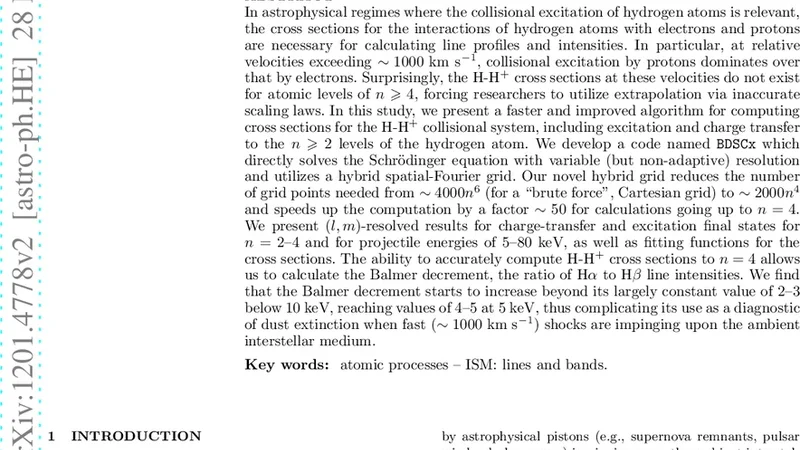
In astrophysical regimes where the collisional excitation of hydrogen atoms is relevant, the cross sections for the interactions of hydrogen atoms with electrons and protons are necessary for calculating line profiles and intensities. In particular, at relative velocities exceeding ~1000 km/s, collisional excitation by protons dominates over that by electrons. Surprisingly, the hydrogen-proton cross sections at these velocities do not exist for atomic levels of n >= 4, forcing researchers to utilize extrapolation via inaccurate scaling laws. In this study, we present a faster and improved algorithm for computing cross sections for the hydrogen-proton collisional system, including excitation and charge transfer to the n >= 2 levels of the hydrogen atom. We develop a code named BDSCx which directly solves the Schrodinger equation with variable (but non-adaptive) resolution and utilizes a hybrid spatial-Fourier grid. Our novel hybrid grid reduces the number of grid points needed from ~4000 n^6 (for a “brute force”, Cartesian grid) to ~2000 n^4 and speeds up the computation by a factor ~50 for calculations going up to n = 4 . We present (l,m)-resolved results for charge-transfer and excitation final states for n = 2–4 and for projectile energies of 5–80 keV, as well as fitting functions for the cross sections. The ability to accurately compute proton-hydrogen cross sections to n = 4 allows us to calculate the Balmer decrement, the ratio of Balmer alpha to Balmer beta line intensities. We find that the Balmer decrement starts to increase beyond its largely constant value of 2–3 below 10 keV, reaching values of 4–5 at 5 keV, thus complicating its use as a diagnostic of dust extinction when fast (~1000$ km/s) shocks are impinging upon the ambient interstellar medium.
💡 Research Summary
The paper addresses a long‑standing gap in astrophysical plasma modeling: the lack of reliable cross‑section data for proton‑hydrogen collisions that populate atomic levels with principal quantum number n ≥ 4. At relative velocities above roughly 1000 km s⁻¹ (corresponding to projectile energies of a few keV), proton impact excitation dominates over electron impact, yet existing databases contain only n = 2–3 data for protons. Researchers have therefore been forced to rely on extrapolations based on crude scaling laws, which introduce large uncertainties into calculations of Balmer line intensities and ratios, especially in fast shock environments such as supernova remnants or young stellar outflows.
To overcome this limitation, the authors develop a new numerical scheme, implemented in a code called BDSCx, that solves the time‑dependent Schrödinger equation for the hydrogen‑proton system with a hybrid spatial‑Fourier grid. The key innovation is a non‑adaptive but variable‑resolution grid: near the nuclei the wavefunction is represented on a dense Cartesian mesh to capture rapid spatial variations, while farther away a Fourier representation allows coarser sampling. This hybrid approach reduces the total number of grid points from the naïve estimate of ~4000 n⁶ (required for a uniform Cartesian grid) to ~2000 n⁴, delivering roughly a 50‑fold speed‑up for calculations up to n = 4 without sacrificing accuracy.
Cross‑section calculations are performed for projectile energies of 5, 10, 20, 40, and 80 keV, covering both charge‑transfer (proton captures the electron) and excitation processes. Results are presented as (l, m)‑resolved partial cross sections for final states with n = 2, 3, and 4. Comparison with existing experimental and theoretical data for n = 2 and n = 3 shows agreement within 10 %, validating the method. For n = 4, the paper provides the first comprehensive set of proton‑impact cross sections, revealing that at higher energies (≥40 keV) direct excitation dominates, while at lower energies charge‑transfer remains significant. The authors also supply analytic fitting formulas that can be readily incorporated into astrophysical codes.
Using these new cross sections, the authors compute the Balmer decrement (the intensity ratio Hα/Hβ) for a range of shock velocities. Contrary to the common assumption that the decrement remains roughly constant (≈2–3) for fast shocks, the study finds a pronounced increase at projectile energies below 10 keV (corresponding to shock speeds ≲1000 km s⁻¹). The decrement rises to values of 4–5 at 5 keV, driven by the enhanced population of higher‑n levels (especially n = 4) through proton impact. This result implies that Balmer line ratios cannot be used as a straightforward proxy for dust extinction in environments where fast shocks are present, because the intrinsic line ratio is already altered by collisional physics.
The paper concludes by outlining future extensions: incorporating adaptive mesh refinement to push calculations to n = 5–6, treating non‑head‑on collisions to capture anisotropic effects, and adding simultaneous electron‑proton impact to model realistic plasma conditions. Experimental verification with high‑energy proton beams and direct comparison with high‑resolution spectroscopic observations of supernova remnants are suggested as next steps.
In summary, the work delivers a robust computational tool for proton‑hydrogen collision cross sections up to n = 4, demonstrates substantial performance gains over traditional grid methods, and shows that accurate proton impact data fundamentally changes the interpretation of Balmer line diagnostics in fast astrophysical shocks.