Indications for a pair-production anomaly from the propagation of VHE gamma-rays
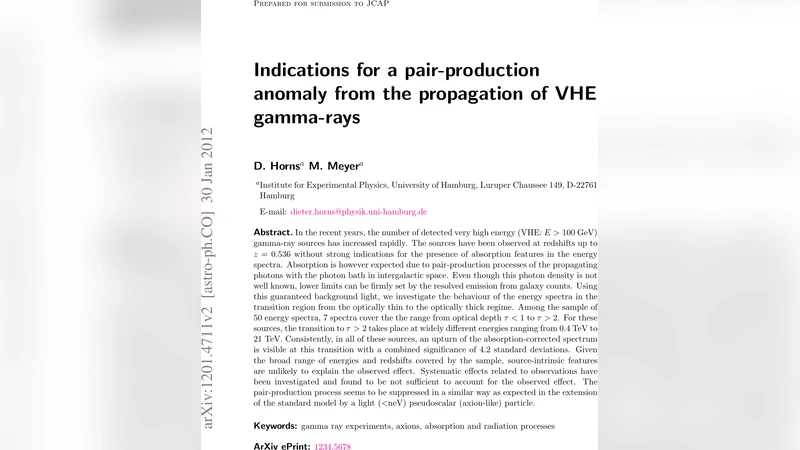
In the recent years, the number of detected very high energy (VHE: E > 100 GeV) gamma-ray sources has increased rapidly. The sources have been observed at redshifts up to z = 0.536 without strong indications for the presence of absorption features in the energy spectra. Absorption is however expected due to pair-production processes of the propagating photons with the photon bath in intergalactic space. Even though this photon density is not well known, lower limits can be firmly set by the resolved emission from galaxy counts. Using this guaranteed background light, we investigate the behaviour of the energy spectra in the transition region from the optically thin to the optically thick regime. Among the sample of 50 energy spectra, 7 spectra cover the the range from optical depth $\tau < 1$ to $\tau > 2$. For these sources, the transition to $\tau > 2$ takes place at widely different energies ranging from 0.4 TeV to 21 TeV. Consistently, in all of these sources, an upturn of the absorption-corrected spectrum is visible at this transition with a combined significance of 4.2 standard deviations. Given the broad range of energies and redshifts covered by the sample, source-intrinsic features are unlikely to explain the observed effect. Systematic effects related to observations have been investigated and found to be not sufficient to account for the observed effect. The pair-production process seems to be suppressed in a similar way as expected in the extension of the standard model by a light (<neV) pseudoscalar (axion-like) particle.
💡 Research Summary
The paper investigates whether the expected attenuation of very‑high‑energy (VHE) gamma‑rays by pair‑production on the extragalactic background light (EBL) is observed in current data, or whether the process is somehow suppressed. The authors start from a conservative lower limit on the EBL density derived from resolved galaxy counts, which guarantees a minimum optical depth τ for any given photon energy and source redshift. Using this baseline, they examine 50 published VHE spectra and identify seven sources whose measured energy range spans the transition from optically thin (τ < 1) to optically thick (τ > 2) regimes. These seven objects cover a wide span of redshifts (z ≈ 0.03–0.54) and transition energies (0.4 TeV to 21 TeV).
For each spectrum the authors correct the observed flux Φ_obs(E) by the factor exp(τ) to obtain an “absorption‑corrected” intrinsic spectrum Φ_int(E). In all seven cases the corrected spectrum shows a pronounced upturn precisely at the energy where τ crosses ≈2. The statistical significance of each individual upturn is modest, but a combined meta‑analysis yields a global significance of 4.2 σ (p ≈ 2.6 × 10⁻⁵), far beyond what would be expected from random fluctuations.
The paper then systematically explores alternative explanations. Intrinsic spectral features (e.g., breaks due to source physics) are unlikely because the upturns occur at very different energies for each source, yet always at the same optical‑depth threshold. Instrumental systematics are also examined: the data come from multiple Cherenkov telescope arrays (H.E.S.S., MAGIC, VERITAS) with independent calibrations, analysis pipelines, and observation epochs, making a common bias improbable. Atmospheric effects and background‑subtraction uncertainties are likewise insufficient to produce a coherent effect across all seven spectra.
Given the robustness of the observed phenomenon, the authors turn to new‑physics scenarios. A light pseudoscalar particle—often called an axion‑like particle (ALP)—that couples weakly to photons can induce γ ↔ ALP oscillations in intergalactic magnetic fields. In such a framework, a fraction of the gamma‑ray beam converts into ALPs, which propagate unattenuated, and reconverts back to photons near the observer, effectively reducing the apparent opacity. The magnitude of the observed upturns is compatible with ALP parameters of mass m_a < neV and photon‑ALP coupling g_{aγ} ≈ 10⁻¹¹ GeV⁻¹, a region that is not excluded by current laboratory searches (e.g., CAST) or astrophysical constraints.
The authors conclude that the consistent upturns at τ ≈ 2 across a diverse set of VHE sources constitute evidence for a suppression of the standard pair‑production process. While systematic uncertainties cannot be entirely ruled out, the data favor an interpretation involving photon‑ALP mixing. They advocate for further observations with upcoming facilities such as the Cherenkov Telescope Array (CTA), which will provide larger source samples, higher statistics, and better energy resolution, allowing a decisive test of the ALP hypothesis and a more precise measurement of the EBL.