The central engines of two unusual radio-intermediate/quiet active galactic nuclei: III Zw 2 and PG 1407+265
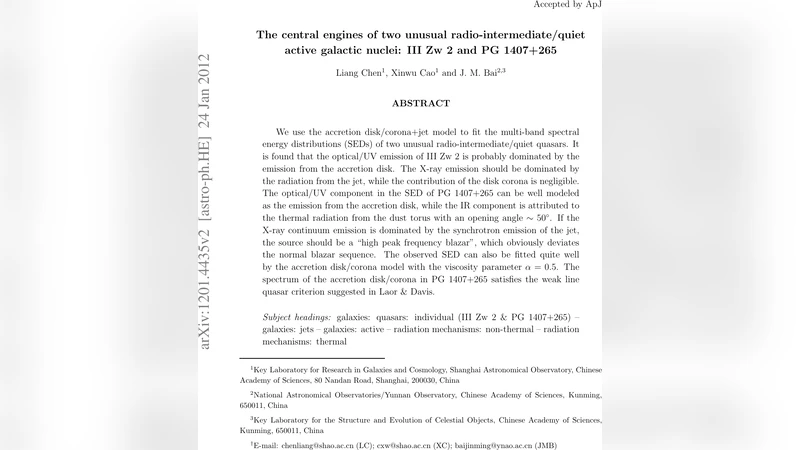
We use the accretion disk/corona+jet model to fit the multi-band spectral energy distributions (SEDs) of two unusual radio-intermediate/quiet quasars. It is found that the optical/UV emission of III Zw 2 is probably dominated by the emission from the accretion disk. The X-ray emission should be dominated by the radiation from the jet, while the contribution of the disk corona is negligible. The optical/UV component in the SED of PG 1407+265 can be well modeled as the emission from the accretion disk, while the IR component is attributed to the thermal radiation from the dust torus with an opening angle ~ 50\circ. If the X-ray continuum emission is dominated by the synchrotron emission of the jet, the source should be a “high peak frequency blazar”, which obviously deviates the normal blazar sequence. The observed SED can also be fitted quite well by the accretion disk/corona model with the viscosity parameter ? = 0:5. The spectrum of the accretion disk/corona in PG 1407+265 satisfies the weak line quasar criterion suggested in Laor & Davis.
💡 Research Summary
**
The paper investigates the central engines of two atypical active galactic nuclei (AGN) that are classified as radio‑intermediate (III Zw 2) or radio‑quiet (PG 1407 265). Using a unified framework that combines a standard thin accretion disc, a hot corona above the disc, and a relativistic jet, the authors fit the multi‑wavelength spectral energy distributions (SEDs) from the infrared (IR) through the optical/ultraviolet (UV) to the X‑ray band.
For III Zw 2, the optical/UV continuum is well reproduced by thermal emission from a Shakura‑Sunyaev disc with a black‑hole mass of order 10⁸ M⊙ and a moderate accretion rate (∼0.1 M⊙ yr⁻¹). The X‑ray spectrum, however, cannot be accounted for by the disc‑corona component; instead, synchrotron radiation from a compact jet dominates. The jet parameters derived from the fit (magnetic field B≈0.2 G, electron power‑law index p≈2.2, minimum Lorentz factor γ_min≈10, maximum γ_max≈10⁴) indicate a high‑frequency peaked synchrotron component, akin to a “high‑peak‑frequency blazar”. The corona contributes negligibly, implying that the jet is the primary high‑energy emitter in this source despite its modest radio loudness.
PG 1407 265 presents a more complex picture. Its optical/UV continuum is also consistent with a standard disc (M_BH≈5×10⁸ M⊙, ṁ≈0.2 M⊙ yr⁻¹). The IR excess is modeled as thermal emission from a dusty torus with an opening angle of roughly 50°, reproducing the observed far‑IR bump. The X‑ray band can be interpreted in two distinct ways. In the first scenario, the X‑rays arise from synchrotron emission of a jet whose parameters (B≈0.1 G, p≈2.0, γ_min≈30, γ_max≈5×10³) place the source on the high‑frequency end of the blazar sequence. This would make PG 1407 265 an outlier, because its radio flux is low while its synchrotron peak lies at X‑ray energies, violating the conventional blazar “sequence” that links radio power to synchrotron peak frequency. In the second scenario, the X‑ray continuum is produced by a hot corona above the disc. To match the data, the authors adopt a relatively large viscosity parameter α≈0.5, which yields a hot, optically thin corona (electron temperature ≈100 keV, optical depth τ≈0.2). This corona model simultaneously satisfies the weak‑line quasar (WLQ) criterion proposed by Laor & Davis: the coronal emission is sufficiently soft that it does not over‑ionize the broad‑line region, leading to the observed unusually weak emission lines.
The dual‑interpretation for PG 1407 265 highlights the degeneracy that can exist when fitting AGN SEDs with limited data. Nevertheless, the study demonstrates that even radio‑intermediate or radio‑quiet AGN can host jets that contribute significantly to their high‑energy output, and that the traditional disc‑corona picture may need to be supplemented by a jet component in many cases. Moreover, the requirement of a high α value for the corona in the WLQ scenario suggests that the energy dissipation in the disc‑corona system can be substantially more efficient than often assumed (α≈0.1–0.3).
Overall, the work provides a comprehensive, physically motivated modeling of the SEDs of two unusual AGN, showing that: (1) the optical/UV emission is dominated by the accretion disc in both objects; (2) the IR emission of PG 1407 265 is consistent with re‑processed dust radiation; (3) the X‑ray band can be jet‑dominated (III Zw 2) or either jet‑ or corona‑dominated (PG 1407 265), depending on the adopted parameters; and (4) the presence of a high‑frequency peaked jet in a radio‑quiet source challenges the universality of the blazar sequence. The authors conclude that a full understanding of AGN central engines requires simultaneous consideration of disc, corona, and jet contributions, and that future multi‑epoch, multi‑wavelength campaigns (including high‑resolution VLBI, X‑ray timing, and IR interferometry) will be essential to disentangle these components and to test the proposed models.