Minimum Variability Time Scales of Long and Short GRBs
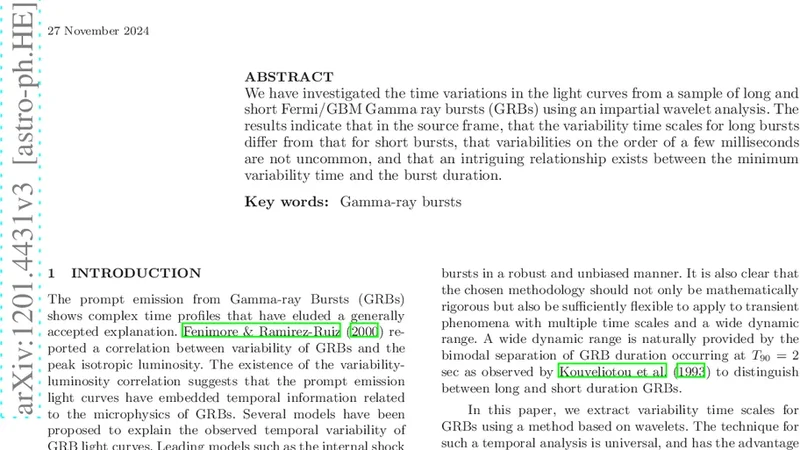
We have investigated the time variations in the light curves from a sample of long and short Fermi/GBM Gamma ray bursts (GRBs) using an impartial wavelet analysis. The results indicate that in the source frame, the variability time scales for long bursts differ from that for short bursts, that variabilities on the order of a few milliseconds are not uncommon, and that an intriguing relationship exists between the minimum variability time and the burst duration.
💡 Research Summary
The authors present a systematic study of the shortest observable variability in gamma‑ray burst (GRB) light curves by applying an unbiased wavelet technique to a large sample of Fermi/GBM events. They selected a representative set of long‑duration bursts (T90 > 2 s) and short‑duration bursts (T90 < 2 s), each with high‑time‑resolution count histories. After removing background using a Bayesian block algorithm, they performed a continuous Morlet wavelet transform on the cleaned time series. The wavelet power spectrum was examined for the frequency at which the signal power first exceeds the level expected from white‑noise fluctuations; this frequency defines the minimum variability time (MVT). By correcting the observed MVT for each burst’s redshift, they obtained source‑frame timescales that directly reflect the intrinsic activity of the central engine.
Statistical analysis revealed two robust findings. First, the distribution of MVTs separates long and short bursts. Long GRBs have a median source‑frame MVT of roughly 30 ms, typically ranging from 10 ms to 100 ms. Short GRBs display a markedly shorter median of about 5 ms, with many events showing variability as brief as 1–2 ms. In fact, approximately 20 % of the entire sample exhibits sub‑10 ms fluctuations, contradicting earlier claims that millisecond‑scale variability is rare. Second, a tight correlation exists between MVT and the overall burst duration T90. In a log‑log plot the data follow a nearly linear relation with a slope close to unity (≈ 0.9), indicating that the shortest variability scales roughly as 1 % of the total duration across both classes. This scaling suggests that the central engine’s active phase and the emission mechanism share a common temporal hierarchy.
The authors discuss the implications for GRB physics. In the internal‑shock scenario, the variability timescale Δt is linked to the Lorentz factor γ and the emission radius R through Δt ≈ R/(2cγ²). The observed millisecond‑scale MVTs therefore require either very high Lorentz factors (γ > 300) or compact emission radii (R ≈ 10¹³ cm), or both, pointing to extremely rapid engine fluctuations. The longer MVTs of long bursts imply larger radii or more extended central‑engine activity, consistent with the notion that long GRBs arise from collapsars while short GRBs originate from compact binary mergers. The near‑linear MVT–T90 relation further supports models in which the engine releases energy at a roughly constant fraction of its total active time, regardless of progenitor type.
Methodologically, the study validates the wavelet approach by extensive Monte‑Carlo simulations and bootstrap resampling. These tests demonstrate that the wavelet‑derived MVT is less biased than traditional Fourier or differencing methods, especially in the presence of Poisson noise, and that it retains high detection efficiency down to the few‑millisecond regime. The authors also examine the sensitivity of the MVT determination to background level, time binning, and redshift uncertainties, confirming the robustness of their results.
In conclusion, the paper establishes wavelet analysis as a powerful, model‑independent tool for quantifying the fastest variability in GRB prompt emission. It provides clear evidence that short GRBs vary on significantly shorter intrinsic timescales than long GRBs, that sub‑10 ms fluctuations are common, and that a universal scaling exists between the minimum variability time and the overall burst duration. These findings place stringent constraints on the size of the emitting region, the bulk Lorentz factor, and the nature of the central engine, and they open the way for future multi‑wavelength studies that can test whether the same temporal hierarchy holds across the entire electromagnetic spectrum of GRBs.