Prograde and Retrograde Black Holes: Whose Jet is More Powerful?
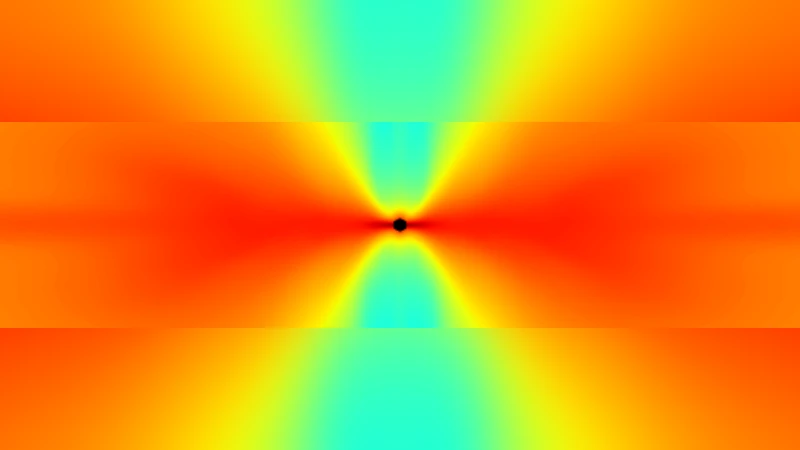
The outflow efficiency (eta) from black hole (BH) accretion disc systems is known to depend upon both the BH spin (a) and the amount of large-scale magnetic flux threading the BH and disc. Semi-analytical flux-trapping models suggest retrograde BHs should trap much more large-scale magnetic flux near the BH leading to much higher eta than for prograde BHs. We self-consistently determine the amount of large-scale magnetic flux trapped by rapidly spinning (a = -0.9 and 0.9) BHs using global 3D time-dependent non-radiative general relativistic magnetohydrodynamic simulations of thick (h/r ~ 0.3-0.6) discs. We find that BH-trapped flux builds up until it is strong enough to disrupt the inner accretion disc. Contrary to prior flux-trapping models, which do not include the back-reaction of magnetic flux on the disc, our simulations show prograde BHs trap more magnetic flux, leading to about 3 times higher eta than retrograde BHs for |a| = 0.9. Both spin orientations can produce highly efficient jets, eta ~ 100%, with increasing eta for increasing disc thickness. The similarity of eta for prograde and retrograde BHs makes it challenging to infer the sign of BH spin based on jet energetics alone.
💡 Research Summary
The paper investigates how the outflow efficiency (η) of black‑hole (BH) accretion‑disc systems depends on both the sign of the BH spin (a) and the amount of large‑scale magnetic flux (Φ_BH) that threads the hole and the disc. Earlier semi‑analytical “flux‑trapping” models predicted that retrograde (a < 0) BHs should capture far more magnetic flux than prograde (a > 0) BHs because the frame‑dragging of a retrograde hole compresses the inner disc, leading to dramatically higher jet efficiencies. Those models, however, ignored the dynamical back‑reaction of the magnetic field on the disc structure.
To address this gap, the authors performed global three‑dimensional, time‑dependent, non‑radiative general‑relativistic magnetohydrodynamic (GRMHD) simulations of thick discs (aspect ratio h/r ≈ 0.3–0.6) around rapidly spinning BHs with a = ±0.9. The simulations self‑consistently evolve the magnetic field, the accretion flow, and the jet, allowing the magnetic pressure to modify the disc geometry.
Key findings are:
-
Flux accumulation differs from analytic expectations. Both prograde and retrograde BHs initially accumulate Φ_BH, but in the retrograde case the growing magnetic pressure quickly disrupts the inner disc, choking further flux supply. In the prograde case the disc remains more robust, permitting continuous flux delivery.
-
Prograde BHs trap more flux. At saturation, Φ_BH around the prograde BH is roughly two to three times larger than around the retrograde BH. Consequently, the jet power P_jet, and thus η = P_jet/Ṁc², are about three times higher for the prograde configuration.
-
High efficiencies are achievable for both spin signs. When the disc is thicker, magnetic pressure can dominate the inner flow, leading to η ≈ 1 (i.e., jet power comparable to the rest‑mass energy accretion rate) for both prograde and retrograde BHs.
-
Implications for spin diagnostics. Because η can reach similar extreme values irrespective of spin sign, using jet energetics alone to infer whether a BH is rotating prograde or retrograde becomes unreliable.
The study demonstrates that the magnetic‑disc back‑reaction is essential for realistic flux‑trapping predictions. It overturns the earlier notion that retrograde BHs necessarily produce more powerful jets, showing instead that prograde BHs can be more efficient when the full GRMHD dynamics are considered. This work therefore calls for caution when interpreting observed jet powers as direct indicators of BH spin orientation and highlights the need for multi‑wavelength, multi‑parameter approaches to constrain BH spin in active galactic nuclei and X‑ray binaries.