SMARTS optical and infrared monitoring of 12 gamma-ray bright blazars
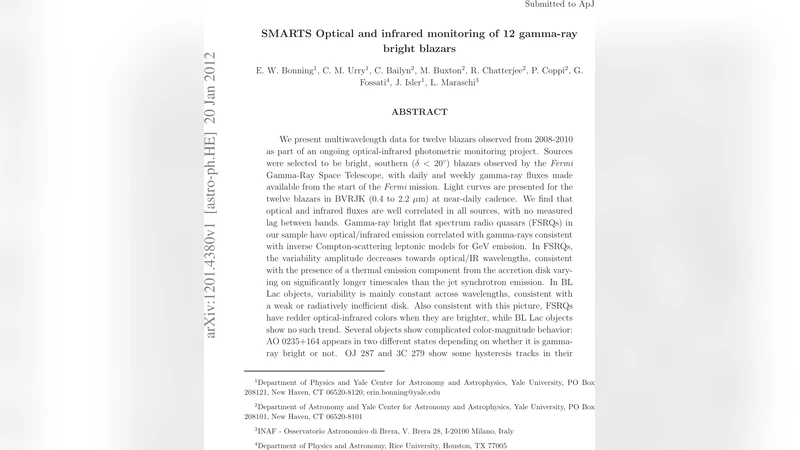
We present multiwavelength data for twelve blazars observed from 2008-2010 as part of an ongoing optical-infrared photometric monitoring project. Sources were selected to be bright, southern (dec < 20 deg) blazars observed by the Fermi Gamma-Ray Space Telescope, with daily and weekly gamma-ray fluxes made available from the start of the Fermi mission. Light curves are presented for the twelve blazars in BVRJK at near-daily cadence. We find that optical and infrared fluxes are well correlated in all sources. Gamma-ray bright flat spectrum radio quasars (FSRQs) in our sample have optical/infrared emission correlated with gamma-rays consistent with inverse Compton-scattering models for GeV emission. In FSRQs, the variability amplitude decreases towards optical/IR wavelengths, consistent with the presence of a thermal emission component from the accretion disk varying on significantly longer timescales than the jet synchrotron emission. In BL Lac objects, variability is mainly constant across wavelengths, consistent with a weak or radiatively inefficient disk. FSRQs have redder optical-infrared colors when they are brighter, while BL Lac objects show no such trend. Several objects show complicated color-magnitude behavior: AO 0235+164 appears in two different states depending on whether it is gamma-ray bright or not. OJ 287 and 3C 279 show some hysteresis tracks in their color-magnitude diagrams. Individual flares may be achromatic or otherwise depart from the trend, suggesting different jet components becoming important at different times. We present a time-dependent spectral energy distribution of the bright FSRQ 3C 454.3 during its December 2009 flare, which is well fit by an external Compton model in the bright state, although day to day changes pose challenges to a simple one-zone model. All data from the SMARTS monitoring program are publicly available on our website.
💡 Research Summary
The paper reports on a coordinated multi‑wavelength monitoring campaign of twelve gamma‑ray bright blazars carried out with the SMARTS (Small and Moderate Aperture Research Telescope System) optical‑infrared facilities between 2008 and 2010. All sources are southern‑hemisphere objects (declination < 20°) that have been continuously observed by the Fermi Gamma‑Ray Space Telescope, providing daily and weekly gamma‑ray fluxes from the start of the mission. The authors present near‑daily light curves in the B, V, R, J, and K bands, achieving a dense temporal sampling that allows a direct comparison of optical/infrared (O/IR) variability with the high‑energy gamma‑ray behavior.
A first key result is the strong correlation between the O/IR bands for every source; cross‑correlation analyses reveal lag times consistent with zero, indicating that the same population of relativistic electrons in the jet produces the synchrotron emission across the entire optical‑to‑near‑infrared range. When the sample is divided into flat‑spectrum radio quasars (FSRQs) and BL Lac objects, systematic differences emerge. In the seven FSRQs, the variability amplitude declines toward shorter wavelengths (i.e., the optical bands vary less than the infrared). This trend is interpreted as evidence for a relatively stable thermal component from the accretion disk that contributes more strongly at optical wavelengths and varies on timescales much longer than the rapid jet fluctuations. Consequently, the jet‑dominated synchrotron component dominates the infrared variability, while the optical flux is a mixture of jet and disk emission.
In contrast, the five BL Lac objects show nearly wavelength‑independent variability amplitudes, suggesting that the thermal disk contribution is weak or radiatively inefficient, and that the jet synchrotron emission alone governs the entire O/IR spectrum. This dichotomy is also reflected in the color‑magnitude behavior. All FSRQs exhibit a “redder‑when‑brighter” trend: as the source brightens, the (B–K) color index becomes larger (redder). This is consistent with the jet synchrotron component becoming relatively more dominant during flares, diluting the blue disk contribution. BL Lac objects, by contrast, display little or no systematic color change with brightness, reinforcing the picture of a jet‑only spectrum.
Several individual sources display more complex behavior. AO 0235+164 occupies two distinct loci in its color‑magnitude diagram depending on whether it is gamma‑ray bright or faint, implying that the external photon field (e.g., from the broad‑line region or dusty torus) changes dramatically during high‑energy flares. OJ 287 and 3C 279 trace hysteresis loops in their color‑magnitude plots, indicating that different electron acceleration or cooling processes dominate at different stages of a flare. Individual flares can be achromatic, while others deviate from the overall trend, suggesting that multiple jet components (e.g., shocks, reconnection sites) become important at different times.
A particularly detailed case study is presented for the bright FSRQ 3C 454.3 during its spectacular December 2009 flare. The authors construct a time‑dependent spectral energy distribution (SED) for each day of the flare and fit it with an external‑Compton (EC) model in which relativistic electrons up‑scatter photons from an external radiation field (likely the broad‑line region). The EC model reproduces the overall SED shape and the correlation between O/IR and gamma‑ray fluxes, but the rapid day‑to‑day spectral changes challenge a simple one‑zone scenario. The authors argue that either multiple emitting zones or a time‑varying external photon density must be invoked to capture the observed variability.
Overall, the study demonstrates that simultaneous O/IR and gamma‑ray monitoring provides powerful diagnostics of blazar jet physics, allowing discrimination between external‑Compton and synchrotron‑self‑Compton mechanisms, and revealing the role of the accretion disk in shaping the multi‑wavelength variability. All SMARTS data are made publicly available, offering a valuable resource for the community to test more sophisticated time‑dependent jet models and to explore the interplay between jet emission, external photon fields, and the central engine.