Hadronic-Origin TeV gamma-Rays and Ultra-High Energy Cosmic Rays from Centaurus A
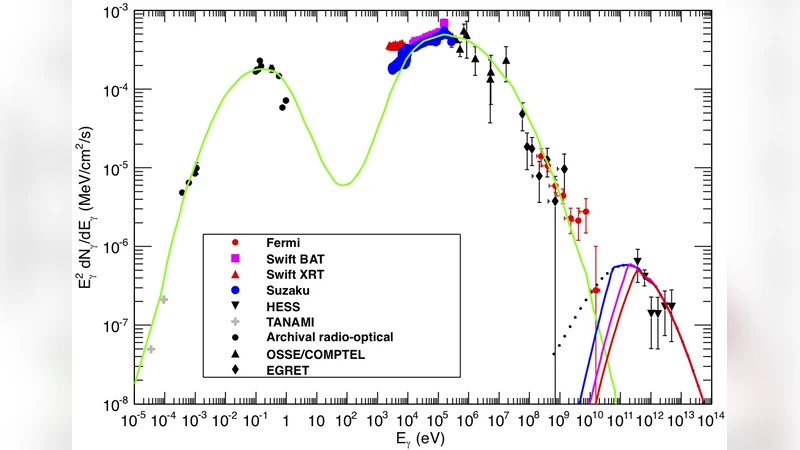
Centaurus A (Cen A) is the nearest radio-loud AGN and is detected from radio to very high energy gamma-rays. Its nuclear spectral energy distribution (SED) shows a double-peak feature, which is well explained by the leptonic synchrotron + synchrotron self-Compton model. This model however cannot account for the observed high energy photons in the TeV range, which display a distinct component. Here we show that ~ TeV photons can be well interpreted as the neutral pion decay products from p-gamma interactions of Fermi accelerated high energy protons in the jet with the seed photons around the second SED peak at ~170 keV. Extrapolating the inferred proton spectrum to high energies, we find that this same model is consistent with the detection of 2 ultra-high-energy cosmic ray events detected by Pierre Auger Observatory from the direction of Cen A. We also estimate the GeV neutrino flux from the same process, and find that it is too faint to be detected by current high-energy neutrino detectors.
💡 Research Summary
Centaurus A (Cen A) is the nearest radio‑loud active galactic nucleus and has been detected across the entire electromagnetic spectrum, from radio up to very‑high‑energy (VHE) gamma‑rays. Its broadband spectral energy distribution (SED) exhibits the classic double‑hump shape that is well reproduced by a leptonic synchrotron plus synchrotron‑self‑Compton (SSC) scenario. However, the SSC component falls far short of the flux measured in the tera‑electron‑volt (TeV) band, where a distinct hard gamma‑ray component is observed by ground‑based Cherenkov telescopes (H.E.S.S., MAGIC, etc.).
In this work the authors propose that the TeV photons originate from hadronic processes, specifically from neutral‑pion (π⁰) decay following proton‑photon (p‑γ) interactions inside the jet. The target photon field is identified with the second SED peak, a hard X‑ray bump centered at ≈170 keV, which provides a dense field of seed photons for photomeson production. Protons accelerated by a Fermi‑type mechanism acquire a power‑law spectrum, dNₚ/dEₚ ∝ Eₚ⁻ᵅ, and interact with the 170 keV photons via the Δ‑resonance. The resulting π⁰’s decay almost instantaneously into two gamma‑rays, each carrying roughly 10 % of the parent proton energy, thereby populating the observed TeV band.
The authors calculate the p‑γ interaction efficiency fₚγ by integrating the product of the photon density, the photomeson cross‑section, and the inelasticity over the relevant photon energies. Although fₚγ is modest (∼10⁻³), the required proton luminosity is compatible with the jet power inferred from radio observations, and the resulting π⁰‑decay gamma‑ray spectrum reproduces both the flux level and the spectral slope measured by the Cherenkov telescopes.
Having fixed the proton spectrum to match the TeV data, the authors extrapolate it to ultra‑high energies (UHE, >10¹⁹ eV). They then estimate the flux of escaping protons that could reach Earth, taking into account propagation losses (photopion production on the cosmic microwave background, pair production) and magnetic deflections. The predicted UHECR flux from the direction of Cen A is consistent with the two events reported by the Pierre Auger Observatory (PAO) that are spatially correlated with Cen A within the experimental angular resolution. This suggests that the same jet‑based acceleration site can simultaneously account for the TeV gamma‑ray excess and a fraction of the observed UHECRs.
The same p‑γ interactions inevitably produce charged pions (π±), whose decays generate high‑energy neutrinos (νμ, ν̄μ). The authors compute the associated neutrino spectrum, finding a GeV–TeV neutrino flux of order 10⁻¹⁰ GeV cm⁻² s⁻¹, well below the current sensitivity of IceCube, ANTARES, and the forthcoming KM3NeT. Consequently, no neutrino counterpart to the Cen A TeV emission is expected with present detectors.
Key insights of the paper are:
- The TeV gamma‑ray component of Cen A can be naturally explained by hadronic π⁰ decay resulting from p‑γ interactions with the hard X‑ray photon field.
- The proton spectrum required for the γ‑ray fit, when extended to ultra‑high energies, yields a UHECR flux compatible with the PAO detections, linking Cen A’s jet to both photon and cosmic‑ray phenomenology.
- The accompanying neutrino signal is predicted to be too faint for current observatories, explaining the lack of a neutrino detection despite the strong hadronic activity.
Methodologically, the paper combines multi‑wavelength SED modeling, photohadronic interaction physics, and cosmic‑ray propagation calculations into a self‑consistent framework. By anchoring the hadronic component to an observed photon field (the 170 keV bump), the authors reduce the number of free parameters and provide a physically motivated link between the electromagnetic and particle‑astrophysics observations of Cen A.
The study underscores the importance of considering hybrid leptonic–hadronic models for nearby radio galaxies, especially when a simple SSC description fails at the highest photon energies. Future improvements—such as more precise TeV spectra from the Cherenkov Telescope Array (CTA), deeper neutrino observations, and larger UHECR statistics—will be crucial to test the proposed scenario and to refine our understanding of particle acceleration in AGN jets.