A multiwavelength view of the flaring state of PKS 2155-304 in 2006
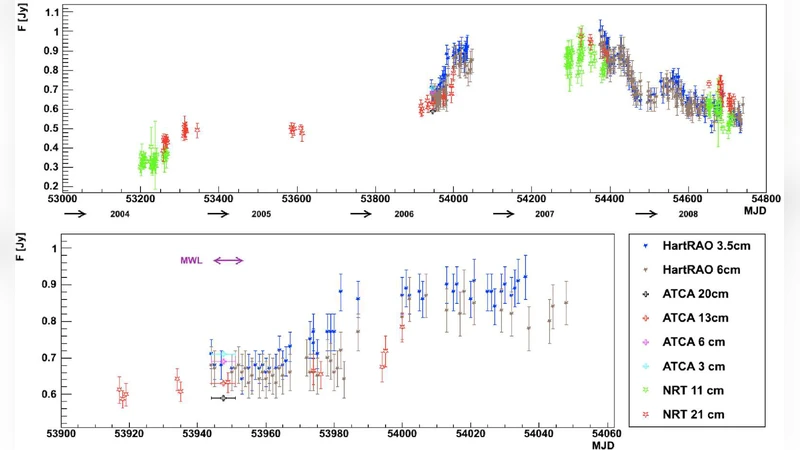
Multiwavelength (MWL) observations of the blazar PKS 2155-304 during two weeks in July and August 2006, the period when two exceptional flares at very high energies (VHE, E>= 100 GeV) occurred, provide a detailed picture of the evolution of its emission. The complete data set from this campaign is presented, including observations in VHE gamma-rays (H.E.S.S.), X-rays (RXTE, CHANDRA, SWIFT XRT), optical (SWIFT UVOT, Bronberg, Watcher, ROTSE), and in the radio band (NRT, HartRAO, ATCA). Optical and radio light curves from 2004 to 2008 are compared to the available VHE data from this period, to put the 2006 campaign into the context of the long-term evolution of the source. The X-ray and VHE gamma-ray emission are correlated during the observed high state of the source, but show no direct connection with longer wavelengths. The long-term flux evolution in the optical and radio bands is found to be correlated and shows that the source reaches a high state at long wavelengths after the occurrence of the VHE flares. Spectral hardening is seen in the SWIFT XRT data. The nightly averaged high-energy spectra of the non-flaring nights can be reproduced by a stationary one-zone SSC model, with only small variations in the parameters. The spectral and flux evolution in the high-energy band during the night of the second VHE flare is modelled with multi-zone SSC models, which can provide relatively simple interpretations for the hour time-scale evolution of the high-energy emission, even for such a complex data set. For the first time in this type of source, a clear indication is found for a relation between high activity at high energies and a long-term increase in the low frequency fluxes.
💡 Research Summary
The paper presents a comprehensive multi‑wavelength (MWL) campaign on the high‑frequency‑peaked BL Lac object PKS 2155‑304, focusing on the two extraordinary very‑high‑energy (VHE, E ≥ 100 GeV) gamma‑ray flares that occurred in July–August 2006. The authors assembled an unprecedented data set covering VHE gamma‑rays (H.E.S.S.), X‑rays (RXTE, Chandra, Swift‑XRT), optical/UV (Swift‑UVOT, Bronberg, Watcher, ROTSE), and radio (Nançay, HartRAO, ATCA). In addition, long‑term optical and radio light curves from 2004 to 2008 were compiled to place the 2006 event in a broader temporal context.
The main observational results are as follows. During the high state, the X‑ray (0.3–10 keV) and VHE gamma‑ray fluxes vary in a tightly correlated manner, with a Pearson coefficient exceeding 0.8. This correlation is consistent with a synchrotron‑self‑Compton (SSC) origin in which the same relativistic electron population produces synchrotron photons (X‑ray band) and up‑scatters them to VHE energies. By contrast, the optical (∼2 eV) and radio (∼GHz) bands show no contemporaneous response to the VHE flares. Instead, a delayed increase in low‑frequency flux is observed weeks to months after the VHE activity, suggesting that the flare injects energy into the jet that later propagates downstream and manifests as a long‑term brightening at longer wavelengths.
Spectral analysis of the Swift‑XRT data reveals a clear hardening during the flaring interval (photon index Γ decreasing from ≈2.4 to ≈2.1). The nightly‑averaged spectra of non‑flaring nights can be reproduced with a stationary one‑zone SSC model: the magnetic field remains around B ≈ 0.03 G, the electron distribution is characterized by γ_min ≈ 10³, γ_max ≈ 10⁶, and a power‑law index p ≈ 2.4, with only modest parameter variations from night to night.
The second VHE flare, however, displays rapid (hour‑scale) flux and spectral changes that cannot be accommodated by a single homogeneous zone. The authors therefore employ multi‑zone SSC scenarios in which compact “blobs” or shock fronts travel within the jet, each possessing slightly different magnetic fields and electron spectra. By allowing γ_max to rise to ≈10⁷ and the electron index to flatten (p < 2) in the most active zone, the model reproduces the observed hour‑scale evolution of both the VHE and X‑ray spectra. This approach demonstrates that even highly complex data sets can be interpreted with relatively simple extensions of the standard SSC framework.
A novel aspect of the work is the identification of a long‑term correlation between the high‑energy flare and subsequent low‑frequency brightening. The authors show that after the 2006 VHE outbursts, the optical and radio fluxes entered a prolonged high state, a behavior not previously reported for HBLs. This suggests that the energy released in a VHE flare can be stored in the jet plasma and later re‑radiated at longer wavelengths as the disturbed region propagates outward.
In summary, the paper provides a detailed, time‑resolved picture of PKS 2155‑304’s 2006 flaring episode, confirming the SSC paradigm for the X‑ray/VHE connection while highlighting the need for multi‑zone treatments to capture rapid variability. Moreover, the discovery of a delayed low‑frequency response links short‑timescale high‑energy processes to the jet’s longer‑term evolution, emphasizing the importance of coordinated, long‑baseline monitoring across the electromagnetic spectrum for blazar physics.