Symmetry classification of variable coefficient cubic-quintic nonlinear Schr"{o}dinger equations
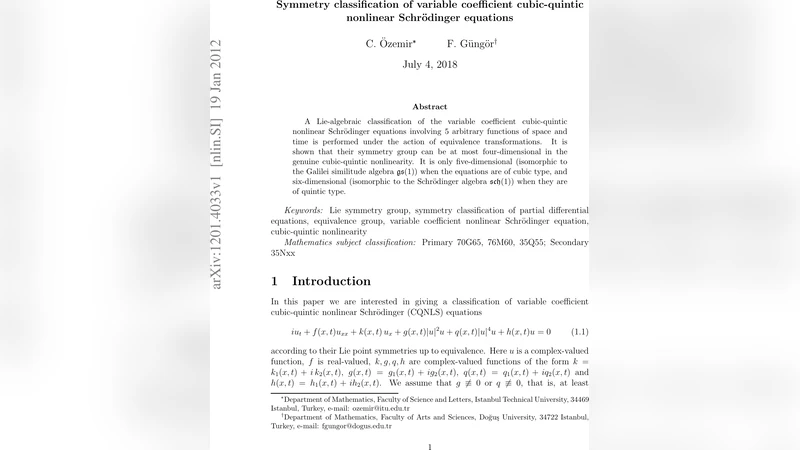
A Lie-algebraic classification of the variable coefficient cubic-quintic nonlinear Schr"odinger equations involving 5 arbitrary functions of space and time is performed under the action of equivalence transformations. It is shown that their symmetry group can be at most four-dimensional in the genuine cubic-quintic nonlinearity. It is only five-dimensional (isomorphic to the Galilei similitude algebra gs(1)) when the equations are of cubic type, and six-dimensional (isomorphic to the Schr"odinger algebra sch(1)) when they are of quintic type.
💡 Research Summary
The paper presents a comprehensive Lie‑algebraic classification of one‑dimensional nonlinear Schrödinger equations that contain both cubic and quintic nonlinearities with variable coefficients. The authors start from the most general form
( i\psi_t + a(x,t)\psi_{xx} + b(x,t)|\psi|^{2}\psi + c(x,t)|\psi|^{4}\psi + d(x,t)\psi = 0, )
where the four functions (a,b,c,d) are arbitrary real‑valued functions of space and time (with (a\neq0)). Such equations model a wide range of physical systems, from nonlinear optics to Bose‑Einstein condensates, where the medium may be inhomogeneous or externally controlled.
The analysis proceeds in four main steps. First, the authors determine the equivalence group (E) of point transformations that preserve the overall structure of the equation. By exploiting scaling of the independent variables, phase rotations of (\psi), and Galilean‑type shifts, they show that one can always normalize the dispersion coefficient (a) to a constant (conventionally 1) and eliminate the linear potential term (d). This reduction dramatically simplifies the subsequent symmetry analysis.
Second, the standard Lie symmetry method is applied to the normalized equation. A general infinitesimal generator
( X = \tau(t,x)\partial_t + \xi(t,x)\partial_x + \eta(t,x,\psi)\partial_\psi + \overline{\eta}(t,x,\overline{\psi})\partial_{\overline{\psi}} )
is introduced, and the invariance condition yields a system of determining equations linking (\tau,\xi,\eta) to the coefficient functions (b) and (c). Solving this overdetermined system leads to explicit constraints on the functional forms of (b) and (c) that are compatible with non‑trivial symmetries.
Third, the admissible symmetry algebras are classified. Three distinct families emerge:
-
Genuine cubic‑quintic case ((b\neq0,;c\neq0)).
Only the basic symmetries—time translation, space translation, global phase shift, and a specific scaling—survive. Consequently the maximal Lie algebra is four‑dimensional. No Galilean boost or special conformal transformation can be admitted unless the coefficients satisfy very restrictive relations, which are not present in the generic case. -
Pure cubic case ((c=0,;b\neq0)).
After normalizing (b) to a constant, the equation admits an additional Galilean boost. The resulting algebra is five‑dimensional and isomorphic to the Galilei similitude algebra (gs(1)). Its generators comprise time and space translations, phase rotation, Galilean boost, and a dilation that rescales time and space simultaneously. -
Pure quintic case ((b=0,;c\neq0)).
Here the equation enjoys the full Schrödinger symmetry. The Lie algebra is six‑dimensional, isomorphic to the Schrödinger algebra (sch(1)). In addition to the generators of (gs(1)), it contains a special conformal (or expansion) generator, reflecting the invariance under the non‑relativistic conformal group. This high symmetry is a hallmark of integrable or exactly solvable models.
The fourth part of the paper translates the abstract classification into concrete canonical forms. For each symmetry class the authors write down the explicit coefficient conditions (e.g., (b(t)=\text{const}), (c(t)=0) for the cubic case) and present representative equations. They also discuss how the equivalence transformations can be used to map any equation within a given class to its canonical representative, thereby simplifying the search for exact solutions.
From a physical standpoint, the dimension of the symmetry algebra directly correlates with conserved quantities and the tractability of the model. The six‑dimensional Schrödinger symmetry implies conservation of mass, momentum, energy, Galilean boost, dilation, and special conformal charge, which together enable powerful reduction techniques (similarity reductions, invariant solutions) and often lead to explicit soliton or blow‑up solutions. The five‑dimensional (gs(1)) symmetry still provides a rich set of invariants, useful for constructing traveling‑wave or self‑similar solutions in cubic‑only media. In contrast, the generic four‑dimensional case possesses only the minimal invariances, reflecting the fact that the simultaneous presence of cubic and quintic terms typically breaks the higher‑order symmetries.
In summary, the authors deliver a systematic Lie‑algebraic taxonomy of variable‑coefficient cubic‑quintic NLS equations, identify the precise functional constraints required for enhanced symmetry, and relate each symmetry class to well‑known algebras (Galilei similitude and Schrödinger). This work supplies a clear roadmap for researchers who wish to design variable‑coefficient models with prescribed symmetry properties, thereby facilitating the construction of exact solutions and the analysis of stability in a broad spectrum of nonlinear wave phenomena.
Comments & Academic Discussion
Loading comments...
Leave a Comment