The late-time afterglow of the extremely energetic short burst GRB 090510 revisited
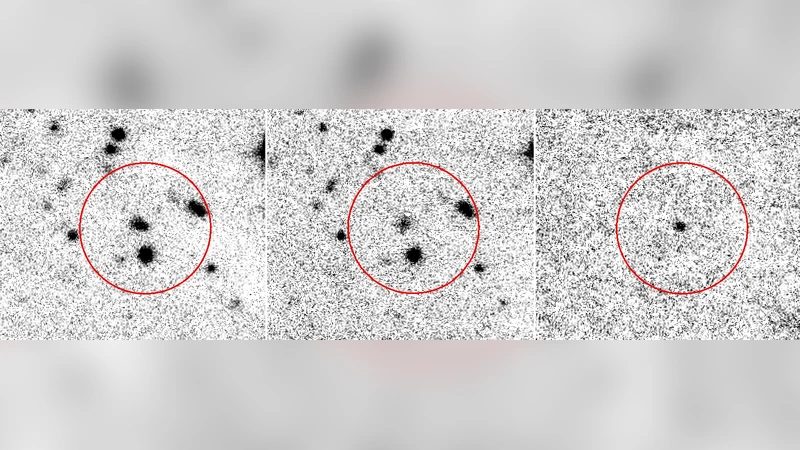
The discovery of the short GRB 090510 has raised considerable attention mainly because it had a bright optical afterglow and it is among the most energetic events detected so far within the entire GRB population. The afterglow was observed with swift/UVOT and swift/XRT and evidence of a jet break around 1.5 ks after the burst has been reported in the literature, implying that after this break the optical and X-ray light curve should fade with the same decay slope. As noted by several authors, the post-break decay slope seen in the UVOT data is much shallower than the steep decay in the X-ray band, pointing to an excess of optical flux at late times. We reduced and analyzed new afterglow light-curve data obtained with the multichannel imager GROND. Based on the densely sampled data set obtained with GROND, we find that the optical afterglow of GRB 090510 did indeed enter a steep decay phase starting around 22 ks after the burst. During this time the GROND optical light curve is achromatic, and its slope is identical to the slope of the X-ray data. In combination with the UVOT data this implies that a second break must have occurred in the optical light curve around 22 ks post burst, which, however, has no obvious counterpart in the X-ray band, contradicting the interpretation that this could be another jet break. The GROND data provide the missing piece of evidence that the optical afterglow of GRB 090510 did follow a post-jet break evolution at late times.
💡 Research Summary
The paper revisits the afterglow of the short, exceptionally energetic gamma‑ray burst GRB 090510, focusing on the apparent discrepancy between its optical and X‑ray decay slopes reported in earlier studies. GRB 090510, detected on 10 May 2009, belongs to the most luminous short‑burst population, with an isotropic‑equivalent energy exceeding 10⁵³ erg. Early observations with Swift’s UV/Optical Telescope (UVOT) and X‑Ray Telescope (XRT) suggested a jet break at roughly 1.5 ks after trigger. In the standard external‑shock model, a jet break should cause the optical and X‑ray light curves to decay with the same power‑law index thereafter. However, the UVOT data displayed a much shallower decay (α≈1.2) compared with the X‑ray decay (α≈2.2), implying an excess of optical flux at late times. This inconsistency prompted the authors to obtain densely sampled, multi‑band optical data with the GROND imager, which simultaneously observes in seven filters (g′, r′, i′, z′, J, H, Kₛ).
GROND observations began a few kiloseconds after the burst and continued for over 100 ks, providing a high‑cadence light curve especially around 20–30 ks where previous data were sparse. After standard reduction (bias subtraction, flat‑fielding, sky subtraction, and photometric calibration), the authors constructed a combined optical light curve. They found that around 22 ks post‑trigger the optical flux entered a steep decline with a decay index α_opt ≈ 2.2, identical to the contemporaneous X‑ray decay (α_X ≈ 2.2). Moreover, the GROND colors remained constant across the break, indicating no significant spectral evolution and suggesting that the same electron population continued to dominate the emission.
These results lead to two key conclusions. First, the previously reported break at 1.5 ks cannot be interpreted as the true jet break; rather, it likely reflects an early‑time transition (perhaps the tail of a prompt optical flare or a change in the external medium) that affected the optical band more strongly than the X‑ray band. Second, the break observed at ~22 ks represents the genuine post‑jet‑break phase for the optical afterglow, as evidenced by the achromatic steepening and the matching decay slopes. The lack of a corresponding feature in the X‑ray light curve, however, indicates that the optical and X‑ray emissions may arise from regions with different physical conditions (e.g., magnetic field strength, ambient density, or electron energy distribution). The authors discuss possible explanations, including a refreshed shock that re‑energizes the optical emitting region, density inhomogeneities in the circumburst medium, or a two‑component jet where the optical and X‑ray components have distinct opening angles.
In summary, the GROND data fill the observational gap that previously left the optical afterglow of GRB 090510 apparently inconsistent with the standard jet‑break scenario. By demonstrating that the optical light curve does, in fact, undergo a steep, achromatic decay matching the X‑ray after the second break, the study confirms that GRB 090510 follows the expected post‑jet‑break evolution at late times. This work underscores the importance of long‑duration, multi‑wavelength monitoring for short GRBs and illustrates how dense optical sampling can resolve apparent contradictions in afterglow physics.