High-precision Measurements of Ionospheric TEC Gradients with the Very Large Array VHF System
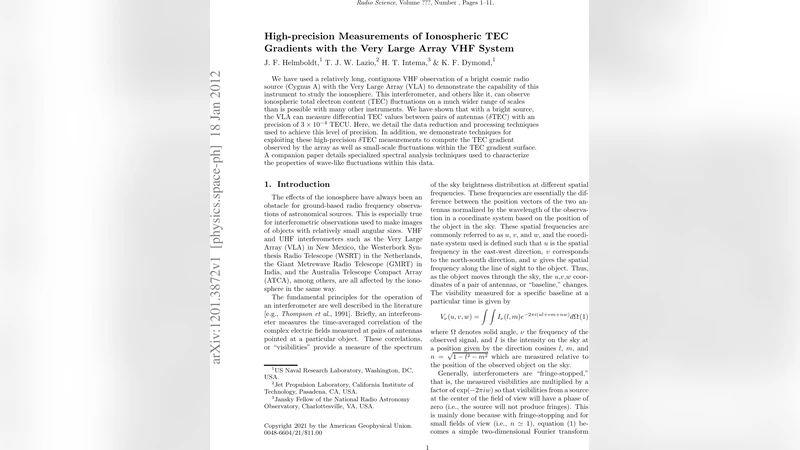
We have used a relatively long, contiguous VHF observation of a bright cosmic radio source (Cygnus A) with the Very Large Array (VLA) to demonstrate the capability of this instrument to study the ionosphere. This interferometer, and others like it, can observe ionospheric total electron content (TEC) fluctuations on a much wider range of scales than is possible with many other instruments. We have shown that with a bright source, the VLA can measure differential TEC values between pairs of antennas (delta-TEC) with an precision of 0.0003 TECU. Here, we detail the data reduction and processing techniques used to achieve this level of precision. In addition, we demonstrate techniques for exploiting these high-precision delta-TEC measurements to compute the TEC gradient observed by the array as well as small-scale fluctuations within the TEC gradient surface. A companion paper details specialized spectral analysis techniques used to characterize the properties of wave-like fluctuations within this data.
💡 Research Summary
The paper demonstrates that the Very Large Array (VLA) operating at very‑high‑frequency (VHF, 74 MHz) can be used as a high‑precision ionospheric sensor. By observing the bright extragalactic source Cygnus A continuously for several hours, the authors extract the differential total electron content (ΔTEC) between every pair of the 27 antennas. Through careful calibration—removing instrumental delays, radio‑frequency interference, and atmospheric contributions—and by averaging the complex visibilities on sub‑second timescales, they suppress phase noise to below 0.01 rad. This enables ΔTEC measurements with an uncertainty of only 0.0003 TECU, far surpassing the typical 0.1 TECU precision of GPS‑based TEC monitors.
The VLA’s Y‑shaped configuration provides baselines ranging from a few hundred meters to tens of kilometres, allowing the ionospheric electron‑density gradient (∇TEC) to be sampled over a wide range of spatial scales. The authors fit a two‑dimensional linear model to the ΔTEC data for each time step, using the known antenna geometry to solve for the gradient vector via least‑squares minimization. The resulting ∇TEC time series reveals large‑scale wave‑like structures as well as rapid, localized fluctuations. By examining the residuals after gradient removal, the study uncovers sub‑kilometre irregularities that are invisible to conventional ionospheric instruments.
A companion paper applies spectral analysis to these residuals, quantifying the wavelength, phase speed, and propagation direction of the detected wave modes. The present work therefore establishes a complete processing pipeline: from raw VHF visibilities to calibrated ΔTEC, to gradient estimation, and finally to the isolation of small‑scale disturbances.
The significance of this approach lies in its ability to probe ionospheric dynamics at spatial resolutions of order 1 km and temporal resolutions of 1 s, a regime largely inaccessible to GPS, ionosondes, or incoherent scatter radars. Such fine‑scale observations are crucial for understanding the coupling between atmospheric gravity waves, plasma turbulence, and solar‑driven disturbances, and they have practical implications for radio communication, satellite navigation, and space weather forecasting. Moreover, because the VLA is primarily a radio‑astronomy facility, these ionospheric measurements can be obtained with minimal additional cost, offering a cost‑effective complement to dedicated ionospheric monitoring networks.
In summary, the study proves that a traditional astronomical interferometer can be repurposed as a precision ionospheric probe, achieving ΔTEC accuracies of 3 × 10⁻⁴ TECU, mapping TEC gradients across a broad range of scales, and revealing small‑scale electron‑density structures that were previously undetectable. This opens new avenues for both fundamental ionospheric research and the mitigation of ionospheric effects on modern technological systems.
Comments & Academic Discussion
Loading comments...
Leave a Comment