Non-Stationary Forward Flux Sampling
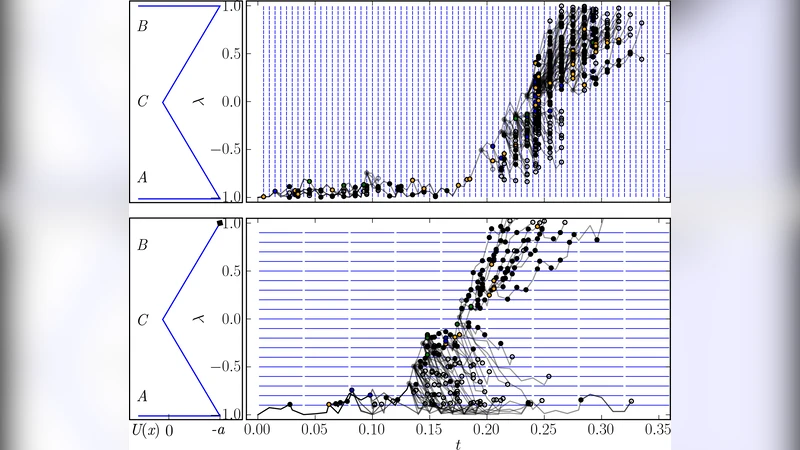
We present a new method, Non-Stationary Forward Flux Sampling, that allows efficient simulation of rare events in both stationary and non-stationary stochastic systems. The method uses stochastic branching and pruning to achieve uniform sampling of trajectories in phase space and time, leading to accurate estimates for time-dependent switching propensities and time-dependent phase space probability densities. The method is suitable for equilibrium or non-equilibrium systems, in or out of stationary state, including non-Markovian or externally driven systems. We demonstrate the validity of the technique by applying it to a one-dimensional barrier crossing problem that can be solved exactly, and show its usefulness by applying it to the time-dependent switching of a genetic toggle switch.
💡 Research Summary
The paper introduces Non‑Stationary Forward Flux Sampling (NS‑FFS), a novel algorithm designed to efficiently simulate rare events in stochastic systems that are either in a stationary regime or undergoing time‑dependent changes. Traditional Forward Flux Sampling (FFS) excels at estimating steady‑state transition rates but suffers from poor sampling efficiency when the underlying dynamics are non‑stationary, i.e., when transition probabilities evolve with time. NS‑FFS overcomes this limitation by integrating two key mechanisms: (i) stochastic branching‑pruning of trajectories and (ii) explicit discretisation of the time axis.
In the branching‑pruning step, each trajectory that reaches a predefined interface in phase space is either duplicated (branching) or removed (pruning) according to probabilistic rules that aim to keep the number of active trajectories at each interface close to a target value. When a trajectory is branched, its statistical weight is split equally between the two offspring; when pruned, its weight is set to zero. This dynamic adjustment guarantees uniform coverage of the phase‑space region of interest while preventing an explosion of computational cost in already‑well‑sampled regions. The second mechanism slices the simulation time into intervals and assigns a separate set of interfaces to each interval. Consequently, the algorithm can estimate a time‑dependent transition probability (P(t)) as a product of interface‑to‑interface crossing probabilities specific to each time slice, thereby capturing rapid variations in the switching propensity.
Mathematically, the method defines a sequence of interfaces (\lambda_0,\lambda_1,\dots,\lambda_N) and a set of time windows ({t_k}). For each window, the crossing probability (P_{i\to i+1}(t_k)) is measured using the weighted ensemble of branched trajectories. The overall time‑dependent switching propensity is then \