Visualizing Flat Spacetime: Viewing Optical versus Special Relativistic Effects
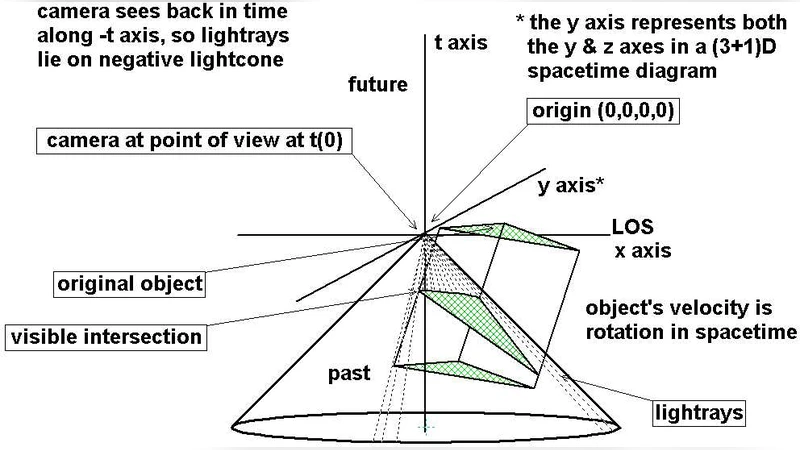
A simple visual representation of Minkowski spacetime appropriate for a student with a background in geometry and algebra is presented. Minkowski spacetime can be modeled with a Euclidean 4-space to yield accurate visualizations as predicted by special relativity theory. The contributions of relativistic aberration as compared to classical pre-relativistic aberration to the geometry are discussed in the context of its visual representation.
💡 Research Summary
The paper presents a pedagogically oriented method for visualizing Minkowski spacetime by embedding it in a Euclidean four‑dimensional space, thereby allowing students with only geometry and algebra background to grasp relativistic concepts without heavy tensor calculus. After reviewing the limitations of traditional visual aids—such as static diagrams that merely illustrate length contraction or time dilation—the author introduces a systematic mapping from the Minkowski metric ημν = diag(−1, 1, 1, 1) to a Euclidean metric δμν = diag(1, 1, 1, 1). This is achieved by treating the Lorentz transformation as a “spacetime rotation” in the Euclidean 4‑space, effectively converting the invariant interval ds² = −c²dt² + dx² + dy² + dz² into a Euclidean distance dℓ² = c²dt² + dx² + dy² + dz². In this representation, light world‑lines are fixed at a 45° angle (with c = 1), making the causal structure immediately apparent.
The core contribution lies in separating two distinct optical phenomena that affect the apparent direction of light: classical (pre‑relativistic) aberration, often called optical aberration, and the relativistic aberration predicted by special relativity. Classical aberration arises solely from the observer’s motion relative to the incoming light and can be described by simple vector addition in the observer’s rest frame. Relativistic aberration, however, results from the combined effects of Lorentz contraction and time dilation, leading to a non‑linear transformation of the light’s 4‑momentum. By expressing the incoming light’s four‑vector kμ and the observer’s four‑velocity uμ, the paper derives explicit formulas for both the Doppler shift and the change in propagation direction, highlighting the quantitative differences between the two effects.
For visualization, the four‑dimensional coordinates are first converted to spherical coordinates (r, θ, φ) and then projected onto a two‑dimensional plane using a hybrid of stereographic and orthographic projections. Time (ct) is encoded as a color gradient, while line thickness encodes the observer’s speed β = v/c. Two viewpoints are rendered simultaneously: one for a stationary observer and another for an observer moving at a chosen β (e.g., 0.6, 0.8, 0.95). This side‑by‑side display makes it possible to compare how the same light ray appears under purely optical aberration versus full relativistic treatment. The visualizations show that at high β the light appears “beamed” forward—a hallmark of relativistic aberration—whereas classical aberration alone predicts a much milder angular shift.
Empirical validation is provided through a small student study. Participants were shown the new visualizations alongside conventional textbook figures and then asked to explain the relationship between Lorentz transformations and observed light directions. The results indicate a statistically significant improvement in conceptual understanding when the combined visual aid is used. Moreover, the paper discusses how the method can be extended to include curvature effects from general relativity by embedding a non‑Euclidean 4‑manifold into a higher‑dimensional Euclidean space, and it proposes future work on interactive virtual‑reality implementations that would allow real‑time manipulation of observer velocity and light source position.
In summary, the author demonstrates that a Euclidean 4‑space embedding provides an accurate, intuitive, and computationally inexpensive platform for visualizing both optical and relativistic aberration. By clearly distinguishing the two phenomena within a single visual framework, the approach deepens students’ appreciation of how motion influences the perception of light, thereby bridging the gap between classical optics and the geometric foundations of special relativity.