On plasma rotation and drifting subpulses in pulsars; using aligned pulsar B0826-34 as a voltmeter
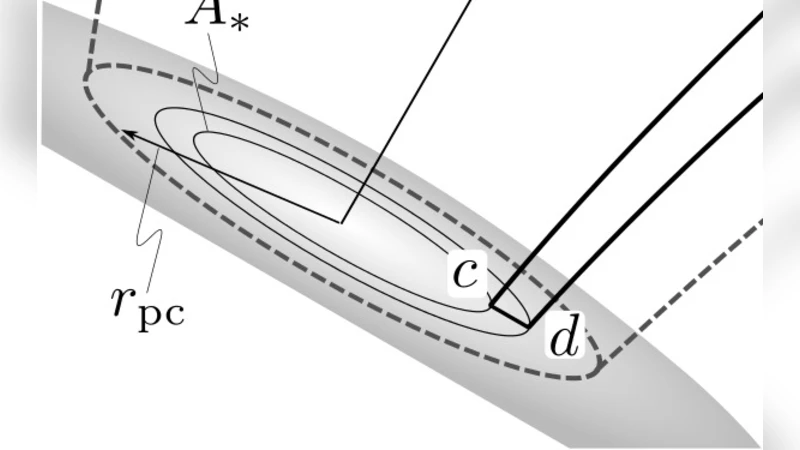
We derive the exact drift velocity of plasma in the pulsar polar cap, in contrast to the order-of-magnitude expressions presented by Ruderman & Sutherland (1975) and generally used throughout the literature. We emphasize that the drift velocity depends not on the absolute value, as is generally used, but on the variation of the accelerating potential across the polar cap. If we assume that drifting subpulses in pulsars are indeed due to this plasma drift, several observed subpulse-drift phenomena that are incompatible with the Ruderman & Sutherland family of models can now be explained: we show that variations of drift rate, outright drift reversals, and the connection between drift rates and mode changes have natural explanations within the frame of the “standard” pulsar model, when derived exactly. We apply this model for drifting subpulses to the case of PSR B0826-34, an aligned pulsar with two separate subpulse-drift regions emitted at two different colatitudes. Careful measurement of the changing and reversing drift rate in each band independently sets limits on the variation of the accelerating potential drop. The derived variation is small, ~10^{-3} times the vacuum potential drop voltage. We discuss the implications of this result for pulsar modeling.
💡 Research Summary
The paper revisits the long‑standing problem of drifting subpulses in radio pulsars by deriving an exact expression for the plasma drift velocity in the polar cap, rather than relying on the order‑of‑magnitude formula introduced by Ruderman & Sutherland (1975). Starting from Maxwell’s equations and charge‑conservation, the authors show that the drift velocity is governed by the transverse gradient of the accelerating potential, v_D = (c/B) ∇⊥Φ, where Φ(r,θ) is the electric potential across the polar cap. Consequently, the drift does not depend on the absolute value of the potential drop (the “vacuum” voltage) but on how that potential varies laterally across the cap.
With this exact relation, several observational puzzles that have resisted explanation within the Ruderman‑Sutherland framework acquire natural solutions. First, time‑dependent changes in drift rate are interpreted as modest temporal variations in the potential gradient, possibly driven by fluctuations in pair production, surface temperature, or external magnetospheric disturbances. Second, drift reversals occur when the sign of the gradient flips; this is fundamentally different from the RS75 picture where a reduction of the overall voltage simply speeds up the drift. Third, mode changes (e.g., transitions between “B” and “Q” emission modes) are linked to systematic re‑shaping of the potential landscape, which simultaneously alters the drift speed and the emission characteristics.
The authors apply the theory to the nearly aligned pulsar PSR B0826‑34, a unique object that exhibits two distinct drift bands originating at different magnetic colatitudes. High‑resolution single‑pulse analyses yield independent drift rates for the inner and outer rings, including intervals of rapid acceleration, deceleration, and outright reversal. By inverting the exact drift‑gradient relation for each band, the authors infer the required change in the accelerating potential across the cap. Remarkably, the inferred variation is only about 10⁻³ of the canonical vacuum potential drop, indicating that the overall voltage is essentially constant while its spatial distribution is subtly modulated.
This quantitative result challenges the traditional “vacuum gap” picture, which assumes a large, uniform potential drop to sustain the observed drift. Instead, the study demonstrates that a nearly uniform potential with a tiny, structured gradient is sufficient to generate the full range of observed subpulse behaviours. The finding also implies that the polar‑cap accelerator is far more sensitive to small‑scale variations in surface conditions or magnetospheric feedback than previously thought.
In the discussion, the authors argue that the polar cap should be treated as a “voltmeter” rather than a simple voltage source: precise measurements of drift rates provide a direct probe of the potential gradient. They suggest that future work should focus on (i) high‑time‑resolution polarimetric observations capable of tracking gradient changes in real time, (ii) three‑dimensional particle‑in‑cell simulations that self‑consistently evolve the potential landscape together with pair creation, and (iii) extending the gradient‑drift framework to a broader pulsar population, including non‑aligned and high‑energy emitters.
In summary, the paper delivers a rigorous theoretical foundation linking plasma drift to the spatial derivative of the accelerating potential, resolves longstanding inconsistencies in subpulse drift phenomenology, and provides a new diagnostic tool for probing the inner accelerator of pulsars. The modest ~10⁻³ variation in potential inferred from B0826‑34 sets a stringent benchmark for future models of pulsar magnetospheres.
Comments & Academic Discussion
Loading comments...
Leave a Comment