Variable gamma-ray sky at 1 GeV
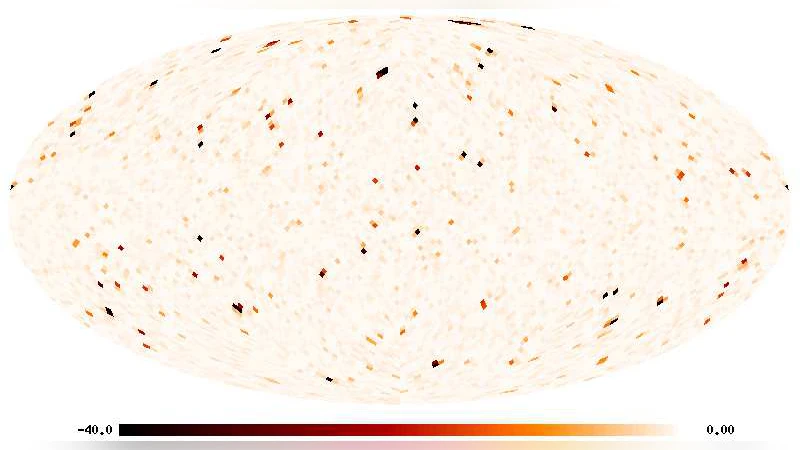
We search for the long-term variability of the \gamma-ray sky in the energy range E > 1 GeV with 168 weeks of Fermi-LAT data. We perform a full sky blind search for regions with variable flux looking for deviations from uniformity. We bin the sky into 12288 bins using Healpix package and use Kolmogorov-Smirnov test to compare weekly photon counts in each bin with a constant flux hypothesis. The weekly exposure of Fermi-LAT for each bin is calculated with the Fermi-LAT tools. We consider flux variations in the bin significant if statistical probability of uniformity is less than 4e-6, which corresponds to 0.05 false detections in the whole set. We identified 117 variable sources, variability of 27 of which has not been reported before. Among the sources with previously unidentified variability there are 25 AGNs belonging to blazar class (11 BL Lacs and 14 FSRQs), one AGN of uncertain type and one pulsar PSR J0633+1746 (Geminga). The observed long term flux variability of Geminga has a statistical significance of 5.1\sigma.
💡 Research Summary
The authors present a systematic, blind search for long‑term variability in the >1 GeV γ‑ray sky using 168 weeks of data from the Fermi Large Area Telescope (LAT). The sky is partitioned into 12 288 equal‑area pixels with the HEALPix scheme (Nside = 32). For each pixel they construct a weekly time series of photon counts and compute the corresponding weekly exposure using the standard Fermi‑LAT tools (gtltcube, gtexpcube2). By comparing the observed photon‑to‑exposure ratios to the hypothesis of a constant flux, they apply a non‑parametric Kolmogorov–Smirnov (KS) test to each pixel’s light curve.
A stringent significance threshold of p < 4 × 10⁻⁶ is adopted, which translates to an expected 0.05 false detections across the entire set of pixels. Pixels that fail the uniform‑flux hypothesis at this level are flagged as variable. This approach has two principal virtues: (1) the KS test does not require any assumption about the underlying count distribution, making it robust against Poisson fluctuations and exposure variations; (2) the method is computationally inexpensive and can be applied uniformly over the whole sky without prior source catalogs.
The analysis yields 117 variable locations. Cross‑matching with existing γ‑ray catalogs shows that 90 of them correspond to previously known variable sources, while 27 represent newly identified variability. Among the newly variable objects are 25 active galactic nuclei (AGNs) of the blazar class—11 BL Lacertae objects and 14 flat‑spectrum radio quasars (FSRQs)—plus one AGN of uncertain type. Remarkably, the pulsar Geminga (PSR J0633+1746) also exhibits significant long‑term flux changes, with a variability significance of 5.1 σ. This is the first robust detection of such variability in a source traditionally considered steady at GeV energies.
The paper discusses methodological strengths and limitations. The blind, pixel‑based KS test efficiently uncovers variability without requiring detailed source modeling, but its sensitivity diminishes in low‑count regimes (high Galactic latitude or regions of low exposure). Fixed‑size pixels can also dilute signals when a variable source lies near a pixel boundary, potentially splitting its photons across adjacent bins. Consequently, some weak or short‑duration flares may remain undetected.
The authors suggest several avenues for improvement. Adaptive pixelization (e.g., using a hierarchical scheme that refines around bright or variable regions) could recover flux that is currently split across boundaries. Complementary time‑series techniques—such as Bayesian block segmentation, Lomb‑Scargle periodograms, or wavelet analysis—could provide finer characterization of variability timescales and amplitudes. Multi‑wavelength follow‑up (radio, optical, X‑ray) of the newly variable blazars would help elucidate the physical drivers (e.g., jet dynamics, particle acceleration episodes) behind the observed γ‑ray changes. For Geminga, coordinated observations could test whether the variability is linked to magnetospheric reconfiguration, changes in the surrounding pulsar wind nebula, or other processes.
In summary, this work establishes a robust, all‑sky framework for detecting long‑term γ‑ray variability at GeV energies, expands the roster of known variable high‑energy sources, and highlights the surprising variability of a classic pulsar. The methodology and results provide a valuable foundation for future studies aiming to connect γ‑ray variability with the underlying astrophysical mechanisms across the diverse population of high‑energy emitters.