Extending gravitational wave burst searches with pulsar timing arrays
Pulsar timing arrays (PTAs) are being used to search for very low frequency gravitational waves. A gravitational wave signal appears in pulsar timing residuals through two components: one independent of and one dependent on the pulsar’s distance, called the ‘Earth term’ (ET) and ‘pulsar term’ (PT), respectively. The signal of a burst (or transient) gravitational wave source in pulsars’ residuals will in general have the Earth and pulsar terms separated by times of the order of the time of flight from the pulsar to the Earth. Therefore, both terms are not observable over a realistic observation span, but the ETs observed in many pulsars should be correlated. We show that pairs (or more) of pulsars can be aligned in such a way that the PTs caused by a source at certain sky locations can arrive at Earth within a time window short enough to be captured during a realistic observation span. We find that for the pulsars within the International Pulsar Timing Array (IPTA) ~67 per cent of the sky produces such alignments for pulsars terms separated by less than 10 years. We compare estimates of the source event rate that would be required to observe one signal in the IPTA if searching for the correlated ETs, or in searching via the PTs, and find that event rates would need to be about two orders of magnitude higher to observe an event with the PTs than the ETs. We also find that an array of hundreds of thousands of pulsars would be required to achieve similar numbers of observable events in PT or ET searches. This disfavours PTs being used for all-sky searches, but they could potentially be used target specific sources and be complementary to ET only searches.
💡 Research Summary
Pulsar timing arrays (PTAs) are a mature tool for detecting ultra‑low‑frequency gravitational waves (GWs) by measuring the arrival‑time residuals of millisecond pulsars. A GW burst leaves two distinct imprints in these residuals: the Earth term (ET), which is common to all pulsars because the wave passes the Earth, and the pulsar term (PT), which arrives after the wave has traveled the pulsar‑to‑Earth distance. The PT is typically delayed by thousands to millions of years, far exceeding any realistic observing span of a few to a few tens of years, and therefore has been considered inaccessible for burst searches.
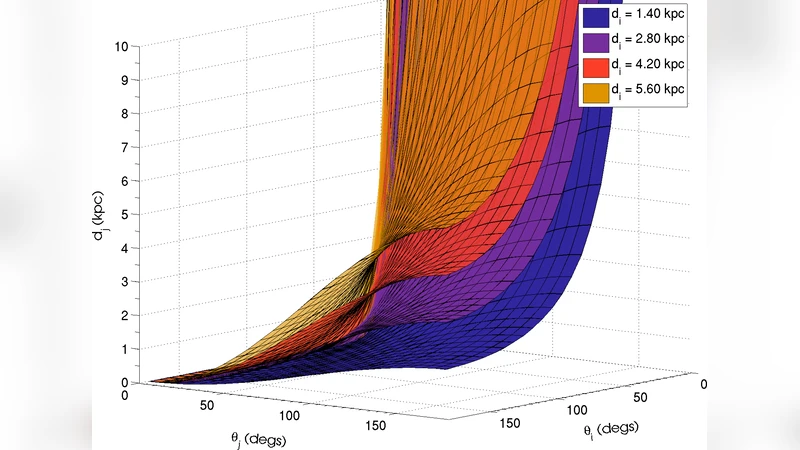
The authors revisit this assumption by asking whether, for a given sky location, the PTs from two or more pulsars can be made to arrive at Earth within a short enough interval to be captured during a normal PTA campaign. The key insight is geometric: the difference in arrival times of the PTs from two pulsars depends on the relative orientation of the source, the two pulsars, and the Earth. By selecting pulsar pairs whose line‑of‑sight vectors to the source are nearly parallel, the extra light‑travel time between the two PTs can be reduced to a few years.
Using the 49 pulsars currently monitored by the International Pulsar Timing Array (IPTA), the authors performed an all‑sky scan to quantify the fraction of the sky for which at least one pulsar pair satisfies a PT separation ≤ 10 yr. They find that roughly 67 % of the sky meets this criterion, meaning that for most source directions a suitable pair (or small group) of pulsars can be identified whose PTs would be temporally coincident enough to be observable.
Having established the geometric feasibility, the paper then compares the observational efficiency of ET‑based versus PT‑based burst searches. An ET is intrinsically correlated across the entire array, so a single GW event can produce a high‑signal‑to‑noise ratio (SNR) detection when combined over many pulsars. In contrast, PTs are independent for each pulsar; to achieve the same SNR one must either observe many more PTs (i.e., have many more pulsars) or rely on a much higher intrinsic event rate. Quantitatively, the authors estimate that the required event rate for PT detection would need to be about two orders of magnitude larger than that for ET detection.
They further explore the scaling with array size. To bring PT‑based detection on par with ET‑based detection, an array of order 10⁵–10⁶ pulsars would be necessary. Even optimistic projections for the Square Kilometre Array (SKA) foresee only a few thousand well‑timed pulsars, far short of the required numbers. Consequently, PTs are unlikely to become the primary channel for all‑sky burst searches.
Nevertheless, PTs may still have a niche role. For known or suspected transient sources—such as a supermassive black‑hole binary merger in a particular galaxy—the PTs from a carefully chosen set of pulsars could be monitored as a targeted search. In such a scenario the PT provides an independent confirmation of an ET detection and can help break degeneracies in source localisation and waveform reconstruction.
In summary, the paper demonstrates that while the pulsar term can, in principle, be aligned across multiple pulsars to fall within a realistic observing window for a large fraction of the sky, the practical requirements (much higher event rates or an unrealistically large pulsar population) make PT‑based all‑sky burst searches uncompetitive with the traditional Earth‑term approach. PTs are best viewed as a complementary tool for targeted investigations or for cross‑validation of ET detections, rather than as a replacement for ET‑centric PTA analyses.