Phase-resolved optical and X-ray spectroscopy of low-mass X-ray binary X1822-371
(Abridged) X1822-371 is the prototypical accretion disc corona X-ray source, a low-mass X-ray binary viewed at very high inclination, thereby allowing the disc structure and extended disc coronal regions to be visible. We study the structure of the accretion disc in X1822-371 by modelling the phase-resolved spectra both in optical and X-ray regime. We analyse high time resolution optical ESO/VLT spectra of X1822-371 to study the variability in the emission line profiles. In addition, we use data from XMM-Newton space observatory to study phase-resolved as well as high resolution X-ray spectra. We apply the Doppler tomography technique to reconstruct a map of the optical emission distribution in the system. We fit multi-component models to the X-ray spectra. We find that our results from both the optical and X-ray analysis can be explained with a model where the accretion disc has a thick rim in the region where the accretion stream impacts the disc. The behaviour of the H_beta line complex implies that some of the accreting matter creates an outburst around the accretion stream impact location and that the resulting outflow of matter moves both away from the accretion disc and towards the centre of the disc. Such behaviour can be explained by an almost isotropic outflow of matter from the accretion stream impact region. The optical emission lines of HeII 4686 and 5411 show double peaked profiles, typical for an accretion disc at high inclination. However, their velocities are slower than expected for an accretion disc in a system like X1822-371. This, combined with the fact that the HeII emission lines do not get eclipsed during the partial eclipse in the continuum, suggests that the line emission does not originate in the orbital plane and is more likely to come from above the accretion disc, for example the accretion disc wind.
💡 Research Summary
X1822‑371 is the prototypical Accretion Disc Corona (ADC) low‑mass X‑ray binary observed at a very high inclination (≈85°), which makes the vertical structure of the disc and its extended corona directly visible. In this work the authors combine high‑time‑resolution optical spectroscopy obtained with the ESO/VLT and phase‑resolved X‑ray spectroscopy from XMM‑Newton to investigate the geometry and dynamics of the accretion flow.
The optical data consist of sub‑second resolution spectra covering the Balmer Hβ line and the He II 4686 Å and He II 5411 Å lines. The Hβ profile shows a complex blend of absorption and emission components that shift from blue‑ward to red‑ward as the binary progresses through its orbit, indicating material that is launched from the impact point of the accretion stream onto the disc and moves both away from and toward the disc plane. The He II lines display classic double‑peaked profiles, but the separation of the peaks corresponds to velocities of only ~300 km s⁻¹, considerably slower than the Keplerian velocities expected for a disc of this size (~500 km s⁻¹). Moreover, the He II emission is not eclipsed during the partial optical eclipse, implying that the line‑forming region lies above the orbital plane, most plausibly in a disc wind or corona.
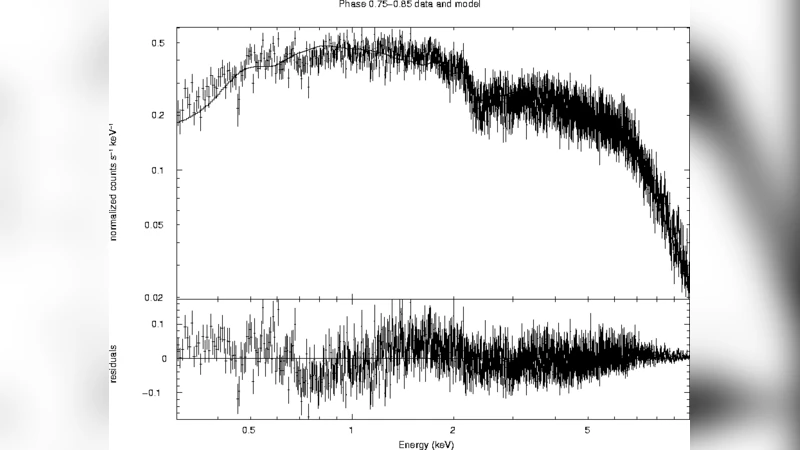
X‑ray spectra were extracted from EPIC‑pn and the high‑resolution RGS instruments in several orbital phase bins. The authors fit a multi‑component model that includes a hot (kT≈10 keV) Comptonised continuum from the ADC, partial covering absorption with column densities up to ~10²³ cm⁻², and reflection features such as the Fe Kα line. The absorption depth varies with phase, being strongest just after the stream‑disc impact and weaker near superior conjunction, consistent with a thickened rim at the disc edge that periodically obscures the central X‑ray source.
Doppler tomography of the optical lines reveals that He II emission is concentrated at radii of ~0.6 RL₁ (the distance from the neutron star to the inner Lagrange point), while Hβ emission peaks much closer to the impact region (~0.2 RL₁) and shows a pronounced asymmetry. This spatial segregation supports a picture in which the stream impact creates a vertically extended “bulge” or rim, from which material is expelled quasi‑isotropically. The expelled gas forms a high‑latitude wind that carries a fraction of the kinetic energy of the stream, producing the observed He II double‑peaked but low‑velocity profiles and the lack of eclipse.
Putting together the optical and X‑ray diagnostics, the authors propose a coherent scenario: (1) the accretion stream strikes the outer disc, generating a thick rim and a localized region of high pressure; (2) this region drives an almost isotropic outflow that lifts material above the disc plane, forming a hot, ionised wind responsible for the He II emission; (3) the wind co‑exists with the canonical ADC, which produces the bulk of the X‑ray continuum; (4) the thick rim periodically obscures the central X‑ray source, giving rise to the observed phase‑dependent absorption and partial eclipses.
The study demonstrates that a simple thin‑disc plus corona model is insufficient for high‑inclination LMXBs like X1822‑371. Instead, a three‑dimensional structure comprising a thickened rim, a stream‑impact‑driven wind, and an extended corona is required to explain both the optical line behaviour and the X‑ray spectral variability. This integrated approach provides a valuable template for interpreting other ADC sources and for refining theoretical models of mass transfer and disc‑wind interactions in compact binaries.
Comments & Academic Discussion
Loading comments...
Leave a Comment