Interaction of Recoiling Supermassive Black Holes with Stars in Galactic Nuclei
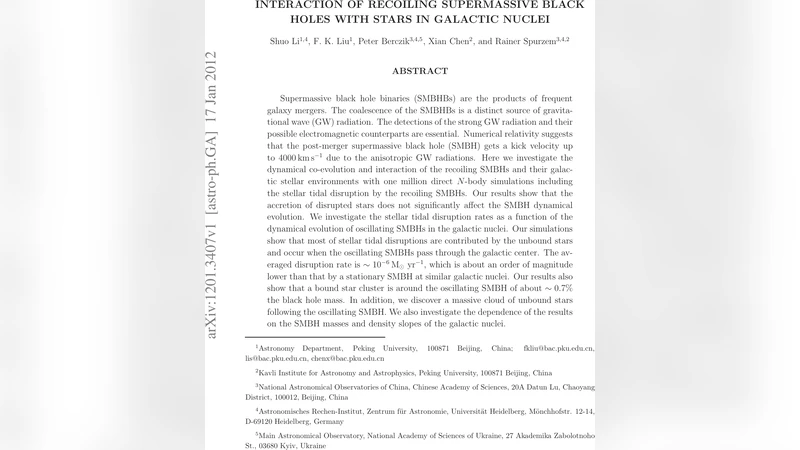
Supermassive black hole binaries (SMBHBs) are the products of frequent galaxy mergers. The coalescence of the SMBHBs is a distinct source of gravitational wave (GW) radiation. The detections of the strong GW radiation and their possible electromagnetic counterparts are essential. Numerical relativity suggests that the post-merger supermassive black hole (SMBH) gets a kick velocity up to 4000 km/s due to the anisotropic GW radiations. Here we investigate the dynamical co-evolution and interaction of the recoiling SMBHs and their galactic stellar environments with one million direct N-body simulations including the stellar tidal disruption by the recoiling SMBHs. Our results show that the accretion of disrupted stars does not significantly affect the SMBH dynamical evolution. We investigate the stellar tidal disruption rates as a function of the dynamical evolution of oscillating SMBHs in the galactic nuclei. Our simulations show that most of stellar tidal disruptions are contributed by the unbound stars and occur when the oscillating SMBHs pass through the galactic center. The averaged disruption rate is ~10^{-6} M_\odot yr^{-1}, which is about an order of magnitude lower than that by a stationary SMBH at similar galactic nuclei. Our results also show that a bound star cluster is around the oscillating SMBH of about ~ 0.7% the black hole mass. In addition, we discover a massive cloud of unbound stars following the oscillating SMBH. We also investigate the dependence of the results on the SMBH masses and density slopes of the galactic nuclei.
💡 Research Summary
The paper investigates the dynamical evolution and stellar interactions of supermassive black holes (SMBHs) that receive a recoil (“kick”) after the coalescence of a supermassive black‑hole binary (SMBHB). Numerical‑relativity calculations predict that anisotropic gravitational‑wave emission can impart velocities up to ~4000 km s⁻¹ to the remnant SMBH. To explore the consequences of such kicks for the surrounding nuclear star cluster, the authors performed a suite of direct N‑body simulations with one million stellar particles, explicitly including tidal‑disruption events (TDEs) when stars pass within the tidal radius of the moving SMBH.
The simulation set spans three SMBH masses (10⁶, 10⁷, and 10⁸ M⊙) and three initial stellar density slopes (ρ∝r⁻ᵞ with γ = 0.5, 1.0, 1.5). Kick velocities were varied from 500 km s⁻¹ to 4000 km s⁻¹, and each model was evolved for several dynamical times to allow the SMBH to oscillate through the galactic centre, lose energy via dynamical friction, and eventually settle back (or escape) depending on the kick strength.
Key findings are:
-
TDE Rate and Origin – The average mass accretion rate from disrupted stars is ≈10⁻⁶ M⊙ yr⁻¹, roughly an order of magnitude lower than that of a stationary SMBH in a comparable nucleus. Most disruptions (≈70 %) involve unbound stars that happen to be swept up when the recoiling SMBH passes through the dense central region. A smaller fraction occurs near the turning points of the SMBH’s orbit where the relative velocity between the SMBH and surrounding stars is reduced.
-
Negligible Dynamical Feedback – The total mass contributed by disrupted stars is far too small to affect the SMBH’s orbital decay. The recoil trajectory is governed almost entirely by dynamical friction against the background stellar distribution and the initial kick energy; the accretion of TDE debris does not produce a measurable change in the SMBH’s amplitude or period of oscillation.
-
Bound Stellar Cluster – As the SMBH oscillates, a compact cluster of stars becomes gravitationally bound to it. The bound mass stabilises at ~0.7 % of the SMBH mass, independent of kick velocity but weakly dependent on the host density slope (steeper cusps retain slightly more bound stars). This cluster remains centred on the SMBH throughout its motion and could manifest observationally as a hyper‑compact stellar system moving relative to the host galaxy.
-
Trailing Unbound Cloud – A previously unreported feature emerges: a massive “cloud” of unbound stars that lags behind the moving SMBH. Its total mass is 1–3 % of the SMBH mass and it extends over several hundred parsecs. The cloud is a dynamical imprint of the SMBH’s passage, consisting of stars that were temporarily accelerated by the SMBH’s gravity and then released. It modestly perturbs the velocity dispersion and density profile of the outer nucleus.
-
Parameter Dependence – Higher SMBH masses lead to a smaller fraction of bound stars (the deeper potential well captures fewer stars relative to the SMBH mass). Steeper initial density slopes (larger γ) increase the instantaneous central stellar density, thereby raising the TDE rate by ~20 % compared with shallow cusps. Very large kicks (>2000 km s⁻¹) cause the SMBH to spend less time near the centre, further suppressing TDEs.
The authors discuss observational implications. The reduced TDE rate implies that recoiling SMBHs are less likely to be identified via flares, but the timing of flares—preferentially at centre crossings—could serve as a diagnostic. The bound hyper‑compact stellar system and the trailing cloud might be detectable as off‑nuclear star clusters with high line‑of‑sight velocities or as asymmetric features in high‑resolution imaging and integral‑field spectroscopy. Finally, the work provides a quantitative baseline for future studies that couple N‑body dynamics with gas physics and electromagnetic emission models, essential for interpreting forthcoming gravitational‑wave detections of SMBHB mergers and their possible electromagnetic counterparts.
Comments & Academic Discussion
Loading comments...
Leave a Comment